
Machine learning is about enabling computers to learn patterns from data and make predictions or decisions without explicit programming. Training data is used to "teach" the model, and test data is used to evaluate the model's performance on unseen data.
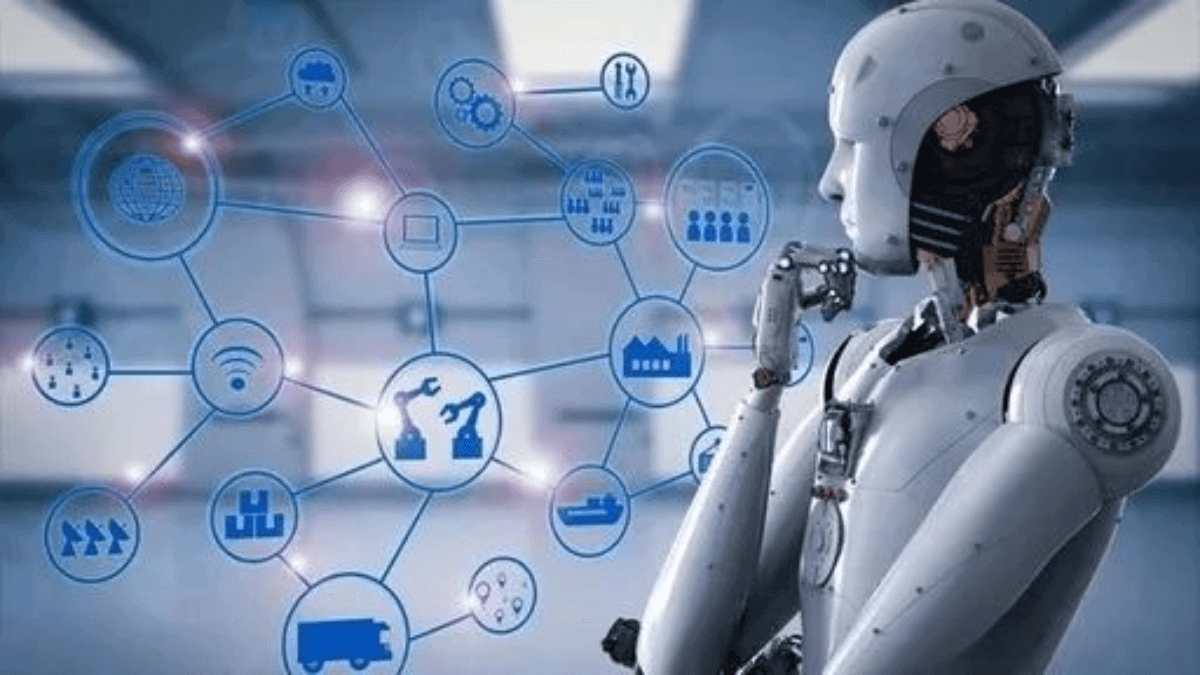
How Machine Learning Works
Basic Principle: Learning Patterns from Data
Machine Learning (ML), as a core branch of Artificial Intelligence (AI), has the fundamental goal of empowering computer systems with the ability to autonomously learn from data and improve performance, without explicit, hard-coded programming instructions. Build mathematical models that can identify patterns, extract rules, and apply them from historical data.
Key Stages of the Workflow
- Data Collection: Obtain raw datasets related to a specific problem. Data can come from multiple channels, such as databases, sensors, web crawlers, etc. The forms of data are also diverse, and can be structured tabular data or unstructured text, image, or audio data.
- Data Preprocessing: Raw data often contains noise, missing values, outliers, or inconsistent formats. It is necessary to organize and transform the data through technical means such as data cleaning, normalization or standardization, and missing value handling to improve the efficiency and performance of subsequent model training.
- Model Training: At this stage, machine learning algorithms use the preprocessed data to learn the intrinsic rules and patterns in the data. Specifically, the algorithm adjusts the model's internal parameters so that the model can respond to or predict input data as accurately as possible. For example, in supervised learning, the model learns the mapping relationship between input features and known output labels; in unsupervised learning, the model attempts to discover inherent structures or clusters in the data.
- Model Evaluation: The purpose of evaluation is to test the model's generalization ability on data it has not seen before, that is, the model's adaptability and prediction accuracy on new data. Commonly used evaluation metrics include accuracy, recall, F1 score, mean squared error, etc. The specific metric chosen depends on the type of problem (such as classification or regression) and business needs.
- Model Application: If the model performs well in evaluation, it can be deployed to a real application environment to make predictions or classifications on new, unknown data.
The entire process is an iterative optimization process, requiring repeated adjustment of model parameters, feature selection, and even algorithm selection based on evaluation results to achieve the best performance.

What Are Training Data and Test Data
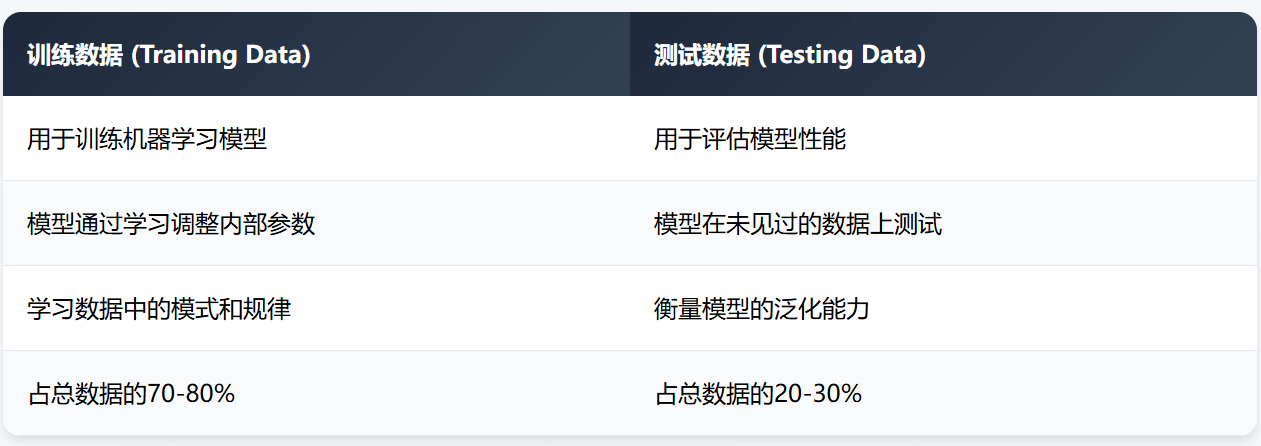
In the practice of machine learning, dataset splitting is a crucial part. The original dataset is divided into a Training Set and a Testing Set, and sometimes a Validation Set is further divided out.
Training Data
is the portion of data used to train a machine learning model. By learning the patterns and rules in these data, the model adjusts its internal parameters and learns how to make predictions or classifications on input data.
Test Data
is the dataset used to evaluate model performance after model training is completed. Test data is completely new and unseen data for the model. By evaluating the model's performance on test data, its generalization ability can be objectively measured, that is, the model's ability to handle unknown data.
Common train-test split ratios include 70% training set and 30% test set, or 80% training set and 20% test set.
Dataset Splitting Methods
- Random Splitting:This is the simplest and most straightforward method: shuffle the dataset randomly and allocate it to the training set and test set according to the ratio.
- Stratified Sampling: This ensures that the proportion of samples in each category in the training set and test set remains consistent with the original dataset.
- Chronological Order: For example, use data from an earlier time period as the training set and data from a later time period as the test set, simulating prediction tasks in real-world scenarios.
A core principle is that during the training process, the modelmust absolutely not be exposed to the test data, ensuring the objectivity and unbiasedness of the evaluation results.
Types of Machine Learning
Supervised Learning
is one of the most common and widely applied types of machine learning. In supervised learning, the training data we provide to the algorithm is labeled. Each training sample contains input features and a known, desired output label. The algorithm's goal is to learn from these labeled samples and construct a mapping function from input to output. When new, unlabeled data appears, the trained model can use this learned function to predict its corresponding output.
Supervised learning tasks can mainly be divided into two major categories:classification and regression。
The goal of classification tasks is to predict discrete category labels, such as determining whether an email is spam (yes/no), or identifying which category an object in an image belongs to (cat/dog/car, etc.). Common classification algorithms include logistic regression, decision trees, support vector machines (SVM), K-nearest neighbors (KNN), and neural networks, among others.
The goal of regression tasks is to predict continuous numerical outputs, such as predicting house prices, stock prices, or future temperatures. Common regression algorithms include linear regression, polynomial regression, decision tree regression, and neural network regression, among others.
Unsupervised Learning
Unlike supervised learning, the training data isunlabeled. The algorithm needs to discover intrinsic structures, patterns, or relationships from the data on its own without explicit guidance. The main tasks of unsupervised learning are exploratory data analysis and dimensionality reduction.
Unsupervised learning tasks includeclustering and dimensionality reduction。
The goal of clustering algorithms is to divide the samples in a dataset into several clusters, so that samples within the same cluster have high similarity, while samples between different clusters have low similarity. For example, in customer segmentation, customers can be divided into different groups based on their purchasing behavior for precision marketing. The K-Means algorithm is one of the most famous clustering algorithms.
The goal of dimensionality reduction algorithms is to reduce the number of features while preserving the most important information in the dataset, simplifying models, improving computational efficiency, and avoiding the "curse of dimensionality." Principal component analysis (PCA) is a commonly used dimensionality reduction algorithm. Association rule mining (such as the Apriori algorithm) is also an important application of unsupervised learning, used to discover interesting associations between data items, such as in market basket analysis: "customers who purchased product A also tend to purchase product B."
Reinforcement Learning
It is a learning paradigm different from supervised learning and unsupervised learning. In reinforcement learning, an entity called anagent learns by interacting with an environment. The agent performs certain actions in the environment, and the environment feeds back areward or penalty based on these actions, and transitions to a newstate。
The goal of the agent is to learn an optimalpolicy, which action to choose in each state, in order to maximize cumulative reward. Reinforcement learning is very suitable for sequential decision-making problems, such as robot control, game AI (such as AlphaGo), autonomous driving, and resource scheduling. Q-Learning and Deep Q-Networks (DQN) are commonly used algorithms in reinforcement learning. The characteristic of reinforcement learning lies in its trial-and-error learning mechanism and delayed rewards. The agent needs to continuously try in order to discover which behaviors can bring the greatest long-term return.
Common algorithms of machine learning
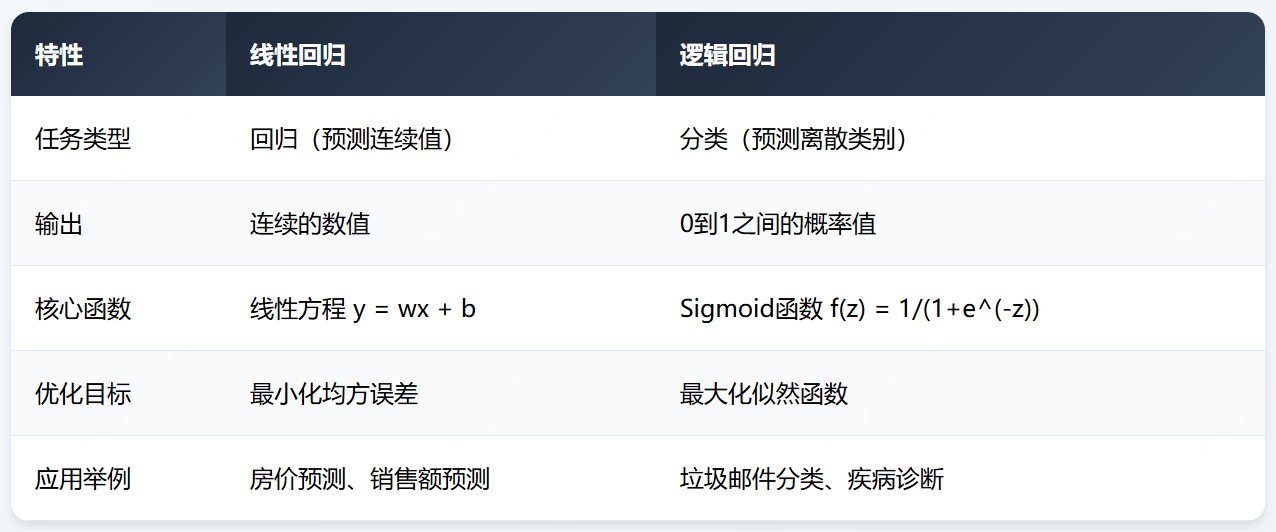
Linear regression and logistic regression: the foundation of prediction and classification
Linear Regression
is a classic supervised learning algorithm used to solve regression problems. The core idea is to assume that there is a linear relationship between the input features (independent variables) and the target variable (dependent variable), and to describe this relationship by finding a best-fitting straight line (a hyperplane in higher-dimensional space). The equation of this line is expressed as y = β₀ + β₁x₁ + β₂x₂ + … + βₚxₚ, where y is the predicted target variable, x₁, x₂, …, xₚ are the input features, β₀ is the intercept term, and β₁, β₂, …, βₚ are the coefficients of each feature, representing the degree of influence of that feature on the target variable. The goal of linear regression is to estimate these coefficients by minimizing the sum of squared errors between the predicted values and the true values (that is, the least squares method). Once the model training is complete, this linear equation can be used to predict the target values of new, unknown data. Linear regression is simple and easy to understand, computationally efficient, and performs well when a linear relationship indeed exists between the features and the target variable. When nonlinear relationships, multicollinearity, or outliers exist in the data, the performance of linear regression may be affected. To solve these problems, polynomial regression can be introduced (by adding higher-order terms of features to fit nonlinear relationships) or regularization methods can be used (such as ridge regression and Lasso regression) to prevent overfitting and handle multicollinearity.
Logistic Regression
is actually a supervised learning algorithm widely used for binary classification problems, and can be extended to multiclass classification problems. Unlike linear regression, which directly predicts continuous values, the goal of logistic regression is to predict the probability that a sample belongs to a certain category. By introducing a Sigmoid function (also called the logistic function), the output of linear regression is mapped to the interval (0, 1). The expression of the Sigmoid function is σ(z) = 1 / (1 + e⁻ᶻ), where z is the output of linear regression, that is, z = β₀ + β₁x₁ + β₂x₂ + … + βₚxₚ. The output of the Sigmoid function can be interpreted as the probability P(y=1|x) that the sample belongs to the positive class. When the probability is greater than 0.5, the sample is predicted to be the positive class; otherwise, it is predicted to be the negative class. Logistic regression estimates the model parameters by maximizing the likelihood function (or minimizing the log loss function). The advantages of logistic regression are that its model is simple, its computational overhead is small, and it can provide probability predictions, which is very useful for many application scenarios that need to evaluate uncertainty. The coefficients of logistic regression can be interpreted as the degree of influence of features on the probability of event occurrence (log odds), and it has a certain degree of interpretability.
Decision Trees and Random Forests: Powerful Nonlinear Models
Decision Tree
is a very intuitive and easy-to-understand supervised learning algorithm that can be used for classification tasks as well as regression tasks. It makes decisions by constructing a tree-like structure. Each internal node of the tree represents a test on a feature, each branch represents a test output, and each leaf node represents a class label (for a classification tree) or a specific numerical value (for a regression tree).
Random Forest
is an ensemble learning method that improves the overall performance and generalization ability of the model by constructing and combining multiple decision trees. The basic idea of random forest is "three cobblers combined equal Zhuge Liang." It introduces randomness in the following two main ways to make the multiple constructed decision trees diverse:
- Bootstrap Aggregating (Bagging): Randomly draw n samples with replacement from the original training set to form a new training subset, which is used to train one decision tree. This process is repeated multiple times to generate multiple different decision trees.
- Random Feature Selection: When splitting at each node of a decision tree, instead of selecting the optimal feature from all features, first randomly select a subset containing k features from all features, and then select the optimal feature from this subset for splitting.
Support Vector Machine (SVM): An Efficient High-Dimensional Data Classifier
Support Vector Machine (SVM)
is a powerful and widely used supervised learning algorithm, mainly used to solve classification problems, and can also be extended to regression problems (called Support Vector Regression, SVR). It finds an optimal hyperplane in the feature space (a straight line in two-dimensional space, and a plane in high-dimensional space) that can effectively separate sample points of different classes, maximizing the distance from this hyperplane to the nearest sample points on both sides (that is, the margin).
Neural Networks and Deep Learning: Complex Pattern Recognition Mimicking the Human Brain
Neural Network
also called Artificial Neural Network (ANN), is a type of machine learning model developed inspired by the structure and function of biological nervous systems. Its basic constituent unit is theneuron, also called a node or unit. Each neuron receives signals from other neurons or external inputs, performs a weighted sum of these signals, and then performs a nonlinear transformation through an activation function to produce an output signal. Multiple neurons are connected according to a certain hierarchical structure to form a neural network.
Deep Learning
is a branch of neural networks, specifically referring to neural network models with multiple hidden layers. As the number of layers increases, the network can learn more abstract and high-level feature representations. For example, in image recognition, shallow networks may learn low-level features such as edges and corners, while deep networks may learn high-level semantic features such as parts of objects and overall structures.
Clustering Algorithms (such as K-means): Grouping Similar Data
Clustering Algorithms are an important class of algorithms in unsupervised learning. Their goal is to divide the samples in a dataset into several groups or "clusters," so that samples within the same cluster have relatively high similarity to each other, while samples in different clusters have relatively low similarity. Cluster analysis has a wide range of applications in many fields, such as customer segmentation, document classification, image segmentation, anomaly detection, and more. There are many methods for measuring sample similarity, commonly including Euclidean distance, Manhattan distance, cosine similarity, etc. The specific choice of distance metric depends on the type of data and the characteristics of the problem.
Dimensionality reduction algorithms (such as PCA): simplify data while preserving key information
Dimensionality Reduction Algorithms are another important class of algorithms in unsupervised learning. Their goal is to reduce the number of features while preserving the most important information in the dataset (such as structure and patterns), thereby mapping high-dimensional data to a lower-dimensional space. The main motivations for dimensionality reduction include:
- Mitigating the "Curse of Dimensionality": High-dimensional data is often very sparse, which makes it difficult for many machine learning algorithms to learn effectively and causes computational complexity to increase sharply.
- Data visualization: Reducing high-dimensional data to two or three dimensions makes it convenient for visualization and display, helping people intuitively understand the structure and distribution of the data.
- Removing redundant and noisy features: High-dimensional data may contain many redundant or irrelevant features, and dimensionality reduction can help remove these features, improving the efficiency and generalization ability of the model.
- Accelerating model training: Reducing the number of features can significantly lower the time and computational resource consumption of model training.
- Principal Component Analysis (PCA) is the most classic and most commonly used linear dimensionality reduction algorithm. PCA projects the original data onto a new set of orthogonal features (called principal components) through a linear transformation. These principal components are arranged in descending order according to their variance (that is, the amount of information they contain). By selecting the top k principal components with the largest variance, dimensionality reduction from high dimension to k dimensions can be achieved. The advantages of PCA are that its mathematical principles are clear, its computation is relatively simple, and it can effectively remove linear correlations between features.
Common Applications of Machine Learning
Image recognition: enabling machines to "understand" the world
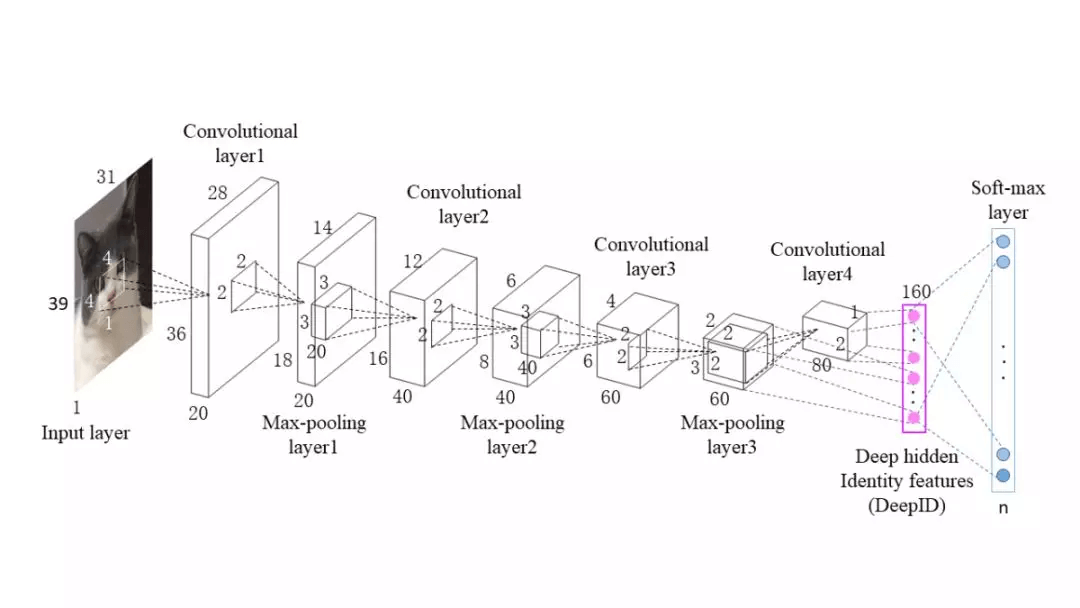
Face recognition
By training CNN models to learn feature representations of faces, functions such as high-precision face detection, face comparison (1:1 comparison, used for identity verification), and face search (1:N recognition, used for identity identification) can be achieved. It is widely used in many areas such as security surveillance, access control systems, mobile phone unlocking, financial payments, and social media.
Object detection
The goal is to identify the object categories in an image and to locate the positions of the objects in the image (usually represented by bounding boxes). Unlike image classification (which classifies the entire image into a certain category), object detection needs to handle situations where multiple objects may exist in an image. It has wide applications in fields such as autonomous driving (recognizing pedestrians, vehicles, traffic signs), intelligent security (abnormal event detection), industrial quality inspection (defective product detection), and medical image analysis (lesion detection).
Medical image analysis
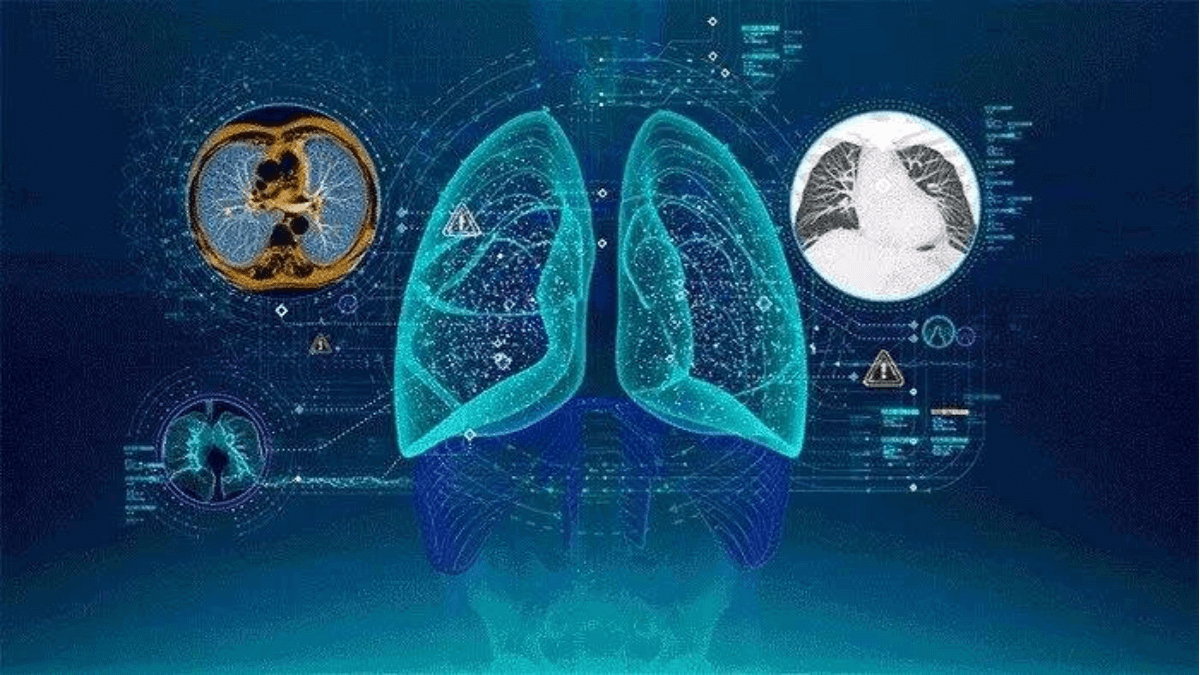
By analyzing medical images such as X-rays, CT scans, MRI images, and pathology slides, it is possible to assist doctors in disease diagnosis, lesion localization, efficacy evaluation, and more. For example, CNN models can be used to detect pulmonary nodules and determine whether they are benign or malignant, assisting in the early screening of lung cancer; retinal images can be analyzed to diagnose eye diseases such as diabetic retinopathy; and mammograms can be analyzed to assist in the diagnosis of breast cancer.
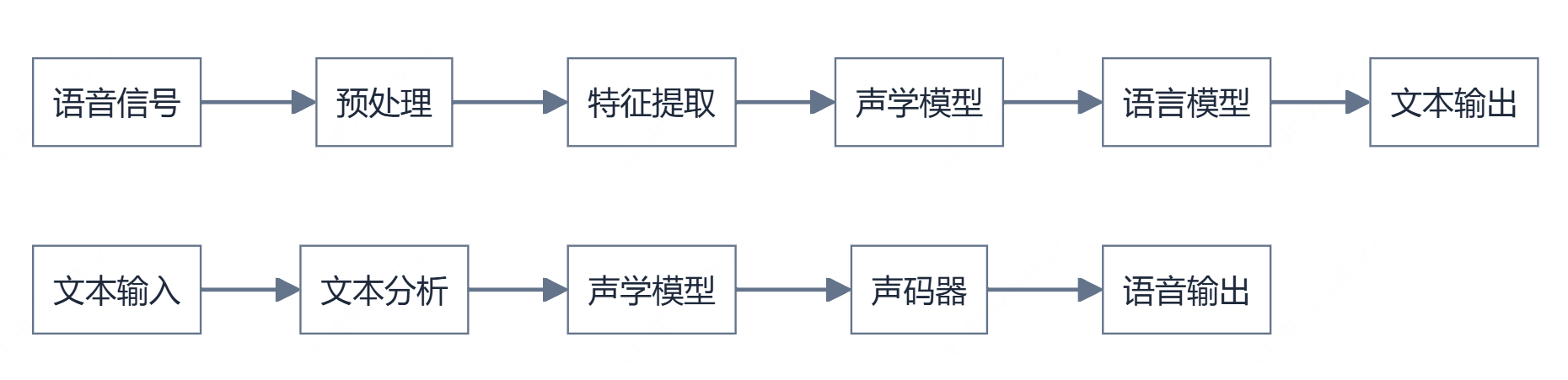
Speech processing: enabling machines to "understand" and "speak" human language
Intelligent assistants
For example, Apple's Siri, Amazon's Alexa, Google's Google Assistant, and Xiaomi's Xiao Ai. These intelligent assistants can be awakened by voice commands and execute various user requests, such as playing music, checking the weather, setting reminders, and controlling smart home devices.
Speech-to-Text (STT)
That is, speech recognition, which is widely used in scenarios such as meeting minutes, court hearing records, subtitle generation, and voice search. For example, in video conferences, STT technology can convert participants' speeches into text in real time, making it convenient for recording and later reference; on video platforms, automatically generated subtitles can improve content accessibility and user experience.
Real-time translation
It is the combination of speech processing and machine translation technology, enabling instant interpretation between different languages. For example, in scenarios such as multinational conferences and travel communication, real-time translation tools can translate speech in one language into speech or text in another language in real time, breaking down language barriers.
Predictive analytics: predicting future trends based on historical data
Stock market forecasting
By analyzing data such as historical stock prices, trading volume, company financial reports, macroeconomic indicators, and news sentiment, machine learning models (such as time series models, regression models, and neural networks) attempt to predict future stock price trends and provide decision support for investors.
Weather forecasting
Meteorological departments use large amounts of meteorological observation data (such as temperature, humidity, air pressure, wind speed, satellite cloud images, etc.) and numerical weather prediction models, combined with machine learning algorithms, to predict future weather conditions, including temperature, precipitation probability, wind force level, and more.
Sales forecasting
By analyzing historical sales data, promotional activities, seasonal factors, competitor behavior, and macroeconomic trends, enterprises can use regression models, time series models, or machine learning algorithms to predict future sales of products or services. For example, retail enterprises can use sales forecasting to optimize inventory levels and avoid stockouts or overstocking; e-commerce platforms can use sales forecasting to adjust product recommendation and pricing strategies. It can also be applied to many aspects such as energy demand forecasting, traffic flow forecasting, equipment failure forecasting, and customer churn forecasting.
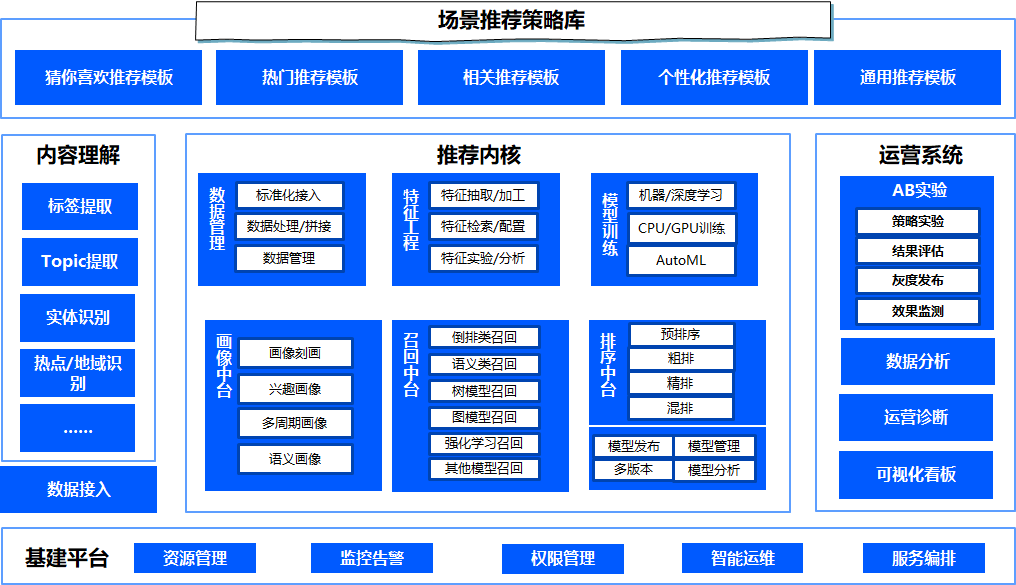
Recommendation systems: personalized information and product recommendations
E-commerce platforms
From product recommendations on the homepage, related recommendations in the shopping cart, and "guess you like" on product detail pages, to personalized promotions and coupon distribution, recommendation systems guide users to discover more products of interest, improving conversion rates, average order value, and user stickiness. E-commerce platforms use data such as users' browsing history, purchase records, search queries, ratings, and reviews, combined with product attribute information, to provide users with personalized shopping experiences through complex recommendation algorithms.
Video websites
Faced with massive amounts of video content, recommendation systems analyze users' viewing history, likes, favorites, sharing, search behavior, and video metadata (such as genre, actors, directors, tags, duration, etc.) to recommend personalized video lists for users, such as homepage recommendations, related video recommendations, and personalized channels. This increases users' viewing time and satisfaction, and brings more advertising revenue and paying users to video platforms.
News aggregation
By analyzing users' reading history, click behavior, dwell time, search keywords, geographic location, and the text, category, source, timeliness, and other characteristics of news content, it recommends news and information that users are interested in. Personalized news push methods have changed the traditional media's "one-size-fits-all" information distribution model, allowing users to obtain the information they care about more efficiently.
Challenges of machine learning
Data is the cornerstone of machine learning, and the performance of a model depends to a large extent on the quality and quantity of the training data. High-quality data should be accurate, complete, consistent, relevant, and timely. However, in the real world, obtaining and preparing high-quality data often faces many challenges. Data may contain noise, errors, missing values, outliers, or bias, which can affect the model's training effectiveness and generalization ability. If there are too few samples of a certain category in the training data, the model may perform poorly in predicting that category.
Data privacy, many machine learning applications, especially in the fields of healthcare, finance, and personal services, need to process large amounts of sensitive personal information. How to effectively protect personal privacy and prevent data leakage and abuse while using data to train models is an urgent challenge to solve.
Algorithmic Bias is an issue of growing concern in the field of machine learning. If the training data contains biases that exist in real society (such as gender bias, racial bias, regional bias, etc.), or if there is bias in the data sampling process, then the trained model may learn and amplify these biases, leading to unfair decision results. For example, in sensitive fields such as recruitment, credit approval, and even judicial sentencing, if a model has a systematic adverse impact on a specific group of people, it will trigger serious ethical and social problems.
Model Interpretability or transparency is another important challenge, especially for complex "black-box" models (such as deep neural networks and ensemble models). In many high-risk application scenarios (such as medical diagnosis, autonomous driving, and financial risk control), merely knowing the model's prediction result is not enough; it is also necessary to understand how the model makes decisions and which features have a key impact on the decision. The lack of interpretability hinders users' trust in the model and also makes model debugging, error troubleshooting, and performance improvement more difficult.
Computing resourcesTraining complex deep learning models usually requires substantial computing power (such as high-performance CPUs, GPUs, TPUs, and other specialized hardware) and storage resources. This means high hardware procurement and maintenance costs and brings enormous energy consumption. Although cloud computing platforms provide convenient computing services for many researchers and enterprises, for large-scale model training and specific application scenarios (such as edge computing), the demand for local computing resources is still urgent.
Professional talentThe field of machine learning requires talent with interdisciplinary knowledge, who must understand algorithm principles and also master data processing, model development, system deployment, and knowledge of specific application domains. Currently, there is a huge global shortage of machine learning engineers, data scientists, and researchers.
Development Trends in Machine Learning
The field of machine learning is showing several important development trends.Automated Machine Learning (AutoML) Automating repetitive tasks in the machine learning process (such as data preprocessing, feature engineering, model selection, and hyperparameter tuning) lowers the barrier to applying machine learning, improves development efficiency, and enables non-expert users to use machine learning to solve practical problems.Federated Learning As an emerging distributed machine learning paradigm, it allows collaborative model training across multiple decentralized edge devices or data holders without sharing raw data. It helps protect data privacy and can also leverage broader data distributions to improve model generalization ability and robustness.Further development of reinforcement learning(especially applications in complex environments and sparse-reward scenarios),few-shot learning/zero-shot learning(addressing the problem of data sparsity),Graph Neural Networks (GNN) applications in handling relational data and complex systems, as well as continued attention toAI ethics and governance, will be important development directions in the field of machine learning in the future. These trends together drive machine learning technology toward becoming more intelligent, more efficient, more trustworthy, and more responsible.