
What is Lynx
Lynx is a high-fidelity personalizedvideo generationmodel launched by ByteDance. It only requires a single portrait photo to generate identity-consistent videos. Built on a Diffusion Transformer (DiT) foundation model, it introduces two lightweight adapter modules, ID-adapter and Ref-adapter, which are used to control person identity and preserve facial details, respectively. Lynx uses a face encoder to capture facial features, enhances expressions through X-Nemo technology, and simulates lighting and shadow effects with the LBM algorithm to ensure the consistency of person identity across different scenarios. Its cross-attention adapter can combine text prompts with facial features to generate videos that meet scene requirements. Lynx has a "time perceiver" that can understand the physical laws of motion and maintain temporal coherence in videos. In large-scale tests, Lynx performs excellently in multiple dimensions such as facial similarity, scene matching, and video quality, surpassing similar technologies. It is licensed under Apache 2.0 and can be used commercially, but it is necessary to ensure that portrait rights are obtained for the original face images.
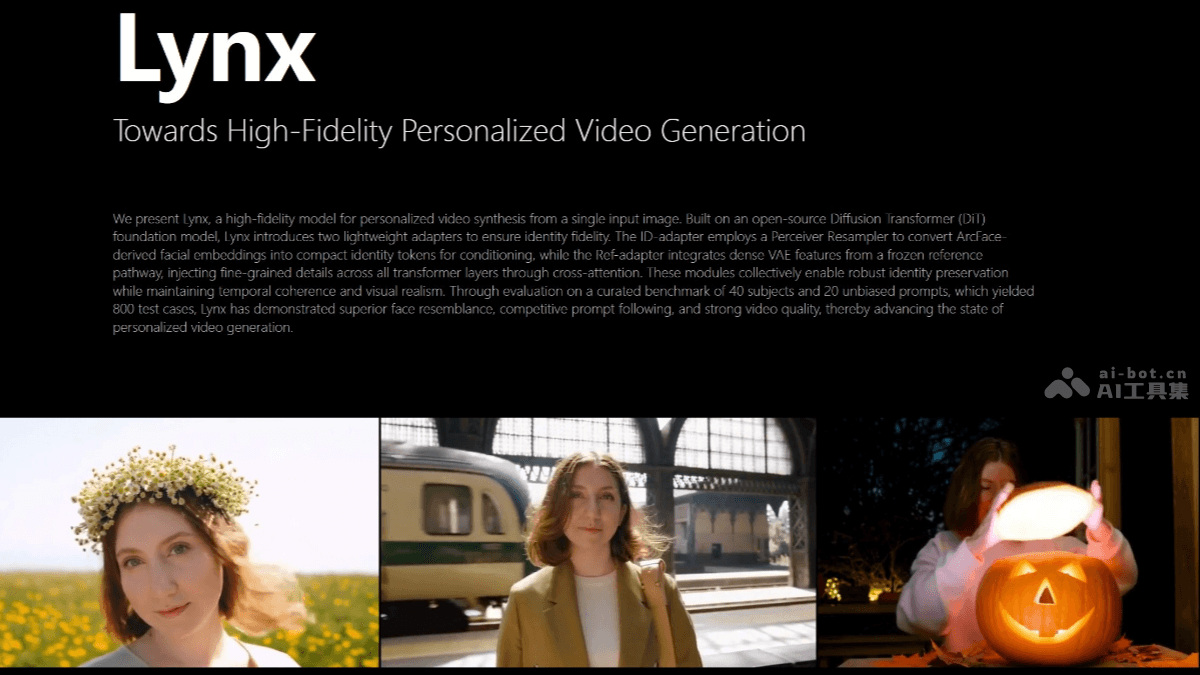
Main Features of Lynx
-
Personalized Video Generation: With just a single portrait photo, it can generate identity-consistent personalized videos.
-
Identity Feature Preservation: Through the face encoder and adapter modules, it ensures the consistency of a person's identity features across different scenarios.
-
Scene Matching Capability: Using the cross-attention adapter, it combines text prompts to generate videos that meet scene requirements.
-
Temporal Coherence: It has a "time perceiver" that understands the physical laws of motion and maintains coherence in the temporal dimension of videos.
-
High Performance: It performs excellently in multiple dimensions such as facial similarity, scene matching, and video quality, surpassing similar technologies.
-
Commercial Licensing: It is licensed under Apache 2.0 and can be used commercially, but it is necessary to ensure that portrait rights are obtained for the original face images.
Technical Principles of Lynx
-
Based on Diffusion Transformer Architecture: Lynx is built on an open-source Diffusion Transformer (DiT) foundation model, efficiently converting random noise into target content.
-
Identity Feature Extraction and Preservation: It extracts facial features through ArcFace technology and uses Perceiver Resampler to convert feature vectors into adapter inputs, ensuring consistency of person identity in generated videos.
-
Detail Enhancement and Adaptation: It introduces lightweight ID-adapter and Ref-adapter modules, which are used to control person identity and preserve facial details, respectively, making the generated videos more realistic in details.
-
Cross-Attention Mechanism: It injects fine-grained details into all Transformer layers and combines text prompts with facial features through the cross-attention mechanism to generate videos that meet scene requirements.
-
3D Video Generation Technology: It adopts a 3D VAE architecture, giving the model a "time perceiver" that enables it to understand the physical laws of motion and maintain coherence in the temporal dimension when generating videos.
-
Adversarial Training Strategy: Through a triple adversarial training mechanism of generator, discriminator, and identity discriminator, it optimizes model performance and improves the realism of generated videos.
Lynx Project Address
- Project Official Website:https://byteaigc.github.io/Lynx/
- Github Repository:https://github.com/bytedance/lynx
- HuggingFace Model Library:https://huggingface.co/ByteDance/lynx
Application Scenarios of Lynx
-
Digital Human Production: Generate realistic dynamic videos for digital humans such as virtual streamers and customer service agents, enhancing the interactive experience.
-
Film and Television Special Effects Production: Quickly generate video clips of specific characters in different scenes, assisting film and television special effects production while saving time and cost.
-
Short Video Creation: Creators can use a single photo to generate diverse videos, enriching content creation and improving creative efficiency.
-
Advertising and Marketing: Generate personalized video advertisements based on product and brand needs, enhancing the appeal and reach of advertisements.
-
Game Development: Generate personalized movements and expressions for game characters, enhancing the immersion and realism of games.
-
Education and Training: Generate educational videos, such as virtual teachers explaining courses, or character demonstrations of operational steps in training videos.