
What is Lumina-Video
Lumina-Video is launched by Shanghai AI Lab and The Chinese University of Hong KongVideo generationframework, based on the Next-DiT architecture, optimized for the spatiotemporal complexity in video generation. Based on the multi-scale Next-DiT architecture, it uses patchify layers of different sizes to improve efficiency and flexibility, and uses motion scores as conditional input to directly control the degree of dynamics of the generated video. Lumina-Video uses progressive training, joint image-video training, and multi-source training strategies to further improve training efficiency and generation quality. Lumina-Video extends the Lumina-V2A model to add synchronized sound to generated videos, making the videos more realistic.
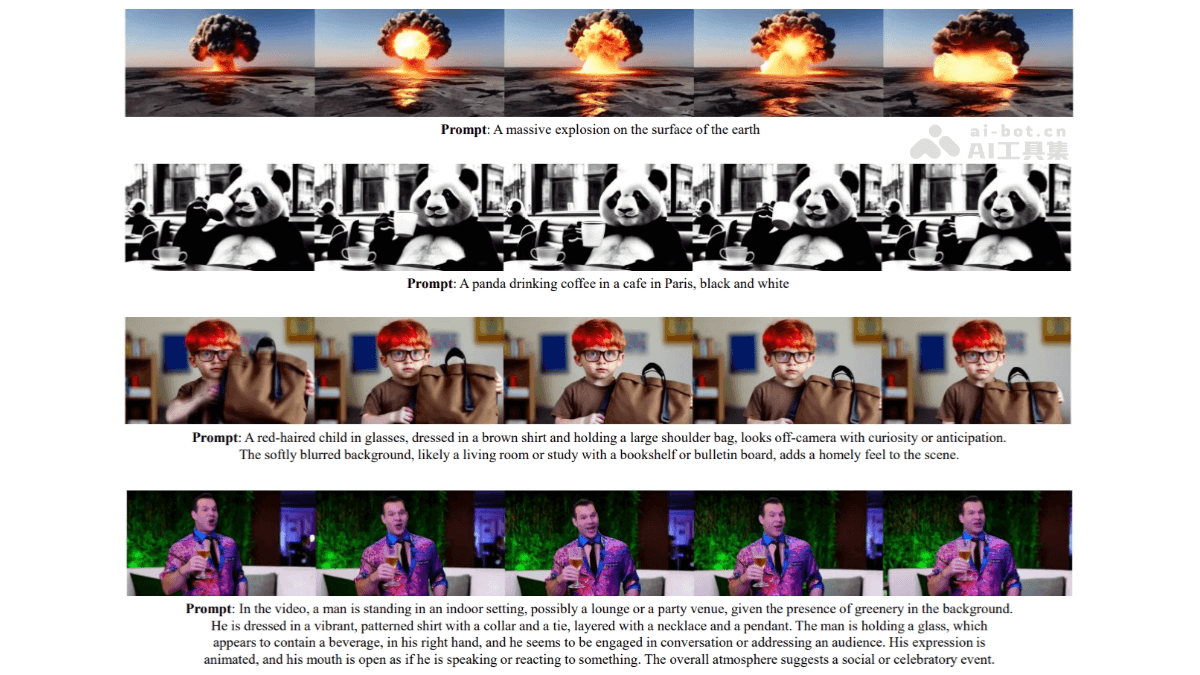
Main features of Lumina-Video
- High-quality video generation: Generate video content with high resolution, rich details, and excellent spatiotemporal coherence.
- Dynamics control: Based on motion scores as conditional input, users can flexibly adjust the degree of dynamics of the generated video, from static to highly dynamic.
- Multi-scale generation: Supports video generation at different resolutions and frame rates, adapting to various application scenarios.
- Video-to-audio synchronization: Based on the Lumina-V2A model, it adds sound synchronized with the visual content to the generated video, enhancing the realism of the video.
- Efficient training and inference: Uses progressive training and multi-source training strategies to improve training efficiency and model performance, and provides flexible multi-stage generation strategies during inference to balance computational cost and generation quality.
Technical principles of Lumina-Video
- Multi-scale Next-DiT architecture: Introduces multiple patchify and unpatchify layers of different sizes, supporting the model in learning video structure under different computational budgets. By dynamically adjusting patch size, the model flexibly adjusts computational cost during inference according to resource requirements while maintaining generation quality.
- Motion control mechanism: Based on motion scores computed from optical flow, it uses them as conditional input to the diffusion model to directly control the degree of dynamics of the generated video. By adjusting the difference in motion conditions between positive and negative samples, fine-grained control over video dynamics is achieved.
- Progressive training: Based on a multi-stage training strategy, it gradually increases the resolution and frame rate of videos to improve training efficiency. Combined with joint image-video training, it uses high-quality image data to improve the model's understanding of visual concepts and frame-level quality.
- Multi-source training: Uses natural and synthetic data sources for training, fully utilizing diverse data to improve the model's generalization ability and generation quality.
- Video-to-audio synchronization (Lumina-V2A): Based on Next-DiT and flow matching technology, it fuses video and text features with audio latent representations to generate sound synchronized with the visual content. It uses a pretrained audio VAE and HiFi-GAN vocoder for audio encoding and decoding, ensuring the quality and synchronization of the generated audio.
Project address of Lumina-Video
- GitHub repository:https://github.com/Alpha-VLLM/Lumina-Video
- arXiv technical paper:https://arxiv.org/pdf/2502.06782
Application scenarios of Lumina-Video
- Content creation and media production: Provides efficient generation tools for media content creation such as movies, TV series, advertisements, and short videos, quickly generating high-quality video materials, reducing creation costs, and improving content production efficiency.
- Virtual reality and augmented reality: Generate realistic virtual scenes and dynamic content, enhance user experience, and provide rich visual and auditory materials for virtual reality and augmented reality applications.
- Education and Training: Create educational videos, simulated training scenarios, etc., to help students and trainees better understand and master knowledge, and improve learning outcomes and training quality.
- Game Development: Used to generate animations, cutscenes, virtual character movements, etc. in games, improve the visual effects and immersion of games, and shorten the game development cycle.
- Intelligent Video Editing: As part of an intelligent video editing tool, assist users in quickly generating video clips, adding special effects, or generating audio for videos, improving the efficiency and creativity of video editing.