
What is Lumina-Image 2.0
Lumina-Image 2.0 is an open-source, efficient unifiedimage generationmodel with 2.6 billion parameters, based on diffusion models and Transformer architecture. It excels in image generation quality, complex prompt understanding, and resource efficiency, achieving industry-leading text alignment capabilities, and can generate high-quality, multi-style images based on text descriptions. The model supports multiple inference solvers, such as midpoint solver, Euler solver, and DPM solver, with fast generation speed.
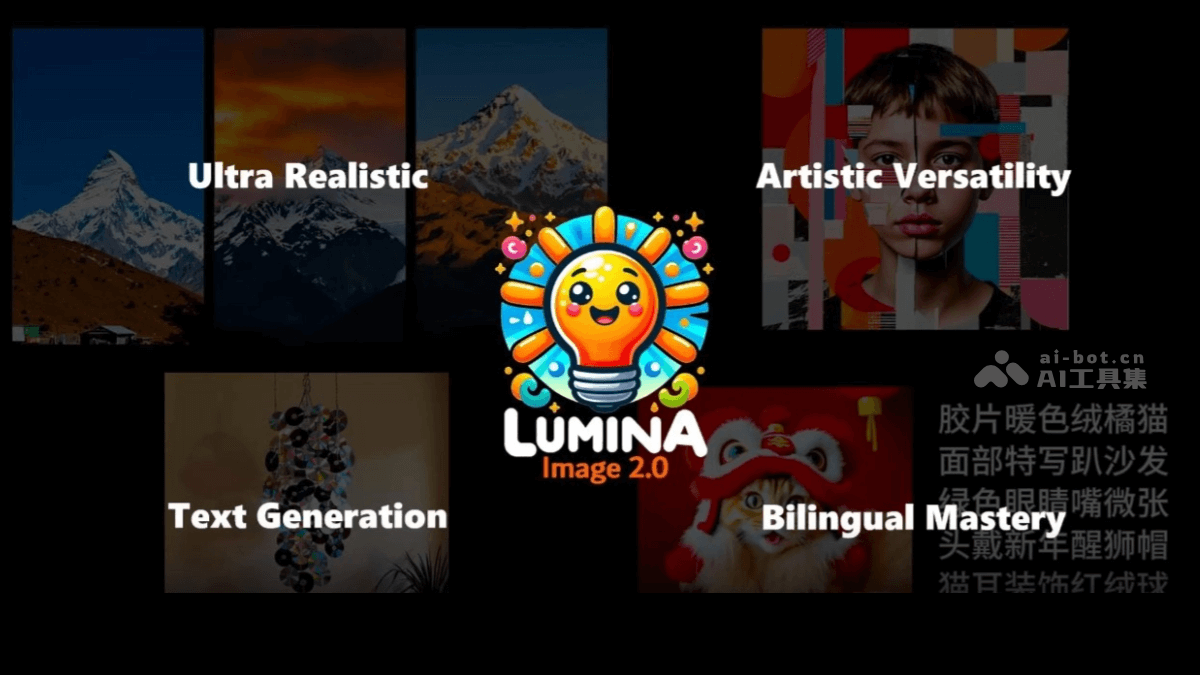
Main Features of Lumina-Image 2.0
- High-Quality Image Generation: Can generate high-quality portraits, artistic text, stylized images, logical reasoning images, etc.
- Multilingual Support: Supports Chinese and English bilingual prompts, and can generate corresponding images based on descriptions in different languages.
- Complex Prompt Understanding: Strong understanding and presentation capabilities for complex prompts such as animals and facial expressions, enabling more accurate image generation based on text descriptions.
- Support for Multiple Inference Solvers: Supports multiple inference solvers such as midpoint solver, Euler solver, and DPM solver.
- Artistic and Stylistic Expression: Performs well in artistic and stylistic expression, and can generate images in multiple styles.
- ComfyUI Integration: Native support for ComfyUI has been implemented, and users can directly use the model through ComfyUI.
Technical Principles of Lumina-Image 2.0
- Diffusion Model: It is a generative model that generates images by gradually removing noise. Specifically, Gaussian noise is first added to image data, and then a neural network is trained to gradually remove this noise, ultimately restoring a clear image. Lumina-Image 2.0 uses a Flow-based Diffusion Model and performs excellently in image generation quality and complex prompt understanding.
- Transformer Architecture: The core architecture of Lumina-Image 2.0 is Transformer, which can handle long-range dependencies and has stronger understanding of text prompts. It uses Gemma-2-2B as the text encoder, which can efficiently convert text prompts into features required for image generation. The model uses FLUX-VAE-16CH as the VAE (Variational Autoencoder), used for efficient image encoding and decoding.
- Support for Multiple Solvers: To improve generation efficiency and quality, Lumina-Image 2.0 supports multiple inference solvers, including Midpoint Solver, Euler Solver, and DPM Solver. They can be selected according to different generation needs and resource constraints to achieve a balance between speed and quality.
- Efficient Training and Inference: Lumina-Image 2.0 has 2.6 billion parameters, and its relatively small parameter count performs excellently in resource efficiency. By optimizing the training process and inference methods, the model can reduce computational resource consumption while maintaining high-quality generation.
Project Address of Lumina-Image 2.0
- Github Repository:https://github.com/Alpha-VLLM/Lumina-Image-2.0
- HuggingFace Model Library:https://huggingface.co/Alpha-VLLM/Lumina-Image-2.0
Application Scenarios of Lumina-Image 2.0
- Artistic Creation: Lumina-Image 2.0 can generate high-quality artistic style images and supports multiple artistic styles, such as oil painting, watercolor painting, digital art, etc. Users can generate artworks with specific styles through text descriptions.
- Portrait and Photography Style: The model can generate realistic portraits and photographic works, and supports high-resolution (1024×1024) image generation.
- Artistic Text and Text Fusion: Lumina-Image 2.0 supports generating images containing artistic text, and can seamlessly fuse text with background images. Used for designing posters or promotional materials.
- Logical Reasoning and Complex Scene Generation: Lumina-Image 2.0 performs excellently in logical reasoning and complex scene generation. Users can generate complex images through detailed text descriptions,