
What is Lumina-DiMOO
Lumina-DiMOO is a new-generation open-source multimodal generation and understanding model from Shanghai Artificial Intelligence Laboratory and other institutions. The model adopts a fully discrete diffusion architecture, uniformly processes multimodal data such as text and images, and supports multiple tasks including text-to-image generation, image editing, and style transfer. Lumina-DiMOO performs excellently on multiple benchmarks, with high sampling efficiency and good generation quality, bringing new breakthroughs to the field of multimodal AI and expected to play an important role in many fields such as content creation, intelligent analysis, and educational research.
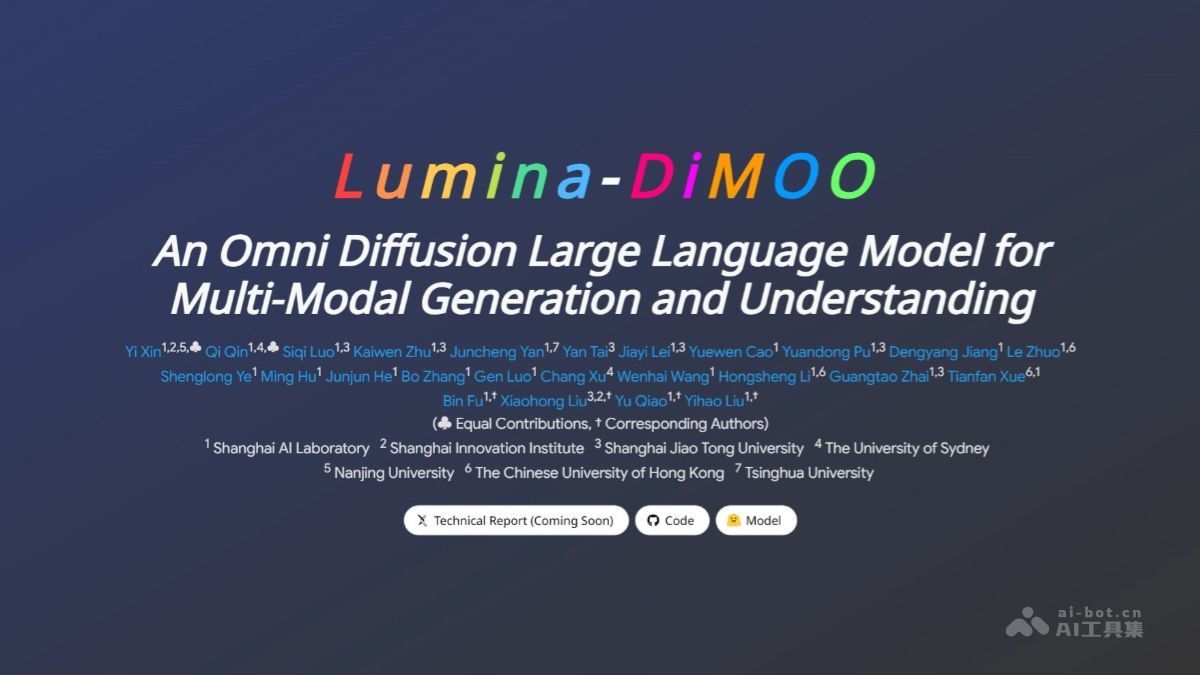
Main Features of Lumina-DiMOO
-
Text-to-ImageGeneration: Generate high-quality images based on text descriptions.
-
Image-to-Image Generation: Supports tasks including image editing, style transfer, and subject-driven generation, such as generating an image of "orange juice splashing out to form the word 'Smile'."
-
Image Understanding: Can analyze image content and provide detailed descriptions and reasoning, for example, analyzing the composition, lighting, and atmosphere of complex images.
-
Multimodal Task Support: Supports multiple multimodal tasks, such as image editing, style transfer, subject-driven generation, and image restoration.
Technical Principles of Lumina-DiMOO
- Fully Discrete Diffusion Modeling: Traditional diffusion models are usually used to generate continuous data (such as images), generating high-quality images from random noise through gradual denoising. Lumina-DiMOO extends diffusion models to the processing of discrete data (such as text), achieving unified modeling of multimodal data such as text and images. During the diffusion process, image data is gradually denoised, and text data is also processed discretely.
- Unified Multimodal Representation: Lumina-DiMOO maps data from different modalities, such as text and images, into a shared high-dimensional semantic space. In this space, the data from different modalities is stripped away, leaving only the most core "meaning." The model learns this "universal cosmic language" through contrastive learning. For example, through large amounts of "image-text" paired data, the model learns how to map text and images into the same semantic space, achieving cross-modal understanding and alignment.
- Efficient Sampling: Lumina-DiMOO specifically designs a caching method based on maximum Logit to improve sampling efficiency. At each step of the model's image generation (the denoising process), the caching method intelligently records the "high-scoring decisions" most likely to be used and directly calls them in subsequent steps, saving a large amount of repeated computation. Compared with traditional autoregressive (AR) models, the parallel processing approach of diffusion models makes the generation process more efficient. Lumina-DiMOO's fully discrete diffusion architecture further optimizes this process, greatly improving sampling speed.
Project Address of Lumina-DiMOO
- Project Official Website:https://synbol.github.io/Lumina-DiMOO/
- GitHub Repository:https://github.com/Alpha-VLLM/Lumina-DiMOO
- HuggingFace Model Library:https://huggingface.co/Alpha-VLLM/Lumina-DiMOO
Application Scenarios of Lumina-DiMOO
- Art and Design: Artists and designers can generate high-quality images based on text descriptions, inspire creative inspiration, and quickly generate preliminary design sketches.
- Advertising Design: Advertising agencies can generate images that match advertising themes, quickly generate multiple design solutions, and improve work efficiency.
- Film and Television Post-Production: Used in film and television production to generate special effects scenes, repair damaged footage in old movies, and more.
- Medical imaging analysis: In the medical field, it helps doctors better understand and analyze medical images such as X-rays, CT scans, and MRIs, assisting in diagnosis and treatment.
- Autonomous driving: In the field of autonomous driving, it is used to process multimodal data collected by vehicle sensors, such as camera images and radar signals, improving the accuracy and reliability of environmental perception.
- Industrial inspection: In industrial production, it is used to analyze images and sensor data on production lines to detect product quality issues.