
What is Lucy Edit Dev
Lucy Edit Dev is an open-source text instruction-based video editing model from the Decart AI team. It can perform various editing operations on videos based on simple text prompts, such as changing clothing, replacing characters, inserting objects, and transforming scenes, while perfectly preserving the video's motion and composition. The model is based on the Wan2.2 5B architecture and inherits the high-compression VAE + DiT stack, making it easy for users to adapt their existing scripts and workflows.
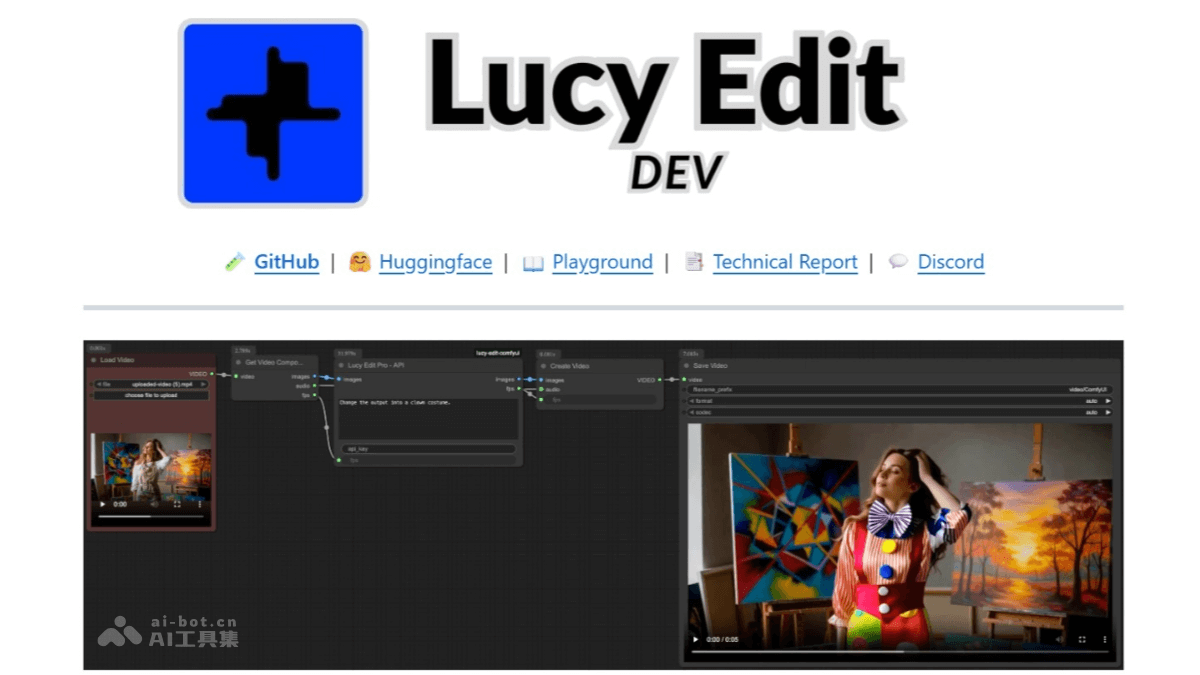
Main Features of Lucy Edit Dev
-
Text Instruction-Based Video Editing: Users can guide video editing through pure text instructions, without the need for fine-tuning or using masks and other operations, making it simple and easy to use.
-
Support for Multiple Editing Types: Supports various video editing operations such as clothing and accessory changes, character replacement, object insertion, and scene replacement, meeting the needs of different users.
-
Motion and Composition Preservation: During the editing process, it can accurately preserve the actions and composition of people in the video, maintaining the video's natural smoothness.
-
High-Precision Editing: It can accurately preserve the identity and actions of people in the video, ensuring consistency between the edited video and the original video in terms of motion and composition.
-
Open-Source Architecture: Based on the Wan2.2 5B architecture, it inherits the high-compression VAE + DiT stack, making it easy for users to adapt their existing scripts and workflows.
Technical Principles of Lucy Edit Dev
-
Text-Based Instruction-Driven: Lucy Edit Dev uses text instructions to guide video editing, parsing the text input by users through natural language processing technology to understand the editing intent.
-
Deep Learning Architecture: The model is based on a deep learning architecture, specifically the Wan2.2 5B architecture, utilizing a high-compression VAE (Variational Autoencoder) and DiT (Diffusion Model) stack to achieve efficient video editing.
-
Video Frame Processing: The video is decomposed into individual frames, and each frame is independently edited while maintaining coherence and consistency between frames.
-
Motion and Composition Preservation: Through advanced motion estimation and composition analysis techniques, it ensures that the actions of people and the overall composition of the video are preserved during the editing process.
-
Text-to-Video Mapping: It maps text instructions to video content, transforming the editing intent described in text into specific video editing operations through a generative model.
-
Non-Fine-Tuning Editing: There is no need to fine-tune the model or use complex operations such as masks. Users can directly edit through text instructions, simplifying the operation process.
Project Address of Lucy Edit Dev
- Online Experience Address:https://platform.decart.ai/
- Github Repository:https://github.com/DecartAI/lucy-edit-comfyui
- HuggingFace Model Library:https://huggingface.co/decart-ai/Lucy-Edit-Dev
Application Scenarios of Lucy Edit Dev
-
Video Content Creation: Creators can quickly modify elements in videos, such as changing clothing and adding special effects, improving creation efficiency.
-
Advertising Production: Advertising teams can quickly adjust product displays, scenes, etc. in advertising videos according to different market strategies to adapt to different audiences.
-
Film and Television Post-Production: Film and television production personnel can use the tool for operations such as character replacement and scene conversion, reducing post-production costs and time.
-
Animation Production: Animators can quickly modify the appearance of animated characters or scenes through text instructions, accelerating the animation production process.
-
Educational Video Production: Educators can easily modify elements in instructional videos to better meet teaching needs and improve the flexibility of teaching resources.
-
Social Media Content Optimization: Users can quickly adjust video content according to the characteristics of social media platforms and audience preferences to increase engagement.