
What is Loopy
Loopy is an audio-drivenAI video generationmodel launched by ByteDance. Users can make a static photo come to life, with the person in the photo synchronizing facial expressions and head movements according to a given audio file, generating realistic dynamic videos. Loopy is based on advanced diffusion model technology, requires no additional spatial signals or conditions, captures and learns long-term motion information, and generates natural and smooth movements, suitable for entertainment, education, and many other scenarios.
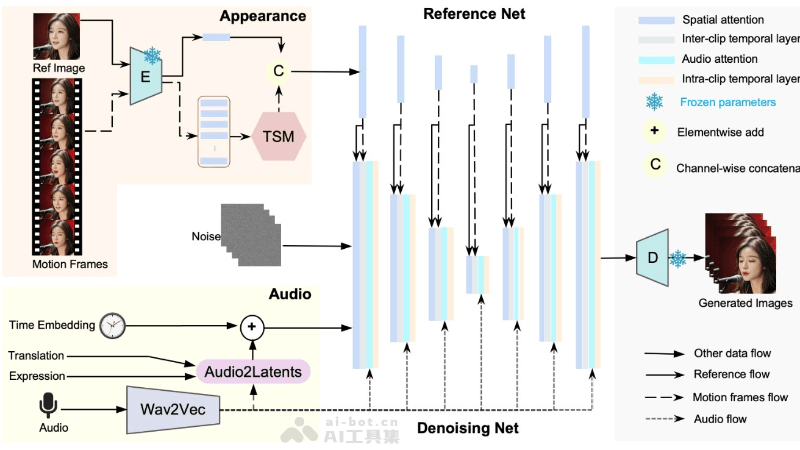
Loopy's Main Features
- Audio-driven: Loopy uses audio files as input and automatically generates dynamic videos synchronized with the audio.
- Facial movement generation: Generates natural movements of facial parts including mouth shape, eyebrows, eyes, etc., making a static image appear as if it is speaking.
- No additional conditions required: Unlike some similar technologies that require additional spatial signals or conditions, Loopy does not need auxiliary information and can generate videos independently.
- Long-term motion information capture: Loopy has the ability to handle long-term motion information, generating more natural and smooth movements.
- Diverse output: Supports generating diverse movement effects, producing corresponding facial expressions and head movements based on the characteristics of the input audio, such as emotion, rhythm, etc.
Loopy's Technical Principles
- Audio-driven model: The core of Loopy is an audio-driven video generation model, which generates dynamic videos synchronized with the audio based on the input audio signal.
- Diffusion model: Loopy uses diffusion model technology, generating data by gradually introducing noise and learning the reverse process.
- Temporal module: Loopy designs temporal modules across segments and within segments, enabling the model to understand and utilize long-term motion information and generate more natural and coherent movements.
- Audio-to-latent space conversion: Loopy uses an audio-to-latent-space module to convert audio signals into latent representations capable of driving facial movements.
- Motion generation: From features extracted from audio and long-term motion information, Loopy generates corresponding facial movements, such as dynamic changes in mouth shape, eyebrows, eyes, and other parts.
Loopy's Project Address
- Product Experience:Jimeng AI – AI Video Generation – "Lip Sync" feature
- Project Official Website:https://loopyavatar.github.io/
- arXiv Technical Paper:https://arxiv.org/pdf/2409.02634
Loopy's Application Scenarios
- Social media and entertainment: Add dynamic effects to photos or videos on social media, increasing interactivity and entertainment.
- Film and video production: Create special effects to "resurrect" historical figures.
- Game development: Generate more natural and realistic facial expressions and movements for non-player characters (NPCs) in games.
- VR and AR: Generate more realistic and immersive virtual characters in VR or AR experiences.
- Education and training: Produce educational videos, simulate speeches by historical figures, or recreate scientific experiment processes.
- Advertising and marketing: Create attractive advertising content and improve the appeal and memorability of advertisements.