
What is LongRAG
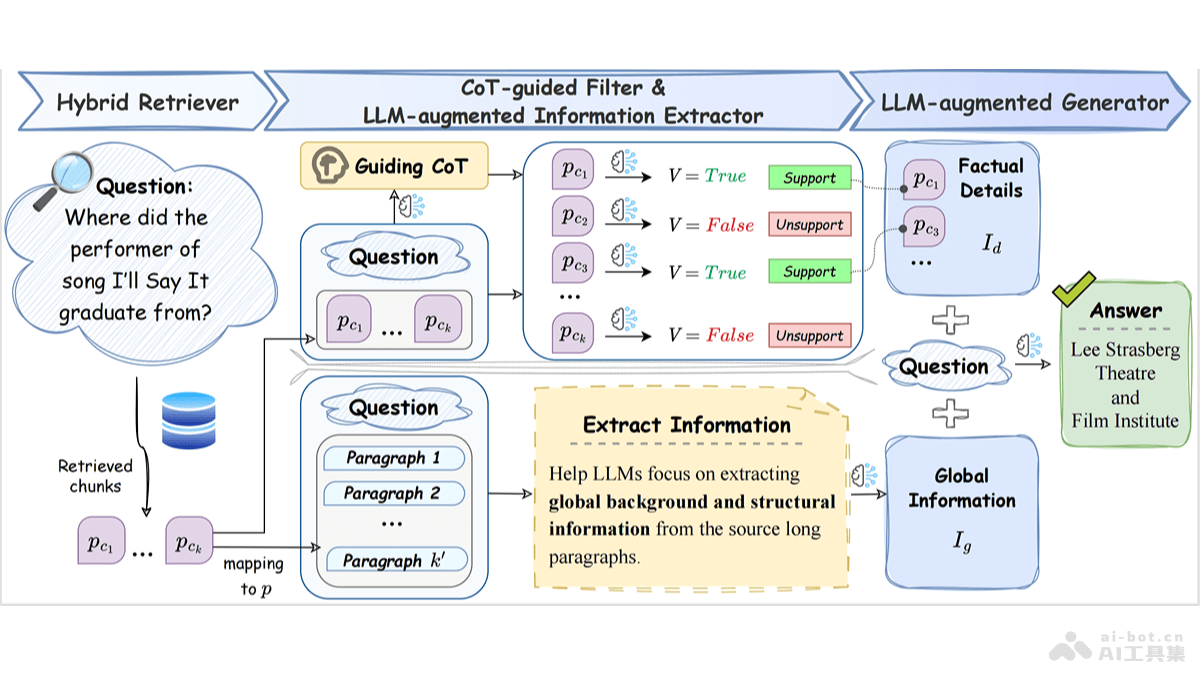
LongRAG is a dual-perspective robust Retrieval-Augmented Generation (RAG) framework for Long-Context Question Answering (LCQA), launched by research teams from Tsinghua University, the Chinese Academy of Sciences, and Zhipu. Built on four components—a hybrid retriever, an LLM-enhanced information extractor, a CoT-guided filter, and an LLM-enhanced generator—it effectively addresses the challenges of global context understanding and factual detail identification in long-text question answering. LongRAG outperforms baseline models such as long-context LLMs, advanced RAG systems, and Vanilla RAG on multiple datasets, demonstrating outstanding performance and robustness. LongRAG provides an automated fine-tuning data construction pipeline that enhances the system's "instruction-following" capability and domain adaptability.
Main Features of LongRAG
- Dual-Perspective Information Processing: Understands and answers long-text context questions based on the dual perspectives of global information and factual details.
- Hybrid Retriever: Quickly retrieves information fragments relevant to the question from large amounts of data.
- LLM-Enhanced Information Extractor: Maps the retrieved fragments back to the original long-text passages, extracting global background and structural information.
- CoT-Guided Filter: Uses Chain of Thought (CoT) to guide the model to focus on information relevant to the question and filter out irrelevant content.
- LLM-Enhanced Generator: Combines global information and key factual details to generate the final answer.
- Automated Fine-Tuning Data Construction: Builds high-quality fine-tuning datasets based on an automated pipeline, improving the model's performance on specific tasks.
Technical Principles of LongRAG
- Retrieval-Augmented Generation (RAG): Based on the RAG framework, retrieves external knowledge to assist the language model in generating answers.
- Integration of Global Information and Detail Information: The system not only focuses on local factual details but also integrates global information in long texts to provide more comprehensive answers.
- Mapping Strategy: Maps the retrieved fragments back to the original long text, restores contextual information, and provides a more accurate background structure.
- Chain of Thought (CoT): Uses CoT as a global clue to guide the model to gradually focus on knowledge relevant to the question, improving evidence density.
- Filtering Strategy: Based on the global clues of CoT, filters out irrelevant information fragments and retains key factual details.
LongRAG Project Address
- GitHub Repository:https://github.com/QingFei1/LongRAG
- arXiv Technical Paper:https://arxiv.org/pdf/2410.18050
Application Scenarios of LongRAG
- Customer Service and Support: In the customer service field, understands and answers lengthy customer queries or historical interaction records, providing more accurate answers and solutions.
- Medical Consultation: In the medical industry, processes large amounts of patient records and medical literature, answering complex questions from doctors or patients about diseases, treatments, and medications.
- Legal Consultation: Helps legal professionals provide in-depth analysis and advice on legal issues based on analyzing large amounts of legal documents and cases.
- Education and Research: In the education field, serves as an auxiliary tool to help students and researchers deeply understand lengthy academic articles and research reports and answer research-related questions.
- Enterprise Decision Support: Analyze long documents such as market research reports and corporate annual reports to provide data support and insights for business decisions.