
What is LongLLaVA
LongLLaVA is a multimodal large language model (MLLM) launched by researchers from The Chinese University of Hong Kong, Shenzhen. Based on a hybrid architecture, it combines Mamba and Transformer modules to improve the efficiency of processing large amounts of image data. LongLLaVA can process up to 1000 images on a single A100 80GB GPU while maintaining high performance and low memory consumption. The model compresses image tokens based on 2D pooling technology, significantly reducing computational costs and preserving key spatial relationship information. LongLLaVA demonstrates outstanding performance in application scenarios such as video understanding, high-resolution image analysis, and multimodal agents, especially in retrieval, counting, and sorting tasks.
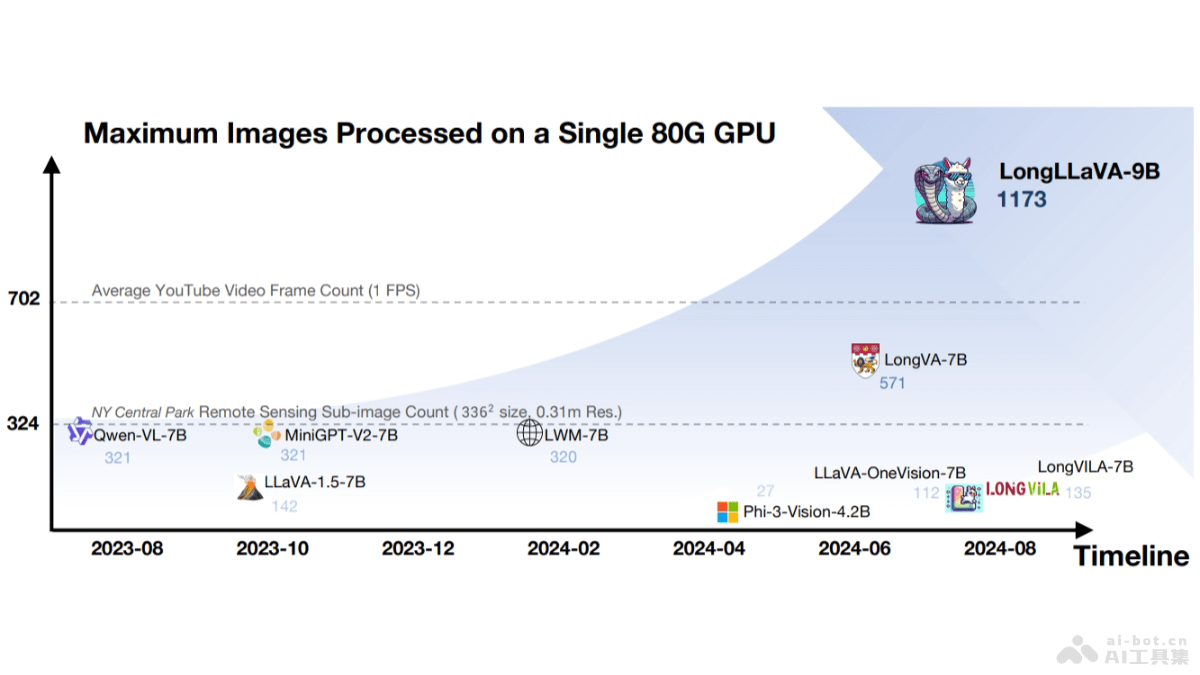
Main Features of LongLLaVA
- Multimodal Long-Context Understanding: Processes long-context information containing large numbers of images, suitable for scenarios such as video understanding and high-resolution image analysis.
- Efficient Image Processing: Processes up to 1000 images on a single GPU, demonstrating high efficiency in handling large-scale visual data.
- Hybrid Architecture Optimization: Combines Mamba and Transformer architectures to balance model efficiency and effectiveness.
- Data Construction and Training Strategy: Based on special data construction methods and phased training strategies, enhances the model's ability to understand multi-image scenarios.
- Excellent Benchmark Performance: Demonstrates outstanding performance in multiple benchmark tests, especially in retrieval, counting, and sorting tasks.
Technical Principles of LongLLaVA
- Hybrid Architecture: Based on a hybrid architecture, integrates Mamba and Transformer modules. The Mamba module provides sequence modeling capability with linear time complexity, while the Transformer module handles complex tasks requiring in-context learning.
- 2D Pooling Compression: Uses a 2D pooling method to compress image tokens, reducing the number of tokens while preserving spatial relationships between images.
- Data Construction: Considers temporal and spatial dependencies between images during data construction, designs a unique data format to enable the model to better understand multi-image scenarios.
- Progressive Training Strategy: The model adopts a three-stage training method, including single-image alignment, single-image instruction tuning, and multi-image instruction tuning, progressively enhancing the model's ability to handle multimodal long contexts.
- Balance of Efficiency and Performance: While maintaining high performance, optimization based on architecture and training strategies achieves low memory consumption and high throughput, demonstrating advantages in resource management.
- Multimodal Input Processing: Can process multiple multimodal inputs, including images, videos, and text, effectively managing preprocessed inputs in a unified manner within the internal hybrid architecture.
Project Address of LongLLaVA
- GitHub Repository:https://github.com/FreedomIntelligence/LongLLaVA
- arXiv Technical Paper:https://arxiv.org/pdf/2409.02889
Application Scenarios of LongLLaVA
- Video Understanding: Can process long video sequences, suitable for tasks such as video content analysis, event detection, video summarization, and video retrieval.
- High-Resolution Image Analysis: In scenarios requiring processing of high-resolution images, such as satellite image analysis, medical imaging diagnosis, and pathological slide analysis, decomposes images into sub-images and understands spatial dependencies.
- Multimodal Assistant: As a multimodal assistant, L provides real-time information retrieval and personalized services based on images and text.
- Remote sensing monitoring: In the field of remote sensing, it processes large amounts of remote sensing images for environmental monitoring, urban planning, and agricultural analysis.
- Medical diagnosis: It assists doctors in analyzing pathological images, improving the accuracy and efficiency of diagnosis.