
What is LongDocURL
LongDocURL is a multimodal long document understanding benchmark dataset jointly released by the Institute of Automation, Chinese Academy of Sciences, and Alibaba's Taobao and Tmall Group. It focuses on evaluating models' understanding, reasoning, and localization capabilities when processing long documents, complex elements, and diverse tasks. The dataset contains 2,325 question-answer pairs, covers more than 33,000 pages of documents, and involves 20 subtasks, aiming to advance the development of document understanding technology.
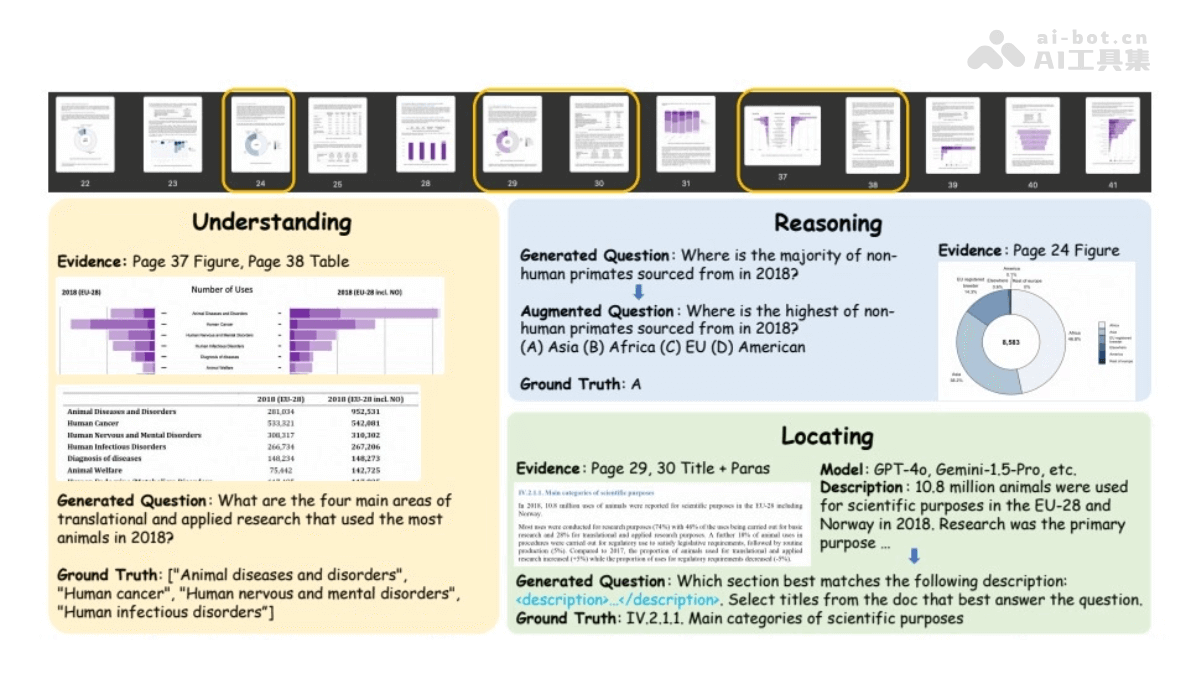
Main Features of LongDocURL
- Long Document Understanding: Evaluates AI models' ability to understand complex textual content, including extracting core information, identifying key passages and details, and analyzing document structure such as headings and figure captions.
- Numerical Reasoning: Examines AI models' ability to process data and perform accurate calculations, especially understanding and handling documents containing large amounts of numerical information, such as data in financial reports and scientific literature.
- Cross-Element Localization: Evaluates models' ability to locate and associate different types of elements in long documents, such as text, tables, and charts, which is crucial for understanding and reasoning tasks.
- Diverse Tasks: The dataset is subdivided into 20 subtasks, covering the three major task categories of understanding, reasoning, and localization, based on different task types and evidence sources.
- Semi-Automated Construction Pipeline: Includes steps such as document screening, question-answer generation, and automated and manual verification to ensure the quality and diversity of the dataset.
- Support for Multiple Document Types: Covers various types of documents such as research reports, user manuals, and books, with an average length of 85.6 pages per document, providing rich application scenarios.
Technical Principles of LongDocURL
- Multimodal Document Understanding: LongDocURL aims to evaluate models' ability to process long documents containing multiple modalities such as text, images, and tables. This involves integrating different document elements, such as text and images, into a shared multimodal embedding space so that models can understand and reason about the relationships between these elements.
- Page Retrieval and Question-Answer Generation: LongDocURL uses multimodal retrieval models such as ColPali to retrieve the pages most relevant to a query, and uses multimodal language models such as Qwen2-VL to perform visual question answering on the retrieved page images and query to generate final answers.
- Semi-Automated Construction Pipeline: LongDocURL constructs the dataset through a semi-automated pipeline, including four modules: document extraction and filtering, question-answer generation, automated verification, and manual verification. This pipeline can efficiently generate high-quality question-answer pairs from large numbers of documents and ensure content quality.
- Model Evaluation: LongDocURL proposes a new benchmark containing 2,441 multi-hop questions distributed across 3,368 PDF documents, totaling 41,005 pages. Each question is supported by evidence from one or more documents, covering multiple modalities such as text, images, and tables, capturing the typical complexity and diversity of real-world documents.
- Task Classification: LongDocURL divides tasks into three main categories: understanding, reasoning, and localization, and further subdivides them into 20 subtasks based on different main tasks and answer evidence, supporting more fine-grained evaluation.
Project Address of LongDocURL
- Project Address:longdocurl.github.io
- Github Repository:https://github.com/dengc2023/LongDocURL
- arXiv Technical Paper:https://arxiv.org/pdf/2412.18424
Application Scenarios of LongDocURL
- Document Understanding: The LongDocURL dataset can be used to evaluate and train AI models' comprehension capabilities when processing long documents, including extracting key information and parsing document structures.
- Numerical Reasoning: In fields such as finance and accounting, LongDocURL can be used to train AI models to perform numerical calculations, comparisons, and summarization, handling documents that contain large amounts of numerical information.
- Legal Domain: In the legal domain, LongDocURL can help AI systems analyze large volumes of legal documents, providing case-related information extraction and evidence localization.
- Medical Domain: LongDocURL can be used to analyze textual records and imaging materials in medical records, assisting doctors in making more comprehensive diagnoses.
- Intelligent Manufacturing: In the field of intelligent manufacturing, LongDocURL can be used to monitor the status of equipment on production lines, optimizing production processes by combining operation manuals and sensor data.
- Scientific Research: LongDocURL provides a standardized evaluation benchmark that helps improve model performance in scientific document understanding tasks, especially when processing structured scientific literature.