
What is LongCat-Next?
LongCat-Next is a multimodal model launched by Meituan LongCat, with its core innovation being the LoZA sparse attention mechanism. The model intelligently screens module importance and replaces 50% of low-importance modules with streaming sparse attention, forming a ZigZag structure that interleaves global and local attention. LongCat-Next achieves a 1M ultra-long context, a 10x increase in decoding speed, a 30% reduction in compute usage, and doubled hardware utilization. It includes two versions: Flash-Exp (1M context experimental version) and Flash-Lite (68.5B MoE architecture), with performance on long-text tasks surpassingQwen-3。
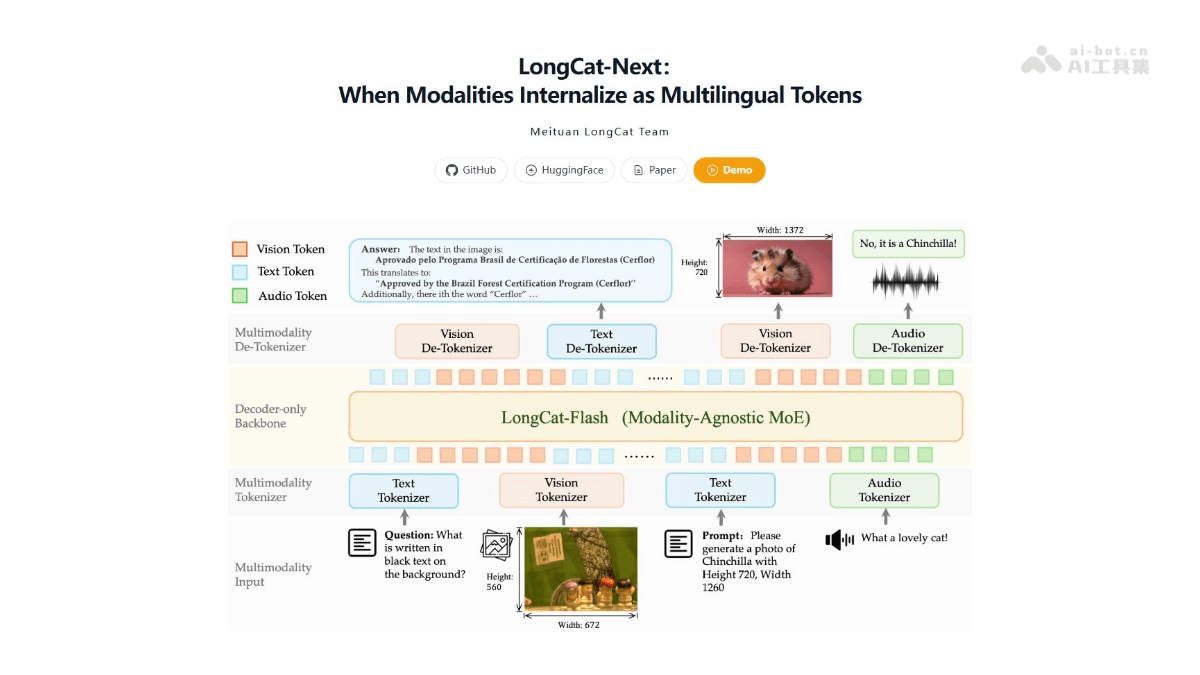
Main Features of LongCat-Next
-
Ultra-long context understanding: Supports processing of ultra-long text of 1 million tokens, and can process document content twice as long under the same hardware.
-
LoZA sparse attention: Through intelligent screening of module importance and the use of a ZigZag interleaved structure, it enables efficient collaborative computation of global and local attention.
-
Inference acceleration optimization: Supports a 10x increase in decoding speed for 128K context and a 50% speedup in 256K preloading, greatly reducing the time cost of long-text processing.
-
Compute cost savings: Compute consumption during the model's 256K decoding stage is reduced by 30%, allowing enterprises to deploy large model services at lower cost.
-
Flexible choice of two versions: Provides Flash-Exp, an experimental version with 1M context, and Flash-Lite, a lightweight version with a 68.5B MoE architecture, to meet the needs of different scenarios.
-
Stable long-text performance: Outperforms Qwen-3 on the MRCR long-text benchmark, with more stable and reliable results on complex document question answering and code generation tasks.
Key Information and Usage Requirements of LongCat-Next
-
Publisher: Meituan LongCat Team (Meituan LongCat)
-
Core technology: LoZA (LongCat ZigZag Attention) sparse attention mechanism
-
Context window: Supports up to 1M tokens (1 million)
-
Model architecture: 68.5B MoE (Mixture of Experts), activating 2.9B-4.5B parameters per inference
-
Performance improvements: 10x faster 128K decoding, 50% faster 256K preloading, and 30% compute savings
-
Hardware requirements: Specific configurations have not been disclosed, but the LoZA mechanism reduces dependence on high-end hardware
-
API service: LongCat-Flash-Lite provides API access, with a generation speed of 500-700 token/s
Core Advantages of LongCat-Next
- Ultra-long context processing capability: Supports understanding of ultra-long text of 1M tokens (1 million), and can process documents twice as long under the same hardware, breaking through the long-text bottleneck of large models.
- Efficient sparse attention mechanism: LoZA technology intelligently screens module importance and replaces 50% of low-importance modules with streaming sparse attention, achieving precise collaborative computation of global and local information.
- Significant speed improvement: The model's 128K context decoding speed is increased by 10x, and 256K preloading is sped up by 50%, greatly shortening long-text response time.
- Low-compute-cost deployment: Compute consumption during the 256K decoding stage is reduced by 30%, allowing enterprises to deploy high-performance large model services at lower hardware cost.
- Stable performance: Surpasses Qwen-3 on the MRCR long-text benchmark, matches the original version on everyday question answering and code generation tasks, and performs more reliably in complex scenarios.
How to use LongCat-Next
-
Obtain open-source resources: Visit the GitHub repository, download the released model weights and inference code for local deployment.
-
Hardware configuration: Using the LoZA sparse attention mechanism, achieve 2x long-text processing capability on existing hardware without upgrading to high-end devices.
LongCat-Next project address
- Project official website:https://longcat.chat/longcat-next/intro
- GitHub repository:https://github.com/meituan-longcat/LongCat-Next
- HuggingFace model library:https://huggingface.co/meituan-longcat/LongCat-Next
- Technical paper:https://github.com/meituan-longcat/LongCat-Next/blob/main/tech_report.pdf
Comparison of LongCat-Next with similar competitors
| Comparison item | LongCat-Next | Qwen-3 | GPT-4 |
|---|---|---|---|
| Long-text benchmark | MRCR testSurpassesQwen-3 | Previous leader | MRCR data not disclosed |
| Context window | 1M Token | Equivalent length not specified | Approximately 128K tokens |
| Core technology | LoZA sparse attention | Traditional full attention | Details not disclosed |
| Inference speed | 128K decoding10x faster | Quantitative data not disclosed | High computing power dependency |
| Computing cost | Saves 30%, hardware utilization doubled | Standard consumption | Higher API cost |
Application scenarios of LongCat-Next
-
Intelligent long-document processing: Supports deep understanding, summary generation, and cross-chapter information retrieval of million-word-level legal contracts, academic papers, and technical documents, solving the context truncation problem of traditional models.
-
Code repository-level development assistance: The model can analyze an entire large codebase (such as a million-line-level project), enabling cross-file dependency understanding, global refactoring suggestions, and long-context code generation.
-
Enterprise knowledge base question answering: Build intelligent customer service and decision support systems based on massive internal documents, achieving high-precision long-text retrieval and reasoning at lower computing cost.
-
Multimodal long-content analysis: In the future, it will support long video script parsing and long image-text content understanding, enabling cross-modal long-sequence information integration and generation.