
What is Logics-Parsing
Logics-Parsing is an end-to-end document parsing model open-sourced by Alibaba, based on Qwen2.5-VL-7B. Through reinforcement learning, it optimizes document layout analysis and reading order inference, and can convert PDF images into structured HTML output, supporting multiple content types, including regular text, mathematical formulas, tables, chemical formulas, and handwritten Chinese characters. It uses two-stage training: the first stage is supervised fine-tuning, learning to generate structured output; the second stage is layout-centric reinforcement learning, optimizing text accuracy, layout positioning, and reading order. It performs excellently on the LogicsParsingBench benchmark, especially outperforming other methods in parsing plain text, chemical structures, and handwritten content.
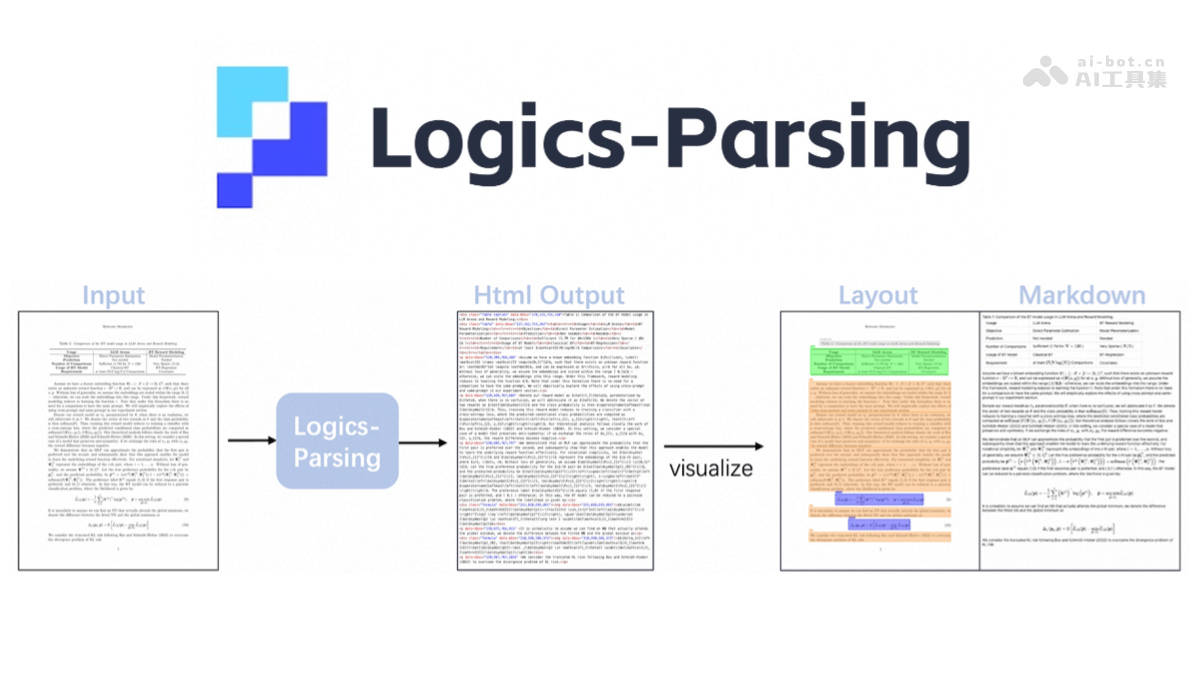
Main Features of Logics-Parsing
-
End-to-End Document Parsing: Logics-Parsing can directly convert PDF images into structured HTML output, supporting multiple content types, including regular text, mathematical formulas, tables, chemical formulas, and handwritten Chinese characters.
-
Reinforcement Learning Optimization: It uses a two-stage training method. The first stage learns to generate structured output through supervised fine-tuning, and the second stage uses layout-centric reinforcement learning to optimize text accuracy, layout positioning, and reading order.
-
High Performance: On the LogicsParsingBench benchmark, Logics-Parsing performs excellently across multiple document types, especially outperforming other methods in parsing plain text, chemical structures, and handwritten content.
-
Wide Range of Application Scenarios: It is suitable for various complex document types such as academic papers, complex multi-column documents, newspapers, and posters, and can handle multi-column layouts, mathematical formulas, and chemical structures.
Technical Principles of Logics-Parsing
-
Based on Qwen2.5-VL-7B: Logics-Parsing is built on the powerful Qwen2.5-VL-7B model and inherits its advantages in visual and language processing.
-
Two-Stage Training: The first stage is supervised fine-tuning, where the model learns to generate structured HTML output; the second stage is layout-centric reinforcement learning, optimizing the model through three reward components: text accuracy, layout positioning, and reading order.
-
Reinforcement Learning Optimization: Through reinforcement learning, the model can better understand the document layout and the logical order of the content, generating more accurate structured output.
-
Structured HTML Output: The model can convert document images into structured HTML format, preserving the logical structure of the document. Each content block has a category, bounding box coordinates, and an OCR text label.
-
Advanced Content Recognition: The model can accurately recognize complex scientific formulas, chemical structures, and handwritten Chinese characters, and convert chemical structures into standard SMILES format.
-
Automatic Removal of Irrelevant Elements: The model can automatically identify and filter out irrelevant elements such as headers and footers, focusing on the core content of the document.
Project Address of Logics-Parsing
- Github Repository:https://github.com/alibaba/Logics-Parsing
- HuggingFace Model Library:https://huggingface.co/Logics-MLLM/Logics-Parsing
- arXiv Technical Paper:https://arxiv.org/pdf/2509.19760
Application Scenarios of Logics-Parsing
-
Academic Paper Parsing: It can handle academic papers containing multi-column layouts, mathematical formulas, and chemical structures, accurately extracting key information and generating structured output.
-
Complex Multi-Column Documents: Suitable for complex multi-column documents such as newspapers and posters, effectively parses layout and extracts content.
-
Handwritten Document Recognition: Supports recognition and parsing of handwritten Chinese characters, applicable to scenarios such as handwritten notes and exam papers.
-
Chemical Document Processing: Accurately recognizes chemical formulas and converts them to standard SMILES format, suitable for document parsing in the chemistry field.
-
Mathematical Document Parsing: Can process documents containing complex mathematical formulas, such as mathematics textbooks and scientific research papers, providing accurate formula parsing.
-
Multilingual Document Support: Supports document parsing in multiple languages, suitable for international document processing scenarios.