
What is LocalAI
LocalAI is an open-source local AI inference framework that provides a complete localized AI solution, supports multimodal models (such as text generation, image generation, speech processing, etc.), and is compatible with the OpenAI API. It emphasizes privacy protection: all data processing is completed locally and is not uploaded to the cloud. LocalAI supports a variety of hardware configurations, including CPU-only scenarios, and is also compatible with NVIDIA, AMD, and Intel GPUs. It supports multiple model formats, such as GGML, GGUF, and GPTQ, and provides flexible deployment options. LocalAI also includes components such as LocalAGI and LocalRecall, which are used for autonomous AI agents and semantic search, respectively. Its multimodal capabilities make it suitable for projects that require multiple AI functions.
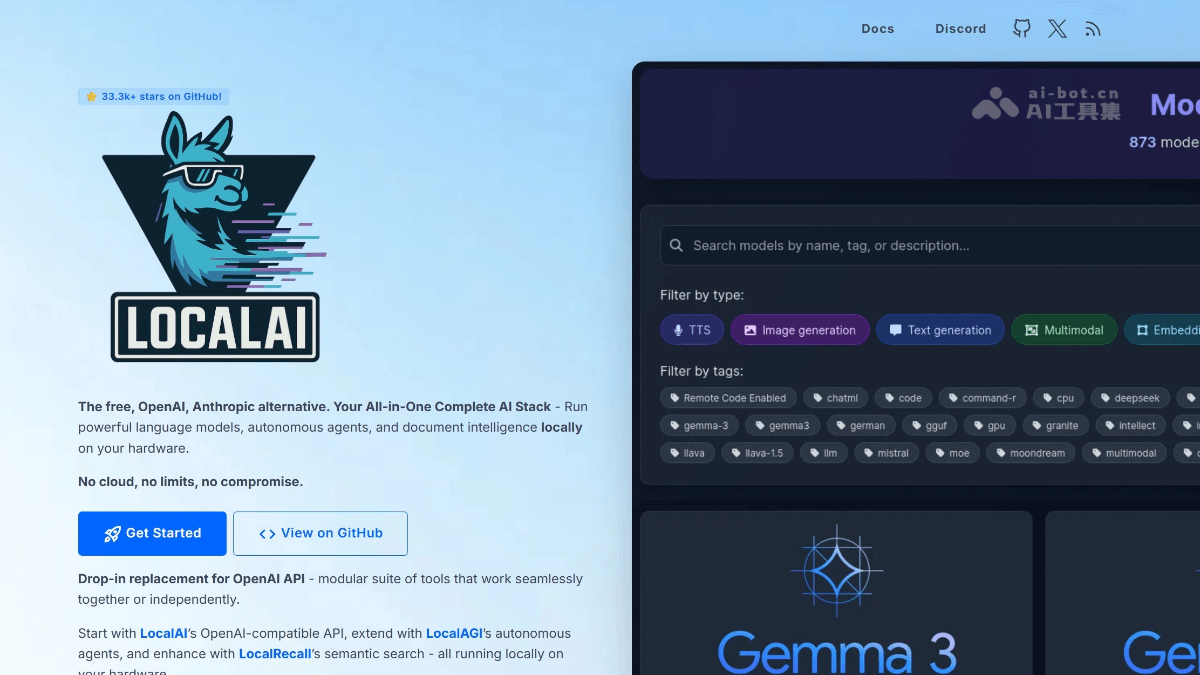
Main features of LocalAI
-
Multimodal support: LocalAI supports a variety of multimodal functions such as text generation, image generation, speech-to-text, and text-to-speech. For example, through the image generation interface, experimental data can be automatically converted into visual charts.
-
OpenAI API compatibility: LocalAI provides a REST interface compatible with the OpenAI API, allowing users to seamlessly replace existing OpenAI services in a local environment. This enables existing applications to be deployed locally without modifying code.
-
Local inference and privacy protection: The core advantage of LocalAI is that data processing is fully localized. All AI inference processes are completed locally, ensuring that sensitive information is not transmitted to external servers over the network, thereby protecting user data privacy.
-
Hardware compatibility: LocalAI supports a variety of hardware configurations, including CPU-only scenarios, and is also compatible with NVIDIA, AMD, and Intel GPUs.
-
WebUI support: LocalAI provides a web-based graphical user interface, making it convenient for users to perform operations such as model management, file processing, and real-time conversations.
-
Model management and loading: Through the gRPC interface, LocalAI supports model loading and management. Users can load commonly used models into memory in advance, significantly reducing the latency of the first inference.
-
Tool calling and function integration: LocalAI supports function calling and embedding services, allowing developers to integrate AI capabilities into existing systems.
Technical principles of LocalAI
-
Implementing functionality based on open-source libraries: LocalAI uses a variety of open-source libraries to implement different functions. For example, it uses
llama.cppandgpt4all.cppfor text generation,whisper.cppfor audio transcription, and Stable Diffusion for image generation. -
Compatible with OpenAI API specifications: By being compatible with OpenAI's API specifications, LocalAI achieves seamless integration with existing systems. This allows users to use LocalAI as a replacement for OpenAI and run it locally without modifying code.
-
Multi-hardware support: LocalAI supports a variety of hardware configurations, including CPU-only scenarios, and is also compatible with NVIDIA, AMD, and Intel GPUs. Through quantization techniques (such as ggml/q4_0), LocalAI can efficiently run large models on consumer-grade hardware.
-
Distributed inference architecture: LocalAI implements distributed inference capabilities based on a P2P network, allowing computing tasks to be split across multiple nodes for collaborative processing. Node discovery is implemented through mDNS and DHT protocols, and communication encryption uses the libp2p protocol stack to ensure secure communication between nodes.
-
Dynamic task scheduling: In distributed inference, LocalAI adopts a decentralized design, dynamically allocating tasks based on nodes' CPU/memory usage and network latency, prioritizing nodes with lighter loads to handle new requests, which improves the cluster's availability and fault tolerance.
LocalAI project address
- Project official website:https://localai.io/
- Github repository:https://github.com/mudler/LocalAI
LocalAI application scenarios
-
Enterprise intranet environment: In an enterprise intranet, LocalAI can build a private AI assistant for handling internal documents, code review, knowledge Q&A, and other tasks. All data processing is done locally, avoiding the leakage of sensitive information.
-
Personal development environment: As a local AI programming assistant, LocalAI can quickly respond to code-related tasks, reduce network latency, and improve development efficiency.
-
Offline AI applications: In an offline environment, LocalAI can implement AI functions and support offline research, programming, and content creation.
-
Autonomous AI Agent: Build and deploy autonomous Agents locally to achieve task automation and complex workflows without relying on the cloud.
-
Semantic retrieval and memory: Build a local knowledge base and semantic retrieval to enhance the AI's contextual awareness and persistent memory capabilities.
-
Multimodal content generation: Generate text, images, and audio locally, suitable for creative projects, marketing, and multimedia production.