
What is LocAgent
LocAgent is a framework focused on code localization tasks, launched jointly by institutions such as Stanford University, Yale University, and the University of Southern California, helping developers quickly and accurately find the parts of a codebase that need to be modified. LocAgent parses the codebase into a directed heterogeneous graph, capturing the structure and dependencies of the code, enabling large language models (LLMs) to efficiently search for and locate relevant code entities based on powerful multi-hop reasoning capabilities. LocAgent provides agent-based code search tools, such as SearchEntity, TraverseGraph, and RetrieveEntity, helping developers quickly and accurately find the code snippets that need to be modified, significantly improving development and maintenance efficiency.
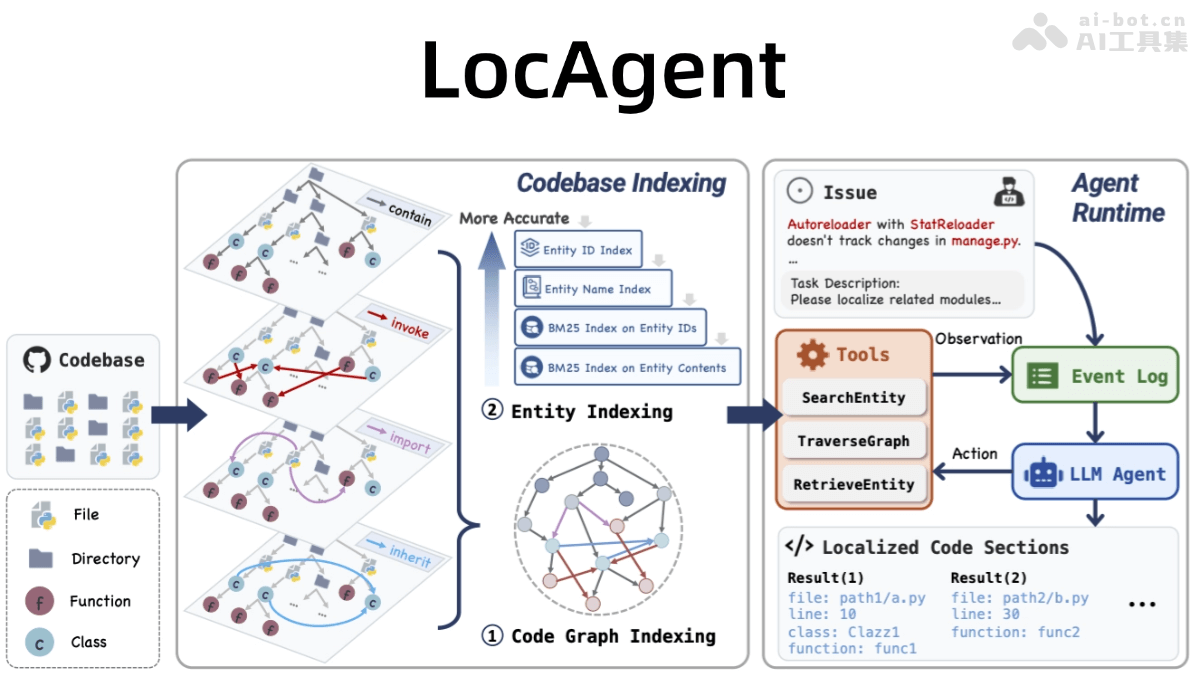
LocAgent's main features
- Quickly locate problematic code: Based on a problem described in natural language (such as a bug report, feature request, performance issue, or security vulnerability), quickly locate the specific file, class, function, or line of code in the codebase that needs to be modified.
- Support for multiple types of problems: Supports multiple types of software development and maintenance tasks, including bug fixing, feature addition, performance optimization, and security vulnerability repair.
LocAgent's technical principles
- Multi-hop reasoning based on graph representation and large language models (LLMs):
- Graph representation: LocAgent parses the codebase into a directed heterogeneous graph, where nodes represent entities in the codebase (such as files, classes, functions), and edges represent relationships between entities (such as imports, calls, inheritance). This graph structure can capture the hierarchical structure and complex dependencies of the code.
- Multi-hop reasoning: LocAgent uses the reasoning capabilities of LLMs to locate the root cause of a problem through multi-hop reasoning. Even if the problem description does not directly mention the affected code snippets, it reasons based on the chain of relationships in the graph to find the source of the problem hidden in multiple layers of dependencies.
- Efficient search tools:
- SearchEntity: Keyword search for relevant entities in the codebase.
- TraverseGraph: Starting from a given entity, perform multi-hop traversal along the relationships in the graph.
- RetrieveEntity: Retrieve the complete attributes of a specified entity, including code content, file path, line number, etc.
- Sparse hierarchical index: Builds a sparse hierarchical index, including an index based on entity IDs, an index based on entity names, and an inverted index based on the BM25 algorithm. The index can quickly locate code entities related to the problem description and maintain efficient performance in large codebases.
LocAgent's project address
- GitHub repository:https://github.com/gersteinlab/LocAgent
- arXiv technical paper:https://arxiv.org/pdf/2503.09089
LocAgent's application scenarios
- Bug fixing: Based on the problem description, quickly find the location of the problematic code and reduce debugging time.
- Feature addition: Add new features to an existing codebase, helping developers find code snippets related to the new feature and determine the best insertion point.
- Performance optimization: Locate code snippets related to performance bottlenecks and provide optimization suggestions.
- Security vulnerability repair: Quickly find code snippets related to security vulnerabilities and help developers fix the vulnerabilities.
- Code maintenance and refactoring: Help developers find code snippets that need to be refactored and provide detailed contextual information.