
What is LMMs-Eval
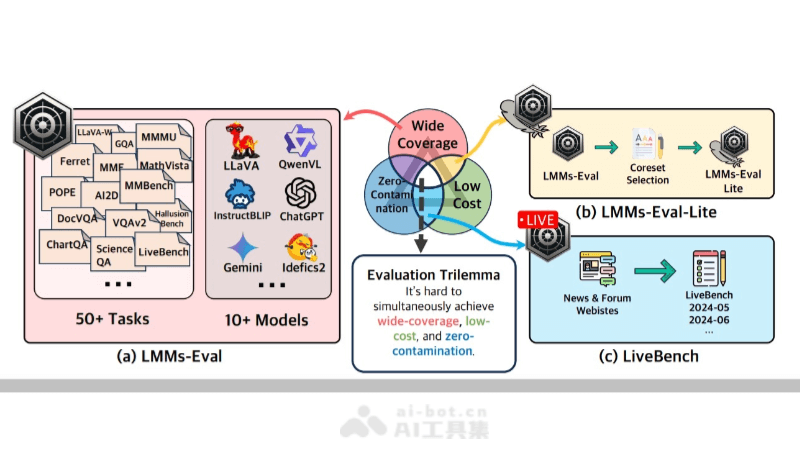
LMMs-Eval is a unified evaluation framework designed for multimodal AI models, providing standardized, broadly covering, and cost-effective solutions for model performance evaluation. It includes over 50 tasks and more than 10 models, and through a transparent and reproducible evaluation process, helps researchers and developers comprehensively understand model capabilities. LMMs-Eval also introduces LMMs-Eval Lite and LiveBench; the former reduces evaluation costs through streamlined datasets, while the latter uses the latest web information for dynamic evaluation, examining model generalization ability in a zero-contamination manner. It provides an important evaluation tool for the future development of multimodal models.

Main Features of LMMs-Eval
- Unified Evaluation Suite: Provides a standardized evaluation process, supporting comprehensive evaluation of multimodal capabilities across more than 50 tasks and over 10 models.
- Transparent and Reproducible: Ensures the transparency and reproducibility of evaluation results, making it easy for researchers to verify and compare the performance of different models.
- Broad Coverage: Covers multiple task types, such as image understanding, visual question answering, document analysis, etc., comprehensively examining the model's multimodal processing capabilities.
- Low-Cost Evaluation: Provides a streamlined evaluation toolkit through LMMs-Eval Lite, reducing dataset size and lowering evaluation costs while maintaining evaluation quality.
Technical Principles of LMMs-Eval
- Standardized Evaluation Process: By defining unified interfaces and evaluation protocols, LMMs-Eval allows researchers to test and compare the performance of different models on the same benchmark.
- Multi-Task Evaluation: The framework is designed to handle multiple types of tasks simultaneously, including but not limited to image and language understanding and generation tasks.
- Dataset Selection and Coreset Extraction: LMMs-Eval uses algorithms to select representative data subsets to reduce the resources required for evaluation while maintaining the consistency and reliability of evaluation results.
- Dynamic Data Collection: The LiveBench component automatically collects the latest information from news and forums on the internet to generate dynamically updated evaluation datasets.
- Anti-Contamination Mechanism: By analyzing the overlap between training data and evaluation benchmark data, LMMs-Eval can identify and reduce data contamination, ensuring the validity of the evaluation.
LMMs-Eval Project Address
- Project Official Website:https://lmms-lab.github.io/
- GitHub Repository:https://github.com/EvolvingLMMs-Lab/lmms-eval
- arXiv Technical Paper:https://arxiv.org/pdf/2407.12772
How to Use LMMs-Eval
- Obtain the Code: You need to clone the LMMs-Eval code repository from the GitHub repository to your local environment.
- Install Dependencies: Install the required dependencies. This involves Python packages and possibly system dependencies.
- Select Model and Dataset: According to the evaluation needs, select the corresponding model and task from the supported models and datasets.
- Configure Evaluation: According to the selected model and dataset, configure the evaluation parameters and settings. This includes specifying model weights, data paths, evaluation types, etc.
- Run Evaluation: Use the command-line tools or Python scripts provided by LMMs-Eval to start the evaluation process. Execute the standardized evaluation process and generate results.
Application Scenarios of LMMs-Eval
- Academic ResearchResearchers can use LMMs-Eval to evaluate and compare the performance of different large multimodal models across various tasks, such as image recognition, natural language processing, and cross-modal understanding.
- Industrial Application TestingWhen developing multimodal AI applications, LMMs-Eval can be used to conduct comprehensive testing of models to ensure they meet specific business needs.
- Model Development and IterationAt various stages of model development, LMMs-Eval can help developers quickly evaluate model improvements, perform tuning and iteration.
- Education and TrainingEducational institutions can use LMMs-Eval as a teaching tool to help students understand the working principles and evaluation methods of multimodal models.
- Competitions and Benchmark TestingIn AI competitions, LMMs-Eval can serve as a standardized evaluation platform to ensure fair comparison among different participating teams on the same benchmark.