
What is LLM2LLM
LLM2LLM is an innovative iterative data augmentation strategy that improves the performance of large language models (LLMs) in data-scarce scenarios. The method generates synthetic data based on a powerful teacher model to augment the student model's training dataset. Specifically, the student model is first fine-tuned on limited seed data, and then the teacher model identifies errors in the student model's predictions and generates new synthetic data based on these errors. This synthetic data is then added to the training set, forming a cyclical iterative process. The advantage of LLM2LLM lies in its ability to effectively reduce dependence on large-scale annotated data while specifically addressing the student model's weaknesses, significantly improving the model's accuracy and robustness in low-data tasks. This method is particularly suitable for fields where data acquisition is costly, such as medical diagnosis and specialized domain research.
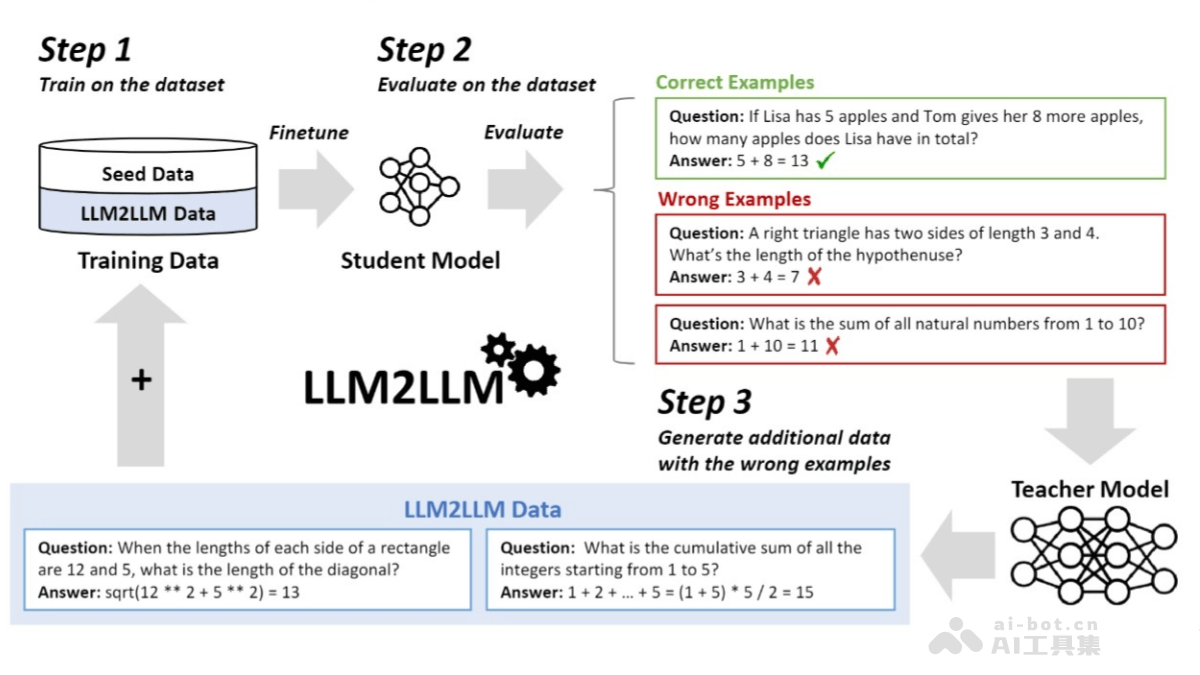
Main Features of LLM2LLM
- Data Augmentation: Generates new data points similar to the student model's prediction errors through the teacher model, thereby augmenting the training dataset.
- Iterative Learning: The method progressively improves the model through an iterative process, with each iteration targeting data points where the model currently performs poorly for augmentation.
- Targeted Reinforcement: Focuses on augmenting data points where the model makes incorrect predictions, rather than blindly augmenting all data.
- Quality Control: Prevents the propagation of errors and degradation of data quality by limiting the use of data generated by the teacher model.
- Avoiding Data Inflation: Limits the scope of synthetic data generation, augmenting only based on the original incorrect answers, thereby avoiding data inflation.
Technical Principles of LLM2LLM
- Initial Fine-Tuning: First, the student model is preliminarily fine-tuned on a small-scale seed dataset. This is to give the student model a certain foundational capability to handle simple tasks.
- Performance Evaluation and Error Extraction: Next, the system evaluates the student model's performance, identifying areas where the model is deficient. Specifically, it uses the student model to evaluate the current dataset and records the evaluation results, then filters out the data points where the model makes incorrect predictions.
- Synthetic Data Generation: Based on the evaluation results, the teacher model generates new, targeted training data. This data is specifically designed to address the student model's weaknesses; for example, if the student model performs poorly on a particular type of text, the teacher model will generate more similar text.
- Iterative Optimization: The newly generated data is added to the existing dataset, and the student model is then retrained using this updated dataset. In this way, the student model can further learn and improve on new, more challenging data. This process is repeated continuously until the model performance reaches the expected level or no longer shows significant improvement.
LLM2LLM Project Address
- Github Repository:https://github.com/SqueezeAILab/LLM2LLM
- arXiv Technical Paper:https://arxiv.org/pdf/2403.15042
Application Scenarios of LLM2LLM
- Medical Field: In medical research and clinical applications, LLM2LLM can be used to generate text data related to rare diseases, helping models better understand and classify these diseases.
- Legal Field: Legal texts usually have complex structures and specialized terminology. LLM2LLM can generate data related to specific legal cases, helping models better understand and analyze legal texts.
- Education: In educational software, LLM2LLM can be used to generate personalized questions and exercises that adapt to different students' learning levels and needs. For example, it can generate math problems that match students' current learning progress to help them improve their problem-solving skills.
- Natural language processing tasks: In natural language processing tasks such as question-answering systems and dialogue systems, LLM2LLM can provide more accurate and nuanced answers by continuously optimizing training data.
- Rapid iterative development: For NLP tasks that require rapid iteration and improvement, LLM2LLM provides an efficient method of data augmentation and model training, enabling models to significantly improve performance in a short time.