
What is LLM Council
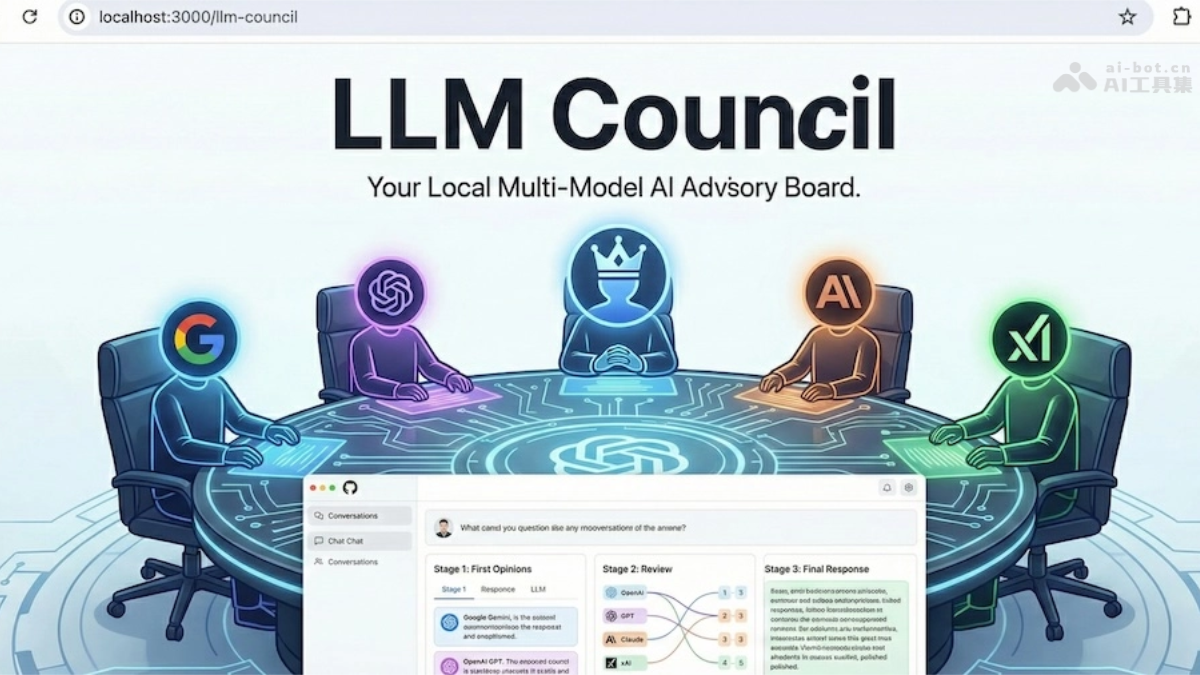
LLM Council is Andrej Karpathy's open-sourcemulti-model collaboration framework, which uses OpenRouter to simultaneously distribute a user's question to multiple large models (such as Claude, GPT, Gemini, etc.) for independent answers, with each model anonymously reviewing and scoring the others, and finally a designated Chairman LLM synthesizes all viewpoints to output the optimal answer, achieving multi-model cross-validation and collective decision-making.
Main features of LLM Council
-
Multi-model parallel answering: A single question simultaneously triggers multiple LLMs to generate answers independently, with tabbed views to see each model's original response.
-
Anonymous cross-review: Each model anonymously reviews the other models' answers, ranking them by accuracy and insight, avoiding favoritism toward itself.
-
Chairman model synthesis: A designated Chairman LLM aggregates all drafts and review opinions to output the final unified answer.
-
Local session management: Conversation history is stored locally as JSON files, supporting review and continuation of past discussions.
-
Visualized three-stage process: The web interface clearly displays the complete "draft -> review -> final" pipeline.
Technical principles of LLM Council
-
Backend architecture: Built on FastAPI (Python 3.10+), using asynchronous httpx to concurrently call the OpenRouter API for parallel multi-model requests.
-
Frontend technology: Supports the React + Vite tech stack, with react-markdown to render the Markdown content output by the models.
-
Anonymous review mechanism: In Stage 2, each model's identity is anonymized to ensure the review process is objective and fair, eliminating brand bias.
-
Three-stage pipeline: Stage 1 collects each model's draft -> Stage 2 distributes anonymous answers for mutual review and ranking -> Stage 3 the chairman model synthesizes the final draft.
-
Local data storage: Session data is saved as JSON files in the
data/conversations/directory, with no external database required.
How to use LLM Council
-
Clone the repository: Run
git clone https://github.com/karpathy/llm-council.gitto download the project code. -
Install dependencies: For the backend, run
uv sync; for the frontend, enter thefrontenddirectory and runnpm install。 -
Configure the API key: Create a
.envfile in the project root directory and fill inOPENROUTER_API_KEY=sk-or-v1-...。 -
Customize models(optional): Edit
backend/config.pyto modify theCOUNCIL_MODELSlist andCHAIRMAN_MODEL。 -
Start the application: Run
./start.shfor one-click startup, or start the backend and frontend development servers separately. -
Start a conversation: Visit
http://localhost:5173in your browser, enter a question to trigger the multi-model advisory council process.
Core advantages of LLM Council
-
Eliminates single-model bias: Through multi-model cross-validation and mutual criticism, it significantly reduces hallucinations, blind spots, and inherent bias.
-
Significantly improved answer quality: Through the dual mechanism of review-based filtering + chairman synthesis, the final output is more comprehensive and reliable than a single model.
-
Fully local deployment: Code is open source, data is stored locally, and conversation privacy does not depend on any third-party platform.
-
Highly flexible model combinations: Through OpenRouter, any models can be freely combined, and the community has expanded support for Ollama local model integration.
-
Lightweight and fast setup: 99% of coding is AI-assisted (Vibe Code), with minimal dependencies, and local deployment can be completed in just a few minutes.
LLM Council's project address
- GitHub repository:https://github.com/karpathy/llm-council
Comparison of LLM Council with similar competing products
| Dimension | LLM Council | AutoGen | CrewAI |
|---|---|---|---|
| Product positioning | Multi-model answer integration and review tool | Conversational multi-agent orchestration framework | Role-driven task collaboration framework |
| Collaboration mode | Parallel answering + anonymous peer review + chairman arbitration | Group chat conversation + negotiated consensus | Role division + sequential/hierarchical execution |
| Model source | Cross-vendor (OpenRouter aggregation) | Single or homogeneous models | Single or homogeneous models |
| Anonymous review | ✅ Native support | ❌ Not supported | ❌ Not supported |
| Peer review scoring | ✅ Native support | ❌ Not supported | ❌ Not supported |
| Chairman summary | ✅ Native support | ❌ Requires custom implementation | ❌ Can be replaced by a manager Agent |
| Deployment method | Fully local | Local/cloud | Local/cloud |
| Data privacy | Data is stored completely locally | Depends on deployment method | Depends on deployment method |
| Learning curve | Extremely low (one-click startup) | Medium (requires understanding the conversation paradigm) | Low (role configuration is intuitive) |
| Applicable scenarios | Q&A decision-making, content review, model evaluation | Code generation, scientific research exploration, debate | Content creation, market research, process automation |
LLM Council's application scenarios
-
Complex problem decision-making: Important decision-making scenarios such as technology selection and business strategy that require cross-validation of multiple perspectives.
-
Academic research assistance: When reading papers or books, obtain different interpretations and in-depth analyses of the same concept from multiple models.
-
Content quality review: Let multiple models review articles, code, or proposals for each other, automatically selecting the best version.
-
Horizontal evaluation of model capabilities: Compare the answer quality of different LLMs on the same question to assist teams in model selection.
-
Creative brainstorming: Use multi-model perspectives to inspire more diverse creative solutions and avoid single-minded thinking patterns.