
What is LLM-as-a-Verifier
LLM-as-a-Verifier is a general-purpose verification framework jointly open-sourced by Stanford, UC Berkeley, and NVIDIA Research. The framework requires no additional training and replaces traditional discrete scoring by generating continuous fine-grained scores from the full logits distribution of scoring tokens. The framework supports scaling verification capabilities along three dimensions: scoring granularity, repeated evaluation, and criteria decomposition, and can be used for test-time candidate selection, Agent progress tracking, and dense rewards for reinforcement learning. It achieves SOTA on benchmarks such as Terminal-Bench and SWE-Bench.
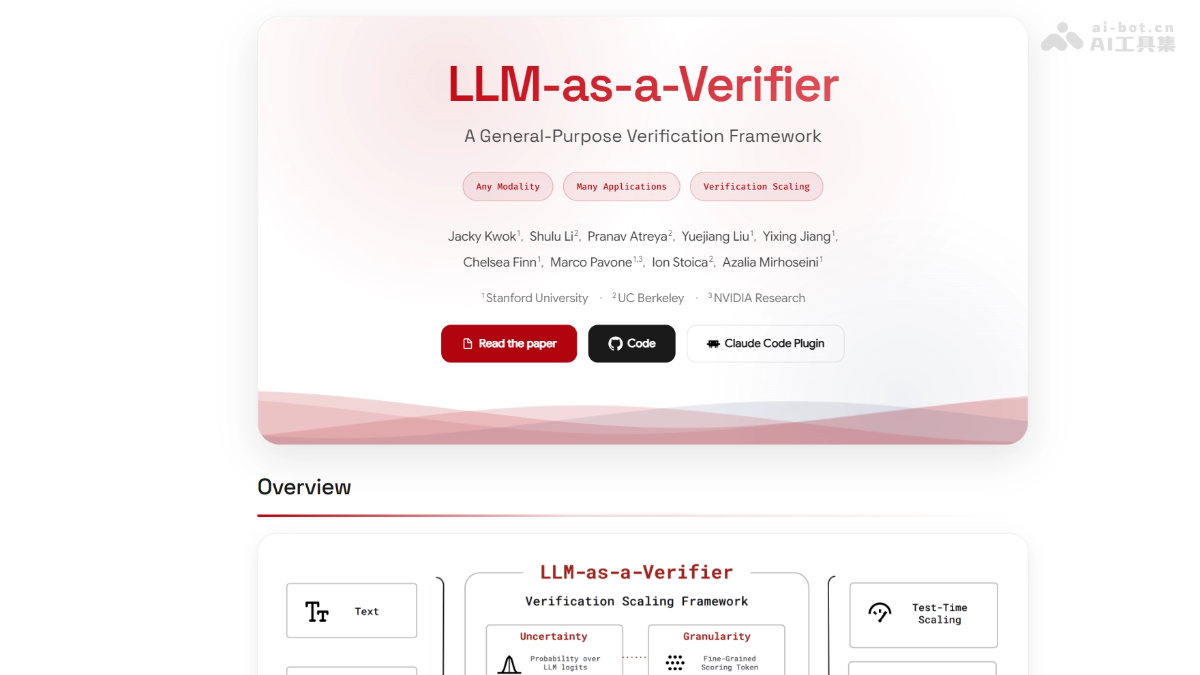
Main features of LLM-as-a-Verifier
-
Fine-grained verification scoring: Computes a continuous expected value from the full logits distribution of scoring tokens, replacing coarse discrete scoring and significantly reducing tie rates.
-
Test-time Best-of-N selection: Uses the Probabilistic Pivot Tournament algorithm to select the optimal solution from multiple candidate trajectories at linear cost, enabling low-cost self-verification.
-
Real-time progress tracking: Outputs fine-grained scores for each step of Agent execution, enabling both offline review of complete trajectories and online monitoring with early termination of hopeless tasks.
-
Dense rewards for reinforcement learning: Serves as a pluggable dense reward signal to improve the sample efficiency of offline/online RL algorithms.
-
Multimodal input support: In addition to text, it can directly process images and videos, uniformly verifying VLM Agent and robotic visual rollouts.
-
Claude Code plugin integration: Automatically generates multiple responses in parallel and selects the best in real time through the TurboAgent proxy, without modifying the original workflow.
Technical principles of LLM-as-a-Verifier
- Probabilistic fine-grained scoring: Replaces traditional discrete scoring with computing the expected value using the full logits distribution of scoring tokens. The model outputs scores in the range of 1–20, extracts the logprob of each token, performs a weighted sum, and normalizes to [0,1], thereby preserving the model's uncertainty information and avoiding the high tie rates and information loss caused by a single discrete value.
- Three-dimensional verification scaling: Verification can be independently scaled along three dimensions: granularity, repetition, and decomposition. Increasing the number of scoring tokens improves the separation between positive and negative samples; averaging multiple independent evaluations reduces variance; splitting evaluation into sub-criteria such as Specification, Error, and Output and scoring them separately before aggregation reduces prompt bias. The combination of the three can continuously improve verification accuracy under a controlled budget.
- Probabilistic Pivot Tournament (PPT): To reduce the ranking cost of Best-of-N from O(N²) to O(Nk), the algorithm first obtains initial win rates through cyclic comparisons and selects top-k anchors; then non-anchors are compared only with anchors, while anchors compete with each other; finally, based on the Bradley-Terry model, the win-loss relationships are aggregated for ranking, concentrating the budget on uncertain top candidates.
- Preference modeling and multimodal output: Continuous rewards are converted into pairwise preference probabilities via the Bradley-Terry model, supporting reliable candidate comparison. The framework uniformly processes text, image, and video inputs and outputs three types of signals: test-time ranking signals, time-aligned progress tracking signals, and dense reward signals that can be directly used for RL training, achieving zero-shot general-purpose verification.

Follow on WeChat and reply "open source" to joinAI Open Source Project Exchange Group
Core advantages of LLM-as-a-Verifier
-
Zero-shot, ready to use: No additional training, labeled data, or specialized reward models are needed; it works out of the box to provide fine-grained verification for any Agent task.
-
Fine-grained continuous scoring: Computes the expected value using the full logits distribution of the scoring Token, generating a continuous score in [0,1], significantly reducing the high tie rate of traditional discrete scoring.
-
Three-dimensional independent scaling: Supports systematic scaling of verification capability across the three dimensions of scoring granularity, repeated evaluation, and criterion decomposition, continuously improving precision.
-
Low-cost and efficient ranking: The Probabilistic Pivot Tournament algorithm reduces the comparison cost of Best-of-N from O(N²) to O(Nk), greatly saving verification overhead.
-
Cross-modal and general-purpose: Natively supports text, image, and video inputs, and uniformly verifies code Agents, VLMs, and robot rollouts.
-
Trinity of outputs: Simultaneously provides three signals—test-time candidate selection, real-time progress tracking, and dense rewards for reinforcement learning—covering the entire Agent lifecycle.
Project address of LLM-as-a-Verifier
- Project website:https://llm-as-a-verifier.com/
- GitHub repository:https://github.com/llm-as-a-verifier/llm-as-a-verifier
- arXiv technical paper:https://arxiv.org/pdf/2607.05391
Comparison of LLM-as-a-Verifier with similar competitors
| Comparison dimension | LLM-as-a-Verifier | Learned Reward Model (Learned RM) |
|---|---|---|
| Training requirement | Zero-shot, no training or labeled data required | Requires large amounts of human preference data for training, high cost |
| Generalization ability | Cross-domain general-purpose, works out of the box | Limited by training data distribution, prone to failure across domains |
| Feedback granularity | Fine-grained continuous values, supports multi-dimensional decomposition | Usually a single scalar score, relatively coarse granularity |
| Uncertainty modeling | Uses the full logits distribution to explicitly quantify confidence | Usually outputs point estimates, with no uncertainty information |
| Computational cost | O(Nk) API calls during the verification phase | Single forward pass during inference, but training cost is extremely high |
| Scalability | Supports independent scaling in the three dimensions of granularity/repetition/decomposition | Model architecture is fixed; scaling requires retraining |
| Multimodal support | Natively supports text/image/video | Requires separate training for each modality |
| Best suited for | Rapid verification, progress tracking, dense rewards for RL | Large-scale online services, stabilized single domains |
Application scenarios of LLM-as-a-Verifier
-
Code Agent verification: In programming benchmarks such as Terminal-Bench and SWE-Bench, performs Best-of-N selection over multiple code generation trajectories to select the optimal compilable and runnable solution at low cost.
-
Robotic task evaluation: In robotics benchmarks such as RoboRewardBench, performs fine-grained scoring of visual-action rollouts to judge task completion and action reasonableness, surpassing specialized robotic reward models.
-
Medical Agent review: On MedAgentBench, verifies the accuracy of medical diagnoses or medication recommendations to ensure that Agent outputs comply with medical standards and safety requirements.
-
Reinforcement Learning Dense Rewards: As a pluggable dense reward signal replacing sparse 0/1 rewards, it integrates with algorithms such as SAC or GRPO, significantly improving sample efficiency in robotics and mathematical reasoning tasks.
-
Agent Progress Tracking and Early Termination: Output validation scores in real time for each step executed by the Agent, plot task progress curves, and thereby terminate hopeless rollouts in a timely manner to save computational cost.