
What is LLaVA-OneVision
LLaVA-OneVision is an open-source multimodal AI model launched by ByteDance. By integrating insights from data, models, and visual representations, LLaVA-OneVision can simultaneously handle computer vision tasks in single-image, multi-image, and video scenarios. LLaVA-OneVision supports transfer learning across modalities/scenarios, and performs particularly well in image-to-video task transfer, with strong video understanding and cross-scenario capabilities.
Main features of LLaVA-OneVision
- Multimodal understanding: It can understand and process single-image, multi-image, and video content, providing in-depth visual analysis.
- Task transfer: It supports transfer learning between different visual tasks, especially image-to-video task transfer, demonstrating video understanding capabilities.
- Cross-scenario capability: It demonstrates strong adaptability and performance in different visual scenarios, including but not limited to image classification, recognition, and description generation.
- Open-source contribution: The open-source nature of the model provides the community with a codebase, pretrained weights, and multimodal instruction data, promoting research and application development.
- High performance: It surpasses existing models in multiple benchmarks, showing outstanding performance and generalization ability.
Technical principles of LLaVA-OneVision
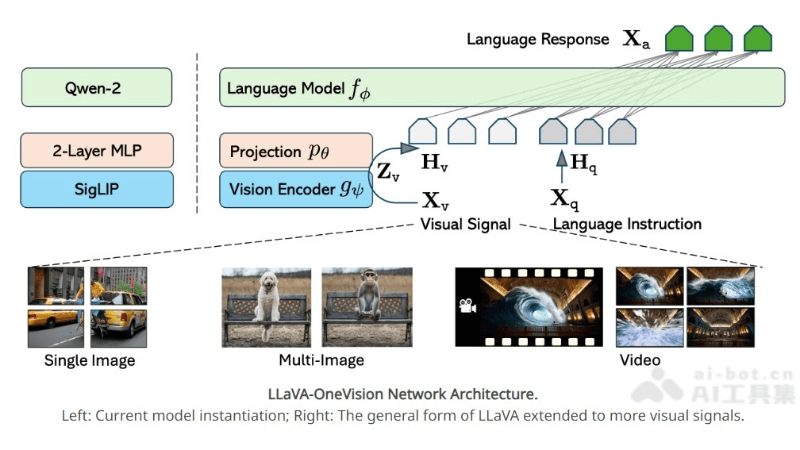
- Multimodal architecture: The model adopts a multimodal architecture that integrates visual information and language information to understand and process different types of data.
- Language model integration: Qwen-2 is selected as the language model. The model has strong language understanding and generation capabilities, and can accurately understand user input and generate high-quality text.
- Visual encoder: Siglip is used as the visual encoder, performing excellently in image and video feature extraction and capable of capturing key information.
- Feature mapping: Visual features are mapped to the language embedding space through a multilayer perceptron (MLP), forming visual tokens and providing a bridge for multimodal fusion.
- Task transfer learning: It allows task transfer between different modalities or scenarios. Through this transfer learning, the model can develop new capabilities and applications.
Project address of LLaVA-OneVision
- GitHub repository:https://llava-vl.github.io/blog/2024-08-05-llava-onevision/
- arXiv technical paper:https://arxiv.org/pdf/2408.03326
How to use LLaVA-OneVision
- Environment preparation: Ensure that there is a suitable computing environment, including hardware resources and necessary software dependencies.
- Obtain the model: Visit the Github repository of LLaVA-OneVision and download or clone the model's codebase and pretrained weights.
- Install dependencies: Install the required dependency libraries according to the project documentation, such as deep learning frameworks (for example, PyTorch or TensorFlow) and other related libraries.
- Data preparation: Prepare or obtain the data you want the model to process, which may include images, videos, or multimodal data, and format the data according to the model's requirements.
- Model configuration: Configure model parameters according to the specific application scenario, involving adjusting the model's input and output formats, learning rate, and other hyperparameters.
Application scenarios of LLaVA-OneVision
- Image and video analysis: Conduct in-depth analysis of image and video content, including object recognition, scene understanding, image caption generation, etc.
- Content creation assistance: Provide inspiration and materials for artists and creators, helping to create multimedia content such as images and videos.
- Chatbots: As chatbots, engage in natural and smooth conversations with users, providing services such as information queries and entertainment interaction.
- Education and training: In the field of education, assist the teaching process, provide visual aids, and enhance the learning experience.
- Security monitoring: In the security field, analyze surveillance videos, identify abnormal behavior or events, and improve the efficiency of security monitoring.