
What is LLaSO
LLaSO (Large Language and Speech Model) is the world's first fully open-source speech model launched by Beijing Deep Logic Intelligence Technology Co., Ltd. It addresses long-standing issues in the field of Large Speech Language Models (LSLM), such as architectural fragmentation, data privatization, limited task coverage, and single interaction modality. LLaSO consists of three core components: LLaSO-Align (a large-scale speech-text alignment dataset), LLaSO-Instruct (a multi-task instruction fine-tuning dataset), and LLaSO-Eval (a standardized evaluation benchmark). It provides unified, transparent, and reproducible infrastructure for LSLM research, driving the field from "going it alone" to "collaborative innovation."
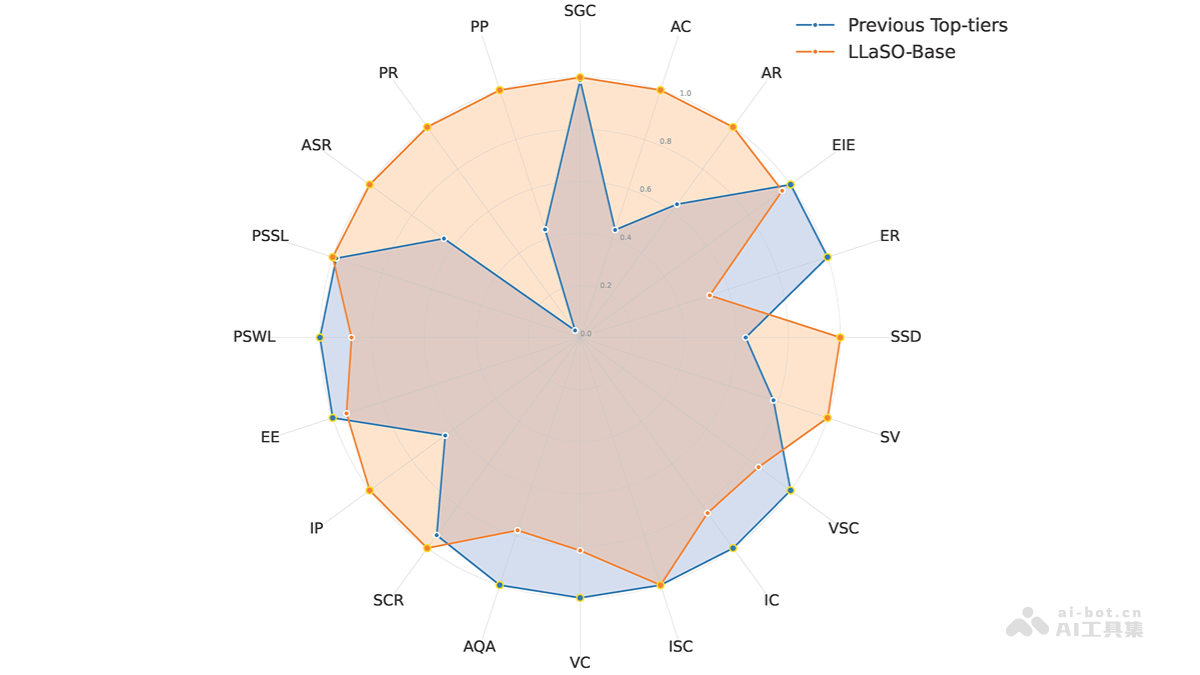
Main Features of LLaSO
- Dataset Provision: LLaSO-Align provides a large-scale speech-text alignment dataset, and LLaSO-Instruct provides a multi-task instruction fine-tuning dataset, offering rich data resources for model training.
- Model Training and Validation: The LLaSO-Base model trained on the LLaSO dataset provides researchers with a performance benchmark, facilitating comparison and validation of different models' performance.
- Standardized Evaluation: LLaSO-Eval provides a standardized evaluation benchmark, ensuring fairness and reproducibility in model evaluation.
- Multimodal Support: Supports multiple modalities such as "text instruction + audio input," "audio instruction + text input," and pure audio interaction, expanding the model's application scenarios.
Technical Principles of LLaSO
- Speech-Text Alignment: Through automatic speech recognition (ASR) technology, speech data is precisely aligned with text data, establishing a mapping relationship between speech representations and the text semantic space.
- Multi-Task Instruction Fine-Tuning: The model is fine-tuned with data from multiple tasks, covering linguistic, semantic, and paralinguistic tasks, enhancing the model's comprehensive understanding and generation capabilities.
- Modality Projection: Techniques such as multi-layer perceptron (MLP) are used to achieve spatial mapping between speech features and text features, enabling the model to process multimodal inputs.
- Two-Stage Training Strategy: First conduct speech-text alignment training, then multi-task instruction fine-tuning, gradually improving the model's performance and generalization ability.
- Standardized Evaluation Benchmark: By designing evaluation benchmarks covering multiple tasks, the model is comprehensively and systematically evaluated, ensuring the objectivity and comparability of evaluation results.
LLaSO Project Address
- GitHub Repository:https://github.com/EIT-NLP/LLaSO
- HuggingFace Model Library:https://huggingface.co/papers/2508.15418
- arXiv Technical Paper:https://arxiv.org/pdf/2508.15418v1
Application Scenarios of LLaSO
- Intelligent Voice Assistants: Used in the development of intelligent voice assistants, such as smart home control, intelligent customer service, in-car voice assistants, etc., enabling device control and information queries through voice commands to enhance user experience.
- Voice Content Creation: Generate voice content such as audiobooks, podcasts, voice advertisements, etc., producing natural and fluent speech based on text content, improving content creation efficiency.
- Education and Learning: Conduct pronunciation practice and oral assessment through voice commands, providing learners with personalized learning experiences to enhance learning outcomes.
- Healthcare: Assist doctors in voice recording and diagnosis, help patients with voice rehabilitation training, improving medical efficiency and patient rehabilitation outcomes.
- Intelligent Customer Service: Provide customer support through voice interaction, understand customer issues and generate accurate responses, improving service efficiency and satisfaction.