
What is LLaMA-Mesh
LLaMA-Mesh is a project jointly launched by Tsinghua University and NVIDIA. It is based on combining 3D mesh generation with large language models (LLMs) to achieve direct text-prompt-basedgeneration of 3D models. The project uses the OBJ file format to convert the vertex coordinates and face definitions of 3D meshes into text. Based on vertex quantization technology for optimized processing, it enables the model to understand and generate 3D meshes. LLaMA-Mesh can generate high-quality 3D meshes while maintaining strong language understanding and generation capabilities, providing a more intuitive and efficient new method for 3D content creation.
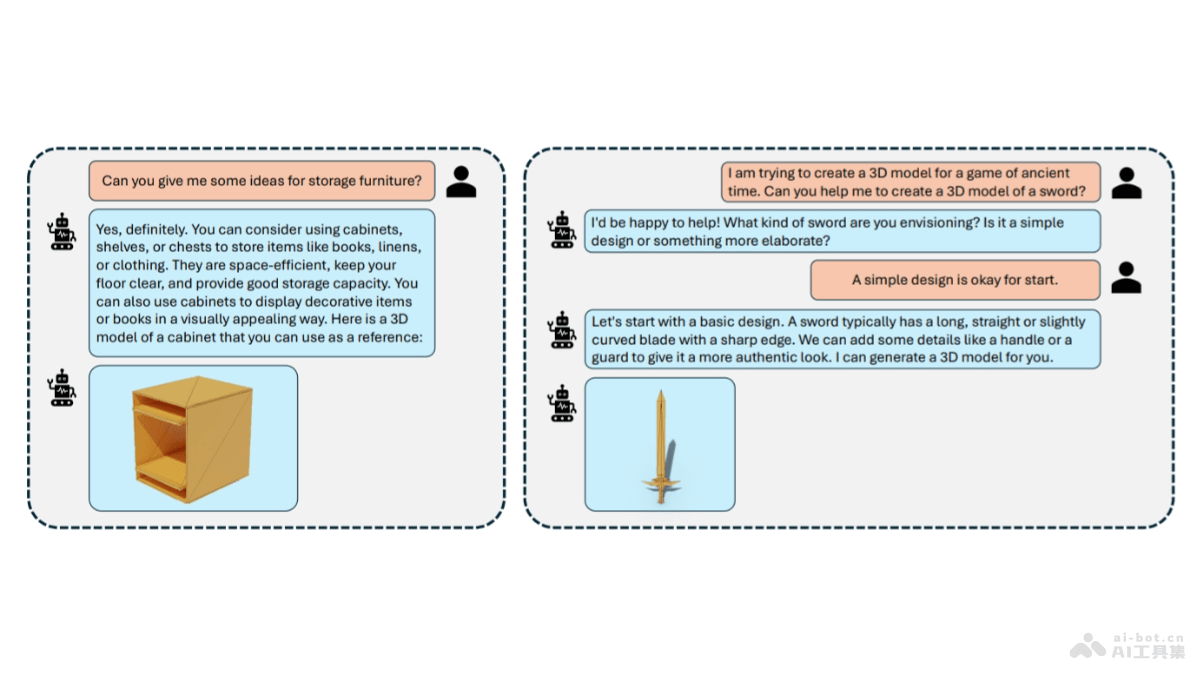
Main features of LLaMA-Mesh
- 3D mesh generation: Generate corresponding 3D mesh models based on text prompts.
- Mesh understanding: Understand and interpret the structure and features of 3D meshes.
- Interleaved text-mesh output: Generate interleaved output of text and 3D meshes in conversations, enabling interactive design.
- Preserve language capabilities: While extending to 3D mesh generation, maintain the model's text understanding and generation capabilities.
Technical principles of LLaMA-Mesh
- 3D representation:
- OBJ file format: Use the OBJ file format to represent the vertex coordinates and face definitions of 3D meshes as plain text, which can be processed by language models.
- Vertex quantization: Quantize vertex coordinates into a fixed number of intervals, reducing the number of tokens, enabling the model to process longer sequences, and preserving geometric details.
- Pretrained model: LLaMA3.1-8B-Instruct uses an instruction-tuned pretrained model, with the ability to understand text prompts and generate 3D meshes.
- 3D task fine-tuning:
- Supervised fine-tuning (SFT) dataset: Build a dataset containing text-3D pairs and interleaved text-3D dialogues, and based on fine-tuning enable the model to master 3D mesh generation skills.
- Rule-based and LLM enhancement: Combine rule-based methods and language-model-based enhancement methods to construct training data, improving the model's 3D understanding and generation capabilities.
- Unified model:
- Unified text and 3D mesh: Generate text and 3D meshes in a unified model, achieving multimodal content generation.
Project address of LLaMA-Mesh
- Project official website:research.nvidia.com/labs/toronto-ai/LLaMA-Mesh
- GitHub repository:https://github.com/nv-tlabs/LLaMa-Mesh
- arXiv technical paper:https://arxiv.org/pdf/2411.09595
Application scenarios of LLaMA-Mesh
- Creative design: Designers can quickly generate 3D models such as furniture, decorations, and artworks, accelerating the transition from concept to prototype.
- Game development: Game developers can quickly generate 3D models such as weapons, props, and characters in games, improving the efficiency and richness of game design.
- Education and training: In the field of education, assist teaching by generating 3D models such as geometric figures, biological structures, and historical artifacts, enhancing students' understanding and learning experience.
- Architecture and engineering: Architects and engineers generate architectural models and engineering components for design verification and visual presentation.
- Virtual reality (VR) and augmented reality (AR): In VR and AR applications, generate realistic 3D scenes and objects, providing an immersive user experience.