
What is Llama 4
Llama 4 is Meta's open-source multimodal AI model series. It is the first to adopt a Mixture of Experts (MoE) architecture, achieving higher computational efficiency during training and inference. Llama 4 currently has two versions: Scout and Maverick. Scout has 17 billion active parameters, 16 "expert" models, 109 billion total parameters, supports a 10 million context, can process over 20 hours of video, and can run on a single H100 GPU, with performance surpassing Gemma 3 and other models. Maverick has 17 billion active parameters, 128 "expert" models, 400 billion total parameters, and excels in precise image understanding and creative writing, making it suitable for general assistants and chat applications, ranking second on the large model LMSYS leaderboard. Llama 4 Behemoth is a preview version, still in training, with 2 trillion parameters and outstanding performance on STEM benchmarks. Llama 4 supports open-source fine-tuning through pre-training on 200 languages, with over 30 trillion tokens of training data.
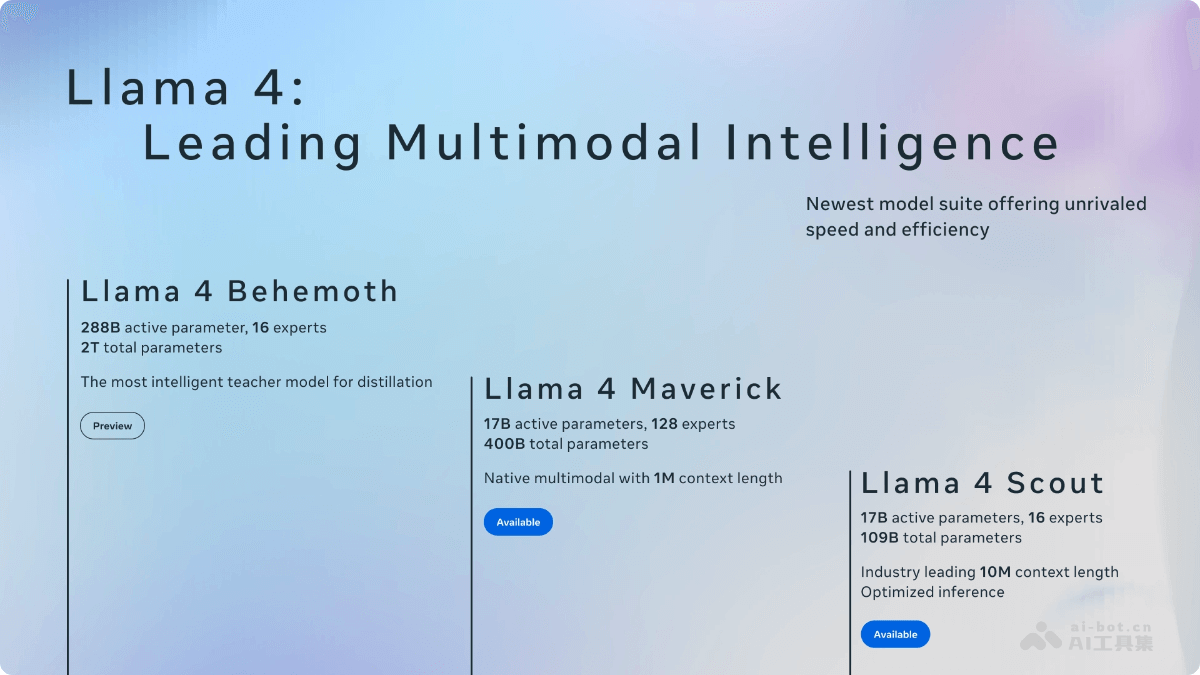
Main features of Llama 4
- Powerful language understanding and generation capabilities: Trained on large amounts of text data, it has precise language understanding. It can generate coherent and logical text, and can be used for creative writing, article writing, dialogue interaction, etc. For example, when creating a story, it can generate rich and vivid story content based on a given theme and plot clues; in dialogue scenarios, it can understand user intent and give appropriate responses.
- Multimodal processing capability: Through training on image data, it has image understanding capabilities, can recognize objects, scenes, colors, and other elements in images, and can describe and analyze image content. The Scout version supports a 10 million token context window, can process text of up to millions of words, and is suitable for tasks such as summarizing long documents and reasoning based on large code repositories.
- Efficient reasoning and computational capability: It adopts a Mixture of Experts (MoE) architecture, dividing the model into multiple "expert" sub-models focused on specific tasks. It is more efficient during training and when answering user queries, can reduce model serving costs and latency, and improves inference efficiency.
- Multilingual processing capability: Through pre-training on 200 languages, it can process and generate text in multiple languages, support cross-language communication and processing tasks, such as language translation, analysis and generation of text in different languages, etc., helping users break down language barriers.
Technical principles of Llama 4
- Mixture of Experts (MoE) architecture: Llama 4 is the first model in the Llama series to adopt the MoE architecture. In MoE models, an individual token only activates a small portion of all parameters. For example, of the 400 billion total parameters in the Llama 4 Maverick model, 17 billion are active parameters. To improve inference efficiency, Meta alternately uses dense layers and MoE layers. The MoE layers use 128 routed experts and one shared expert. Each token is sent to the shared expert and also to one of the 128 routed experts. In this way, only some parameters are activated when running the model, which improves inference efficiency and reduces model serving costs and latency.
- Native multimodal design: Llama 4 is a native multimodal model and adopts early fusion technology, which can seamlessly integrate text and visual tokens into a unified model framework. The model can be pre-trained with massive amounts of unlabeled text, image, and video data together. Meta upgraded Llama 4's vision encoder. The encoder is based on MetaCLIP and is trained separately from a frozen Llama model, allowing better adjustment of the encoder and better adaptation to large language models (LLMs).
- Model hyperparameter optimization: Meta developed a new training method, MetaP, which can more reliably set key model hyperparameters, such as the learning rate and initialization scale for each layer. These hyperparameters adapt well across different batch sizes, model widths, depths, and training token counts.
- Efficient model training: FP8 precision is used, which does not sacrifice quality while ensuring high FLOPs utilization for the model. For example, when pretraining the Llama 4 Behemoth model with FP8 precision and 32K GPUs, it achieved 390 TFLOPs per GPU. The training data contains more than 30 trillion tokens, covering text, image, and video datasets. By continuing to train the model through a "mid-training" approach and using specialized datasets to extend the long context and improve core capabilities, it unlocked a leading 10 million input context length for Llama 4 Scout.
- Post-training process optimization: The training process is lightweight supervised fine-tuning (SFT) > online reinforcement learning (RL) > lightweight direct preference optimization (DPO). To address the problem that SFT and DPO may overly restrict the model, Meta uses a Llama model as a judge, removes more than 50% of data marked as "easy," performs lightweight SFT on the remaining harder data, carefully selects harder prompts in the multimodal online RL stage, and implements a continuous online RL strategy, alternating between model training and data filtering, retaining medium-to-high difficulty prompts, and finally performing lightweight DPO to balance the model's intelligence and conversational ability.
Llama 4 project address
- Project official website:https://ai.meta.com/blog/llama-4
- HuggingFace model library:https://huggingface.co/collections/meta-llama/llama-4
Llama 4 application scenarios
- Dialogue systems: Llama 4 can be used to build intelligent chatbots. For example, Maverick is suitable for general AI assistants and chat applications, can understand user questions and generate natural and fluent answers, provide information, answer questions, engage in casual conversation, and more.
- Text generation: It can perform creative writing, such as creating stories, poems, scripts, etc., and can be used to write news reports, product descriptions, copywriting planning, etc., generating high-quality text according to a given topic and requirements.
- Code generation and assistance: It can help developers generate code, generate corresponding code snippets or complete programs according to functional descriptions, and can provide auxiliary functions such as code explanation, comment generation, and code specification checking, improving development efficiency.
- Code understanding and analysis: Scout can reason based on large codebases, helping developers understand the logic and functionality of complex codebases, and perform code review, vulnerability detection, and other work.
- Image understanding and description: Maverick performs excellently in precise image understanding, can identify elements such as objects, scenes, and colors in images, and describe and analyze image content. For example, when a photo is input, it can describe the photo content, determine the shooting location, and more.
- Information retrieval and recommendation: Combined with its language understanding and generation capabilities, it can be used in information retrieval systems to understand user query intent and provide more accurate search results. It can also make personalized recommendations based on user interests and behavior.