
What is Live Interpreter API
Live Interpreter API is a new feature of Azure SpeechTranslationthat enables real-time multilingual speech translation. Without requiring users to manually set the input language, Live Interpreter API can automatically and continuously recognize the language being used, and can perform low-latency speech-to-speech translation with natural voices while preserving the speaker's style and intonation. Live Interpreter API supports 76 input languages and 143 locales, and is suitable for various scenarios such as international conferences, customer support, online education, etc., greatly promoting the convenience and efficiency of cross-language communication and providing global users with a smoother communication experience.
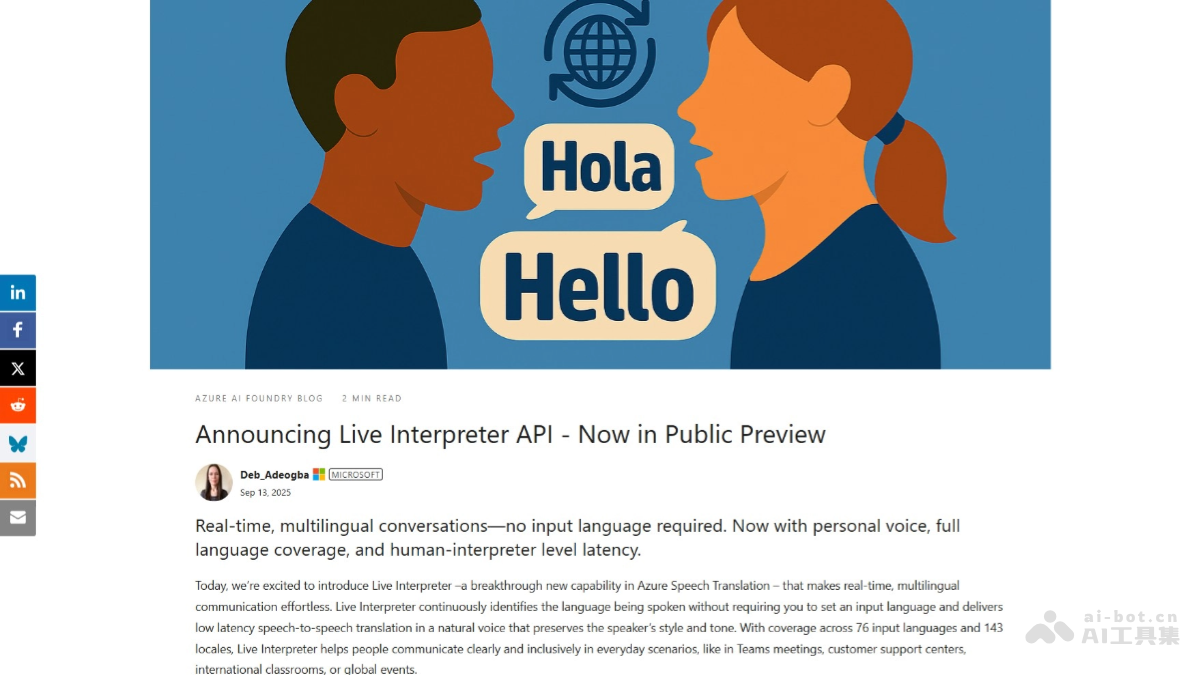
Main features of Live Interpreter API
-
Automatic and continuous language recognition: Without requiring users to manually set the input language, the system can automatically detect and translate, and when the speaker switches languages during a conversation, it can seamlessly recognize and convert.
-
Comprehensive language support: Covering 76 input languages and 143 locales, meeting multilingual needs in different regions and scenarios.
-
Low-latency speech-to-speech translation: Providing real-time translation services, significantly reducing latency, with translation quality approaching the natural conversation level of human interpreters, ensuring smooth communication.
-
Personalized voice output: The translated speech preserves the speaker's style and intonation, including speaking rate, intonation, etc., making the translation result more natural and closer to the original speaker, while also featuring enterprise-grade privacy and consent controls.
How to use Live Interpreter API
- Register and obtain access: Visit the Azure official website https://azure.microsoft.com/注册账户,创建资源获取API密钥和端点。
- Read the official documentation: Carefully read the official documentation of Azure Cognitive Services to understand the detailed parameters, request and response formats, and usage restrictions and requirements of Live Interpreter API.
- Prepare the development environment: Choose a suitable programming language, install the necessary libraries or SDKs, and prepare the development environment for calling the API.
- Write code to call the API: Write code according to the documentation, use the API key and endpoint to make API calls, and implement speech recognition, translation, and synthesis functions.
- Test and optimize: Test API calls in the development environment to ensure normal functionality, and optimize code and parameters based on test results to improve performance and user experience.
- Deploy and monitor: Deploy the application to the production environment, monitor API usage through the Azure portal, ensure it is within the quota range, and adjust resources as needed.
Official project website of Live Interpreter API
- Official project website:https://techcommunity.microsoft.com/blog/azure-ai-foundry-blog/announcing-live-interpreter-api—now-in-public-preview/4453649
Application scenarios of Live Interpreter API
- International conferences and events: At international conferences, seminars, or global events, translate the speaker's speech in real time into the language selected by attendees, enabling everyone to understand and participate in discussions without barriers.
- Online education: In multilingual online classrooms, students can hear course content taught in their native language while preserving the teacher's intonation and rhythm, improving learning outcomes and participation.
- Customer support centers: Multilingual customer support centers can achieve real-time speech translation, allowing customer service representatives to communicate smoothly with customers in different languages without switching language settings, improving customer satisfaction.
- Social commerce live streaming: In livestream e-commerce or social commerce events aimed at a global audience, the host's speech is translated in real time into different languages, preserving brand personality and style and attracting a broader international audience.