
What is Lingua
Lingua is a lightweight and standalone codebase launched by Meta AI, designed to facilitate large-scale training of language models. Built on easily modifiable PyTorch components, it makes it easy for researchers to experiment with new model architectures, loss functions, and datasets. Lingua focuses on end-to-end training, inference, and evaluation, providing tools to optimize speed and stability. The codebase is still under development and provides several application examples demonstrating how to use this codebase. Lingua's design emphasizes simplicity and reusability, supports rapid experimental iteration, and is suitable for scenarios requiring highly customized research.
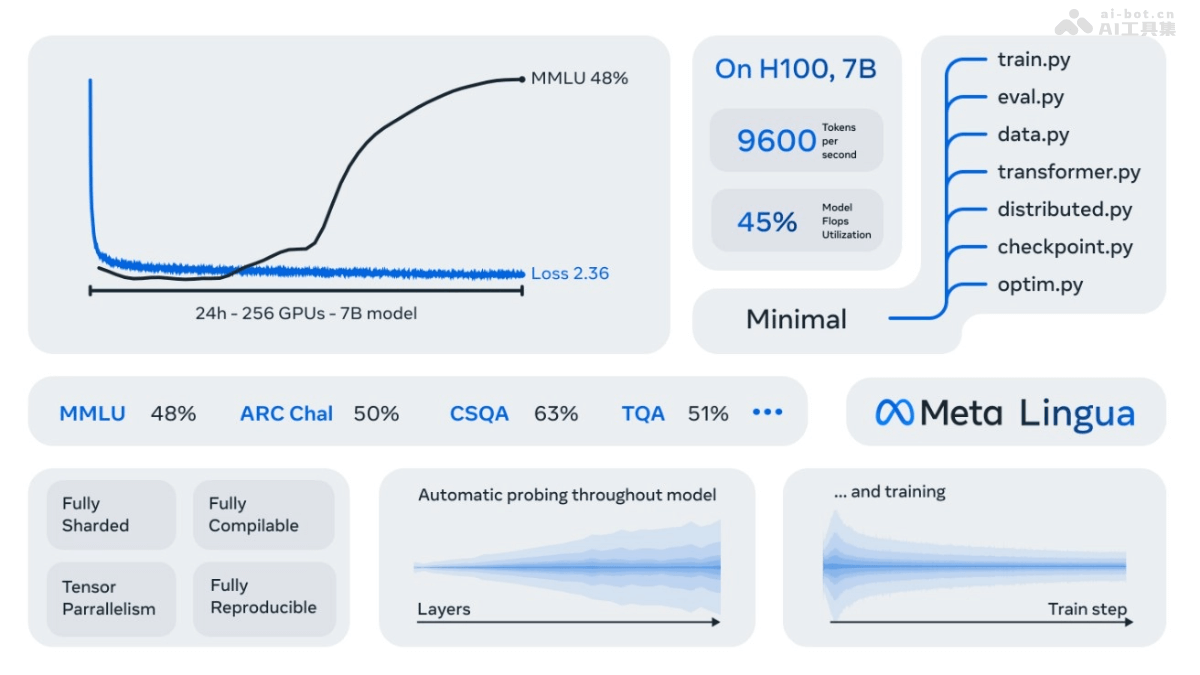
Main Features of Lingua
- Model Training and Inference: Supports end-to-end training and inference of large-scale language models.
- Performance Optimization: Optimizes the performance of model training and inference based on various technical means, such as activation checkpointing and model parallelism.
- Flexibility and Customizability: Uses easily modifiable PyTorch components, making it convenient for researchers to experiment with new model architectures, loss functions, and data.
- Distributed Training Support: Supports distributed training of models on multiple GPUs, improving training efficiency.
- Checkpoint Management: Provides management functionality for model checkpoints, making it convenient to save and restore models.
Technical Principles of Lingua
- Modular Design: Decomposes the training process into modular components, such as data loaders, model architectures, and optimizers, improving the reusability and maintainability of the code.
- PyTorch Integration: Based on the PyTorch framework, it uses dynamic computation graphs and automatic differentiation to simplify the model development and training process.
- Distributed Training Technology: Based on technologies such as data parallelism, model parallelism, and activation checkpointing, it enables efficient training of large models on multiple GPUs.
- Optimizers and Learning Rate Scheduling: Integrates multiple optimizers and learning rate scheduling strategies to adapt to different training needs.
- Checkpoints and Save Format: Uses PyTorch distributed save methods (.distcp format), supporting model saving and loading under different numbers of GPUs and sharding situations.
Lingua's Project Address
- GitHub Repository:https://github.com/facebookresearch/lingua
Application Scenarios of Lingua
- Academic Research: Researchers use Lingua to quickly experiment with and validate new model architectures, training strategies, or optimization algorithms, advancing academic research in the field of natural language processing (NLP).
- Industrial Applications: Enterprises use Lingua to train and deploy customized language models, supporting business needs such as machine translation, text summarization, and sentiment analysis.
- Multilingual Model Development: Lingua supports multilingual data processing and can develop cross-language models, serving globalized applications.
- Model Compression and Optimization: Researchers and engineers use Lingua to experiment with different model compression techniques, such as quantization and pruning, to optimize model size and inference speed.
- Education and Training: Educational institutions use Lingua as a teaching tool to help students understand the construction and training process of language models.