
What Is LingBot-VLA 2.0
LingBot-VLA 2.0 is Ant Lingbo Technology's open-source new-generation embodied intelligence foundation model. Based on 60,000 hours of pre-training data, including 50,000 hours of real-robot data and 10,000 hours of human operation data, it covers 17 brands and 20 robot configurations, and supports multiple degrees of freedom such as single-arm/dual-arm, bipedal/wheeled, as well as head, waist, and chassis. The model adopts a sparse MoE architecture and a unified action space. It leads π0.5 and GR00T N1.7 in both the GM-100 dual-arm evaluation and long-horizon mobile manipulation tasks, with inference latency on an RTX 4090 of less than 130 milliseconds.
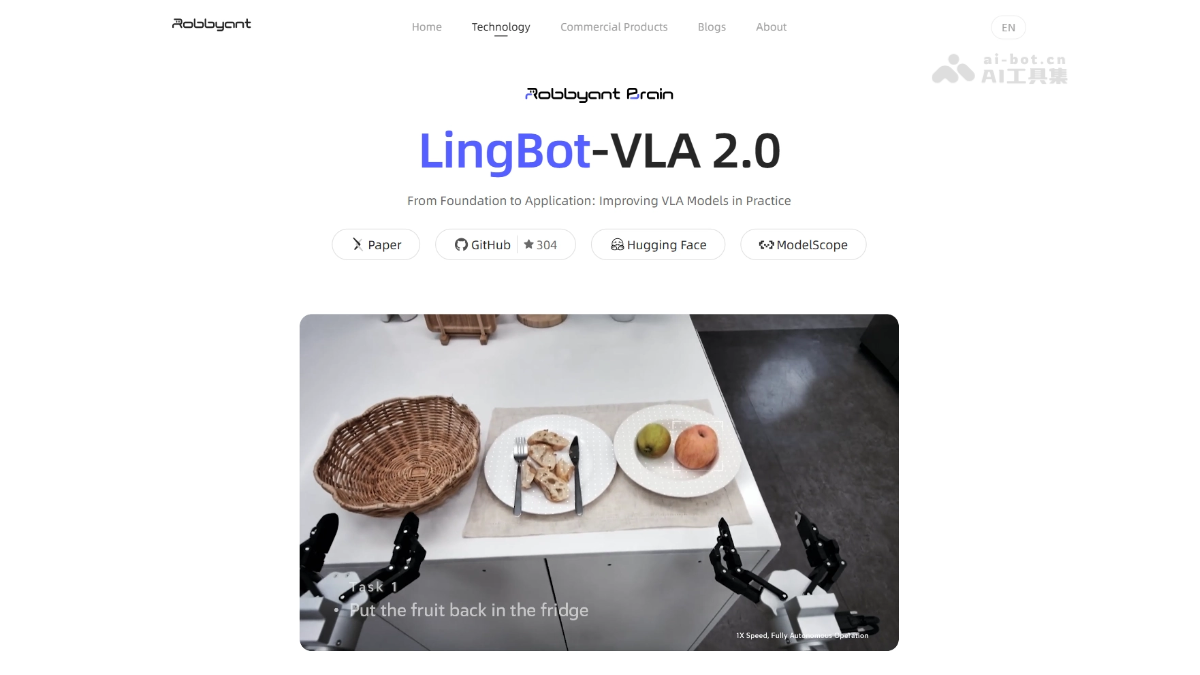
Main Features of LingBot-VLA 2.0
-
20+ Configuration Generalization: Supports 17 brands and 20 robot configurations, covering single-arm, dual-arm, bipedal, wheeled, and other forms.
-
Multi-Degree-of-Freedom Control: Supports whole-body degrees of freedom such as the head, waist, end effectors, chassis, arms, and grippers.
-
Dual-Arm Collaborative Manipulation: Leads competing products in task progress score and success rate in the GM-100 evaluation.
-
Long-Horizon Mobile Manipulation: Supports long-sequence task progression across domain scenarios, such as refrigerator organization and stovetop cleaning.
-
Efficient Inference Deployment: The post-trained version keeps inference latency on an RTX 4090 within 130 milliseconds.
Technical Principles of LingBot-VLA 2.0
- Large-Scale Heterogeneous Data Pre-Training: 60,000 hours of high-quality data were cleaned from 90,000 hours of raw data, of which 50,000 hours came from real-robot operations across 20 robot configurations and 10,000 hours came from first-person human operation videos, covering diverse physical interaction scenarios.
- Unified Action Space Representation: Aligns 20 heterogeneous robot configurations to shared action dimensions such as Arm, EEF, Gripper, Move, Waist, Head, and Hand, enabling scalable cross-embodiment training.
- Sparse MoE Architecture: The model adopts a sparse mixture-of-experts architecture with 1.6B total parameters and 0.6B activated parameters. Under the same activated-parameter budget, both training loss and validation action error are significantly lower than those of the Dense 0.6B model, balancing performance and inference efficiency.
- Dual-Query Distillation Perceptual Prediction: Through the Dual-query Distillation mechanism, it simultaneously predicts current and future RGB, depth maps, and DINO visual representations, enhancing the model's temporal understanding of dynamic environments.
- Multi-Stage Data Cleaning Pipeline: Divides raw data into a robot stream and an egocentric stream, and progressively purifies the training data through stages such as smooth action and state filtering, high-quality video screening, VLM filtering, and hand trajectory reconstruction and standardization.

Follow WeChat and reply “Open Source” to join theAI Open-Source Project Communication Group
How to Use LingBot-VLA 2.0
- Obtain Model Weights: Visit Hugging Face or the ModelScope community to download the LingBot-VLA 2.0 pre-trained model.
- Clone the Open-Source Code: Get the inference and deployment code from GitHub, and read the README to learn about environment dependencies.
- Configure the Robot Body: According to the official list of 20 supported configurations, prepare the corresponding robot hardware and sensors.
- Deploy Inference: Load the model onto an RTX 4090 or an adapted edge computing platform such as Sunrise S600, Jetson Thor/Orin, etc.
- Execute Manipulation Tasks: Send commands to the robot through a unified action interface to complete dual-arm manipulation or long-horizon mobile tasks.
Core Advantages of LingBot-VLA 2.0
-
Strongest cross-embodiment generalization capability: Covers 20 robot embodiments, making it one of the open-source VLA models supporting the most body types in the industry.
-
Leading in both dual-arm and mobile manipulation: Surpasses π0.5 and GR00T N1.7 in both the GM-100 dual-arm benchmark and the cross-domain long-horizon mobile manipulation benchmark.
-
Inference efficiency optimization: The sparse MoE architecture activates only 0.6B parameters for a 1.6B model, with inference under 130ms on an RTX 4090, suitable for edge chips.
-
Comprehensive ecosystem adaptation: Has completed adaptation for mainstream chips such as D-Robotics Sunrise S600 and NVIDIA Jetson Thor/Orin, and has established partnerships with body manufacturers such as Leju and Tita.
Project Addresses of LingBot-VLA 2.0
- Project Website:https://technology.robbyant.com/lingbot-vla-v2
- GitHub Repository:https://github.com/robbyant/lingbot-vla-v2
- HuggingFace Model Library:https://huggingface.co/collections/robbyant/lingbot-vla-v2
- arXiv Technical Paper:https://arxiv.org/pdf/2607.06403
Comparison of LingBot-VLA 2.0 with Similar Competitors
| Comparison Dimension | LingBot-VLA 2.0 | GO-2 |
|---|---|---|
| Developer | Ant Lingbo Technology | AgiBot |
| Model Architecture | Sparse MoE, total parameters 1.6B, activated parameters 0.6B | ViLLA architecture, asynchronous dual system (low-frequency slow system planning + high-frequency fast system execution) |
| Core Innovation | Unified action space + dual-query distillation perception prediction | Action Chain-of-Thought, reasoning and planning directly in the action space |
| Pretraining Data | 60,000 hours (50,000 hours of real robot data + 10,000 hours of human manipulation) | Tens of thousands of hours (relying on the AgiBot World dataset; the GO-1 stage already exceeded one million trajectories) |
| Embodiment Support | 20 robot embodiments, 17 brands (single-arm/dual-arm/biped/wheeled) | Mainly adapted to AgiBot's own bodies (such as G1/G2), with limited cross-brand generalization capability |
| Dual-Arm Manipulation | Leads π0.5 and GR00T N1.7 in both progress score and success rate in the GM-100 benchmark | GM-100 data not publicly available; average success rate of 98.5% on the LIBERO benchmark |
| Long-Horizon Mobile Manipulation | Leads in task progress score and success rate in cross-domain scenarios | Focuses on the planning-execution closed loop; long-horizon mobile generalization data is not clearly public |
Application Scenarios of LingBot-VLA 2.0
-
Retail Services: Completes dual-arm manipulation tasks such as shelf organizing, product picking and placing, and inventory counting in pharmacies, supermarkets, and other scenarios.
-
Logistics and Warehousing: Executes processes such as parcel sorting, cargo handling, and long-horizon mobile loading and unloading, adapted to wheeled mobile bases.
-
Industrial Manufacturing: Completes tasks requiring high precision and multi-degree-of-freedom coordination, such as precision component assembly, tool picking and placing, and equipment inspection.
-
Home Services: Supports daily chores such as refrigerator organization, stovetop cleaning, and articulated object manipulation.
-
Scientific Research and Development: Provides an open-source VLA foundation for universities and research institutions, accelerating embodied intelligence algorithm iteration and embodiment adaptation research.