
What is LingBot-Vision
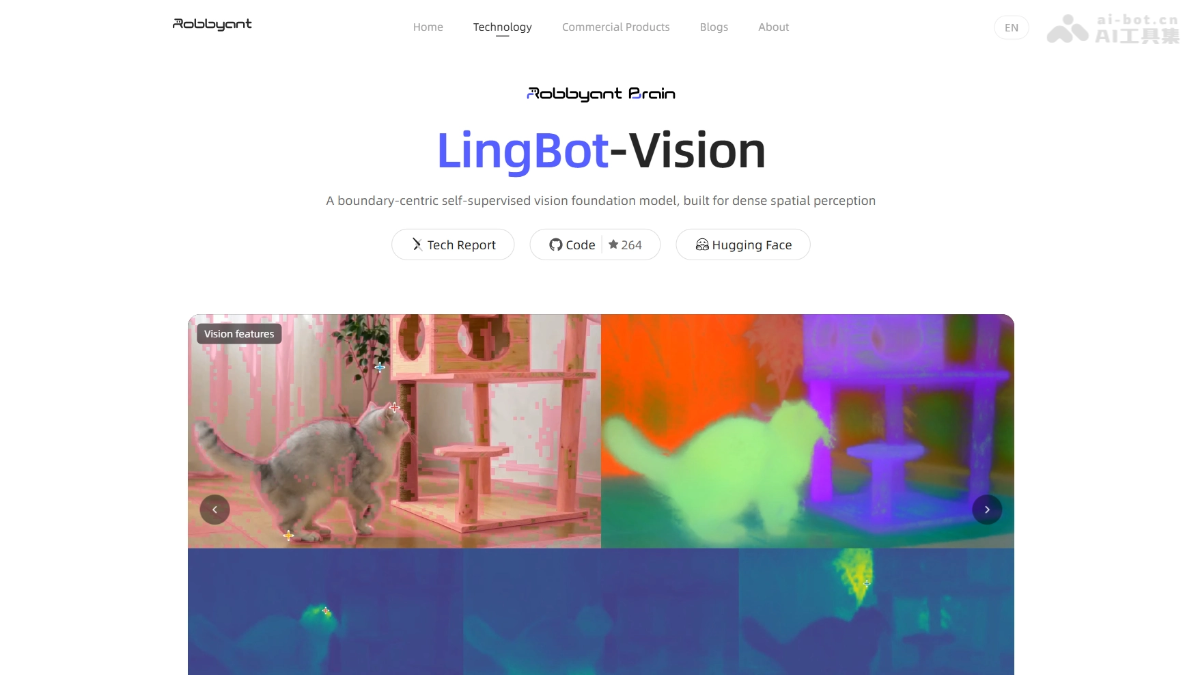
LingBot-Vision is a general-purpose vision foundation model open-sourced by Ant Lingbo Technology. It is the industry's first to use boundary structure as a pre-training objective, adopting a geometric modeling approach to achieve a breakthrough in the spatial perception training paradigm. The model is trained on only 160 million images, possesses sub-pixel-level boundary localization and spatial structure understanding capabilities, supports continuous tracking of object boundaries in videos, and open-sources four versions: ViT-G/L/B/S.
Main features of LingBot-Vision
-
Boundary structure pre-training: The industry's first to use boundary structure as a pre-training objective, achieving a breakthrough in the spatial perception paradigm.
-
Sub-pixel-level boundary localization: Possesses high-precision object boundary recognition and spatial structure understanding capabilities.
-
Continuous video tracking: Can stably and continuously track object boundaries in videos while maintaining temporal consistency.
-
One model, many uses: In addition to supporting depth completion, it possesses general-purpose visual representation and multi-task transfer capabilities.
-
Multi-spec open source: Provides four parameter scales, ViT-G/L/B/S, to suit different deployment needs.
Technical principles of LingBot-Vision
- Breakthrough in the geometric modeling paradigm: Traditional vision foundation models mainly adopt discriminative self-supervised pre-training, learning general-purpose visual representations through contrastive learning or masked reconstruction. LingBot-Vision targets spatial perception needs and is the first to adopt a geometric modeling paradigm, shifting the core of visual understanding from semantic classification to structural parsing, and constructing visual representations oriented toward the physical world by modeling object boundaries and spatial relationships.
- Boundary structure pre-training objective: As the industry's first vision foundation model to establish boundary structure as a core pre-training objective, LingBot-Vision forces the model during pre-training to learn the geometric continuity of object contours, edge curvature variations, and the spatial topological relationships of adjacent surfaces. This gives the model encoder a natural high sensitivity to object boundaries.
- Sub-pixel-level boundary localization mechanism: Through fine-grained geometric supervision signals, LingBot-Vision achieves sub-pixel-level boundary localization capability. The model can distinguish real object edges from texture noise, and can still accurately infer object contours in low-contrast scenarios such as transparent objects and reflective surfaces, completing the 3D structure of regions where traditional depth cameras fail.
- Efficient data training strategy: LingBot-Vision's pre-training corpus is only 160 million images, an order of magnitude smaller than DINOv3. It guides training through structured geometric prior knowledge, proving that under clear physical structure constraints, vision models can learn stronger spatial perception capabilities with less data.

Follow WeChat and reply "open source" to join theAI open-source project communication group
How to use LingBot-Vision
-
Download the model: Visit the HuggingFace or ModelScope repository to obtain the ViT-G/L/B/S version weight files.
-
Read the code: Clone the GitHub open-source repository and view inference examples and API interface documentation.
-
Integrate and deploy: Load the model weights into the vision encoder module, replacing the existing backbone network for forward inference.
-
Fine-tune and adapt: Fine-tune the open-source weights based on downstream task data, and transfer them to specific application scenarios.
Core advantages of LingBot-Vision
-
Efficient training data: The model requires 160 million images for pretraining, an order of magnitude smaller than DINOv3, significantly improving data efficiency.
-
Precise boundary recognition: Recognition of object boundaries and spatial structures is clearer and more stable than mainstream models.
-
Native spatial perception: Geometric modeling designed specifically for spatial perception, breaking through the paradigm of traditional visual foundation models.
-
Stable video tracking: Capable of continuously tracking object boundaries in videos, with excellent temporal consistency.
-
Comprehensive open-source ecosystem: Model weights, technical reports, and code are fully open-sourced, supporting flexible selection across multiple specifications.
Project addresses for LingBot-Vision
- Project official website:https://technology.robbyant.com/lingbot-vision
- GitHub repository:https://github.com/robbyant/lingbot-vision
- HuggingFace model library:https://huggingface.co/collections/robbyant/lingbot-vision
- arXiv technical paper:https://github.com/robbyant/lingbot-vision/blob/main/paper.pdf
Comparison of LingBot-Vision with similar competitors
| Comparison dimension | LingBot-Vision | DINOv3 |
|---|---|---|
| Pretraining objective | Industry-first "boundary structure" geometric modeling | Based on self-supervised discriminative pretraining |
| Training data volume | 160 million images | Approximately 1 billion images |
| Boundary localization | Sub-pixel precision, clearer and more stable recognition | General feature extraction, relatively blurry boundary details |
| Video capability | Supports continuous tracking of object boundaries | Mainly oriented toward static image representation |
| Spatial perception | Natively optimized for spatial perception | General visual representation, not spatial-specific |
Application scenarios of LingBot-Vision
-
Embodied intelligent vision: Provides robots with precise spatial structure and boundary perception capabilities, assisting navigation and manipulation.
-
Depth completion enhancement: As the backbone network of LingBot-Depth 2.0, it improves depth estimation accuracy for transparent/reflective objects.
-
Industrial quality inspection: The model uses sub-pixel-level boundary localization to detect tiny defects and contour deviations in components.
-
Autonomous driving perception: Enhances the stability of recognizing road boundaries and obstacle edges, improving the reliability of environmental understanding.
-
Video content analysis: Continuously tracks target object boundaries in video sequences, supporting security monitoring and behavior analysis.