
What is lingbot-VA
LingBot-VA is the world's first causal video-action world model for general robot control, open-sourced by Ant Lingbo Technology. The model unifies video world modeling and policy learning into an autoregressive framework, enabling robots to simultaneously predict future states and perform precise closed-loop control. The model requires only 30-50 real demonstrations to learn new skills, and significantly outperforms mainstream baseline models in long-horizon tasks, data-efficient post-training, and generalization capability.
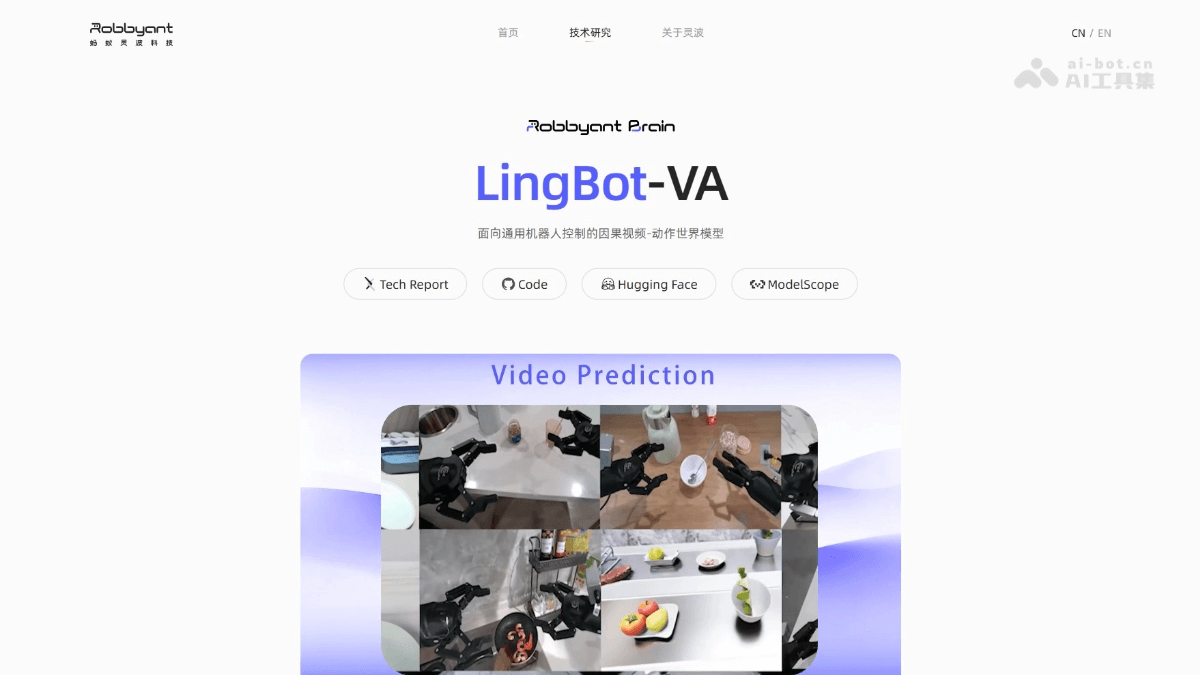
Main Features of lingbot-VA
- Unified Video-Action Modeling: Integrates visual dynamics prediction and action execution into a single framework, enabling closed-loop control that "imagines while acting."
- Long-Horizon Task Execution: The model excels at handling complex tasks that require multi-step planning (such as preparing breakfast or unpacking packages), possesses long-term memory capability, and is not confused by looping states.
- Efficient Post-Training: Only 30-50 real demonstrations are needed to learn new skills, with a success rate about 20% higher than baseline models (such as π₀.₅).
- Cross-Scenario Generalization: The model supports fine manipulation (inserting test tubes, picking up screws), deformable object manipulation (folding clothes), and articulated object control (opening drawers).
Technical Principles of lingbot-VA
- Autoregressive Diffusion Architecture: LingBot-VA adopts an autoregressive diffusion framework that unifies visual dynamics prediction and action reasoning into a single interleaved sequence, enabling the robot to simultaneously reason about future states and perform precise closed-loop control, achieving deep integration of video generation and action decision-making.
- Three-Stage Processing Framework: The framework is divided into three stages: the autoregressive video generation module predicts future frames based on current observations and language instructions; the inverse dynamics model (IDM) decodes specific actions from the predicted video; after executing the actions, the video KV-cache is replaced with real observations, anchoring the model to actual results and forming closed-loop control.
- Inverse Dynamics Model: The IDM can accurately decode actions from predicted videos and demonstrates good generalization capability across different environments and different robot embodiments, serving as a key bridge connecting "imagination" and "execution."
- Real Data Pre-Training: The model is pre-trained on large-scale robot video-action datasets, learning rich visual dynamics to lay a solid foundation for understanding the evolution of the physical world.
lingbot-VA Project Links
- Project Official Website:https://technology.robbyant.com/lingbot-va
- GitHub Repository:https://github.com/Robbyant/lingbot-va
- HuggingFace Model Library:https://huggingface.co/collections/robbyant/lingbot-va
- Technical Paper:https://github.com/Robbyant/lingbot-va/blob/main/LingBot_VA_paper.pdf
Application Scenarios of lingbot-VA
- Long-Horizon Household Tasks: LingBot-VA can perform compound household tasks that require multi-step planning and long-term memory, such as preparing breakfast and unpacking packages.
- High-Precision Industrial Operations: The model is suitable for precision industrial scenarios requiring sub-millimeter control accuracy, such as inserting test tubes and picking up screws.
- Deformable Object Handling: LingBot-VA can handle deformable objects such as folding clothes, understanding material properties and adapting to dynamic deformation processes.
- Articulated Object Interaction: The model supports mechanical structural operations such as opening drawers, and accurately handles constraints and kinematic relationships.
- Few-shot rapid adaptation: The model is particularly suitable for data-efficient scenarios where new skills can be learned with only 30-50 demonstrations.