
What is LingBot-VA 2.0
LingBot-VA 2.0 is the industry's first embodied native world-action model launched by Ant Lingbo. It is pretrained from scratch based on an autoregressive architecture, enabling robots to have general control capabilities of "reasoning while acting." The model adopts a causal DiT + sparse MoE architecture, with a total of 15.3B parameters and only 2.5B activated during inference. It achieves a 93.6% success rate on dual-arm tasks on the RoboTwin 2.0 benchmark and reaches 150Hz inference on a single GPU.
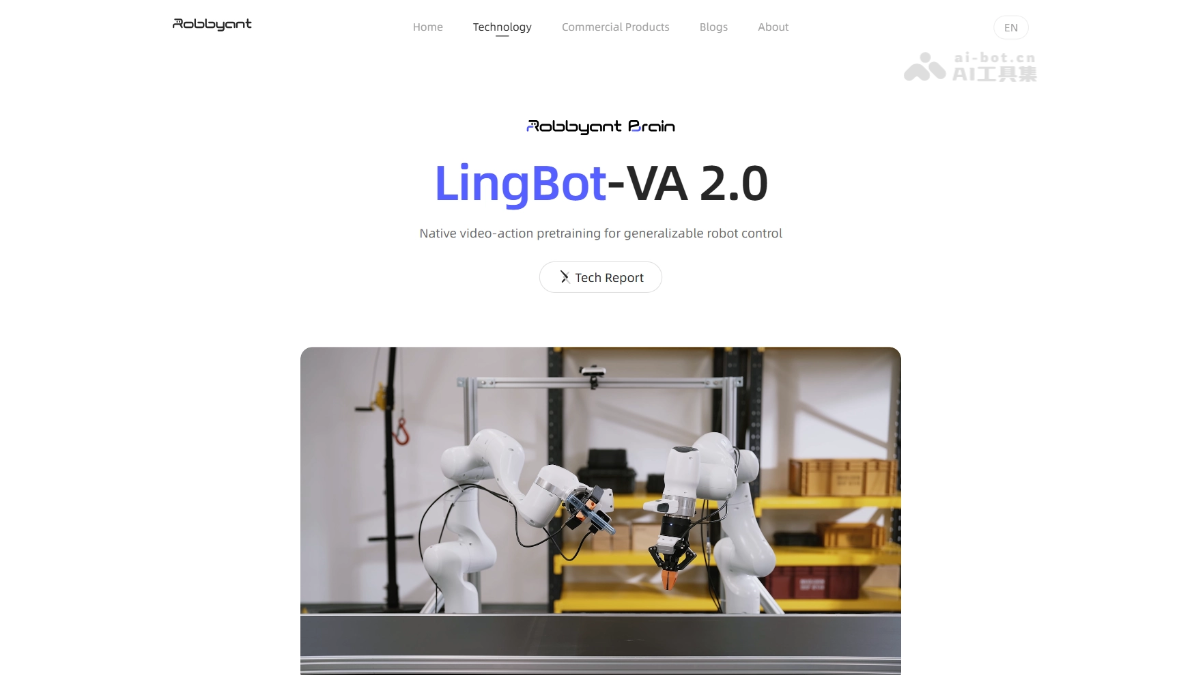
Main features of LingBot-VA 2.0
-
Joint vision-action prediction: Simultaneously generates future world state predictions and the next robot action, enabling "predictive control."
-
Long-horizon task planning: A high-dimensional Planner decomposes complex goals into structured subtasks, supporting dual-arm parallel execution and state memory.
-
Real-time closed-loop control: Foresight Reasoning asynchronous inference precomputes the next step while executing the current action, eliminating serial latency.
-
Cross-domain generalization: Maintains a success rate above 93% in both clean and domain-randomized scenarios, adapting to changes in real environments.
-
Fine manipulation: Supports high-precision force-controlled grasping of thin sheets such as potato chips and fragile objects.
Technical principles of LingBot-VA 2.0
- Semantic vision-action tokenizer: Unlike traditional VAEs that only pursue pixel reconstruction, the tokenizer enforces alignment of semantic and action information during visual compression. Through inverse dynamics and forward dynamics models, it implicitly extracts action supervision from continuous frames, enabling unlabeled internet videos to provide training signals.
- Causal pretraining paradigm: Abandons post-hoc adaptation of bidirectional video generation models and instead trains with an autoregressive causal architecture from day one, ensuring the model learns strictly along a timeline where it can only see the past, naturally matching the unidirectional physical reality of robot closed-loop control.
- Sparse MoE architecture: The video backbone uses Mixture-of-Experts, with about 13B total parameters but only 1.9B activated during inference. Combined with acceleration techniques such as consistency distillation and low-precision compilation, inference latency is reduced from 965ms to 142ms/chunk.
- Foresight Reasoning asynchronous inference: Designs a prediction-execution-correction closed loop. While the robot executes the current action, the model predicts the next step in parallel and recalibrates when real observations return, avoiding physical drift caused by pure imagination. The asynchronous control frequency is increased to 225Hz.
How to use LingBot-VA 2.0
-
Visit the official website: Open https://technology.robbyant.com/lingbot-va-v2 to learn about the model architecture, demo videos, and technical details.
-
Get the code: Visit the GitHub repository to download the open-source code and technical report, and become familiar with the implementation details of causal DiT, sparse MoE, and Foresight Reasoning.
-
Environment deployment: Configure the inference environment on a server or workstation equipped with a high-performance GPU, install dependencies, and load the model weights.
-
Hardware integration: Connect the model to the robot body, link the camera observation stream and the robotic arm/gripper actuators, and ensure real-time input of sensor data.
-
Configure the asynchronous pipeline: Enable the Foresight Reasoning asynchronous inference mechanism so that the model predicts the next state in parallel while executing the current action chunk.
-
Closed-loop calibration: Set up a real observation feedback channel so that the model recalibrates its predictions each time a new observation returns, avoiding physical drift.
-
Task Adaptation: To perform a new task, collect a small amount of robot operation data and perform efficient fine-tuning based on pretrained weights.
Core Advantages of LingBot-VA 2.0
-
Embodied Native: From architecture and data to training objectives, everything is tailor-made for the physical world, rather than fine-tuning a digital video generation model.
-
Real-Time and Efficient: 150Hz inference on a single GPU, meeting the needs of real-time closed-loop control.
-
Causal Consistency: Strict unidirectional temporal modeling, avoiding action precision loss and catastrophic forgetting caused by bidirectional attention.
-
Data Efficient: The MCP multi-step prediction objective accelerates training convergence by 2.3x, reducing dependence on robot annotation data.
-
Full-Stack Collaboration: Forms a complete perception-prediction-execution closed loop with LingBot-Depth, LingBot-VLA, LingBot-Video, etc.
Project Address of LingBot-VA 2.0
- Project Official Website:https://technology.robbyant.com/lingbot-va-v2
- Technical Paper:https://github.com/Robbyant/lingbot-va/blob/main/LingBot_VA2_paper.pdf
Comparison of LingBot-VA 2.0 with Similar Competitors
| Dimension | LingBot-VA 2.0 | ACE-Ego |
|---|---|---|
| Publisher | Ant Lingbo | Daxiao Robotics × CUHK MMLab |
| Model Positioning | Embodied native world action model (VA) | "One brain, multiple embodiments" embodied manipulation VLA model |
| Architecture Route | Autoregressive causal DiT + sparse MoE | Qwen3-VL-4B + Flow-Matching Diffusion Action Expert |
| Pretraining Method | Embodied native pretraining from scratch, not relying on digital video generation models | Joint pretraining with mixed human first-person videos + robot/simulation data |
| Core Mechanism | Foresight Reasoning asynchronous inference, semantic visual-action tokenizer | Camera-space action alignment, morphology-conditioned encoding, temporal alignment chunking, reliability-aware loss |
| Total Parameters / Activated Parameters | 15.3B / 2.5B (sparse activation) | VLM 4B + Action Expert about 600M (fully activated) |
| Inference Speed | Single GPU 150Hz (asynchronous 225Hz) | Specific frequency not disclosed, relies on 4-step flow-matching decoding |
| RoboTwin 2.0 Average Success Rate | 93.6%(Clean 93.8% / Randomized 93.4%) | Easy 91.12% / Hard 90.62% |
Application Scenarios of LingBot-VA 2.0
-
Home Service Robots: Execute long-horizon household tasks such as table organization, item placement, and tableware arrangement, using long-horizon memory and dual-arm coordination to complete complex daily operations.
-
Industrial Dynamic Grasping: Perform real-time grasping of moving targets on conveyor belts and assembly lines; the model predicts the future position of objects and synchronizes action rhythm, replacing traditional photoelectric trigger solutions.
-
Precision Assembly Operations: Complete flexible force-controlled grasping and assembly of chips, thin sheets, and fragile components, relying on fine-grained visual servoing to protect material integrity.
-
Human-Machine Interactive Entertainment: Support high-frequency interactive scenarios such as ice hockey matches and tabletop games that require real-time prediction of the opponent's actions, achieving millisecond-level response and strategy adjustment.
-
Warehousing and Logistics Sorting: Perform goods sorting, handling, and palletizing in dynamically changing warehousing environments, adapting to generalized grasping needs for packages of different sizes and shapes.