
What is Ling-3.1-flash
Ling-3.1-flash is a new-generation large model launched by the Bailing team of Ant Group, with a total parameter count of approximately 560B, 25B activated per token, and a context window of up to 1M. Ling-3.1-flash adopts a hybrid linear architecture and is designed for real-world long-horizon tasks, capable of continuously completing office reports, medical consultations, code compilation, and performance optimization for several hours. Ling-3.1-flash has been integrated into Ant's internal desktop Agent client "Xiaohu".
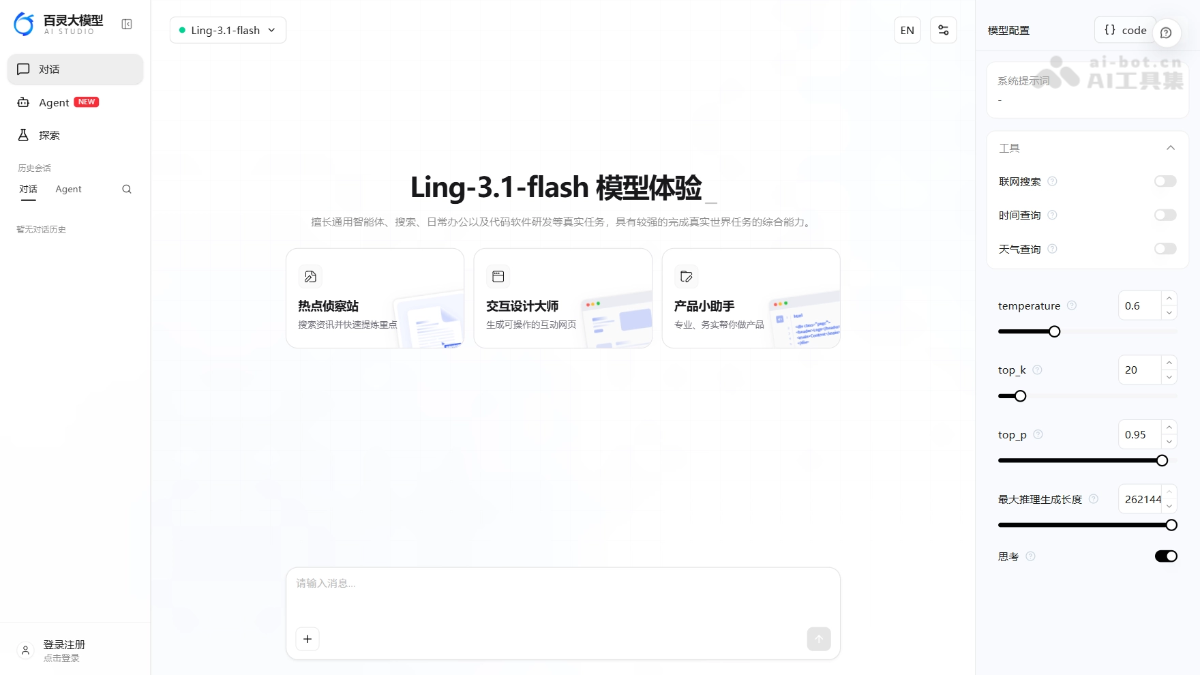
Main features of Ling-3.1-flash
- Daily office work: Automatically breaks down tasks from a vague one-sentence request, integrates materials, and generates deliverables such as research reports, Excel spreadsheets, and PPTs.
- Medical communication: Converts scattered patient symptom descriptions into actionable suggestions such as visit checklists, interpretation of examination indicators, and medication follow-up.
- Software development: Continuously performs problem localization, code modification, test verification, and iterative fixes in a codebase for several hours.
- Security analysis: Autonomously completes vulnerability discovery, root cause localization, PoC construction, and patch generation.
- Web/mobile/3D development: Generates marketing web pages, App interfaces, SVG vector assets, and Three.js 3D interactive demos.
Technical principles of Ling-3.1-flash
- Hybrid linear Attention architecture: Continues the hybrid architecture of Ling-3.0-flash and increases the proportion of linear layers, composed of 7 layers of KDA paired with 1 layer of Gated MLA, enabling the model to still control the per-step computation under a 1M context.
- MoE sparse activation: Sets up 512 routed experts; each token selects 8 routed experts and invokes 1 shared expert, driving 560B total parameters with approximately 25B activated parameters, controlling inference cost while retaining model capacity.
- Long-horizon task loop: Connects requirement clarification, task planning, tool invocation, intermediate result validation, and path correction in the same workflow, enabling the model to keep goals and historical information consistent during hours of execution rather than restarting each round of dialogue.
- Scenario-based RLVR alignment training: For vertical scenarios such as healthcare, performs reinforcement learning alignment based on real demand feedback from applications such as Afu and Haodf, focusing on improving professional expression and multi-turn communication capabilities.
How to use Ling-3.1-flash
-
Access the experience entry point: Open the Ling Studio official website https://chat.ant-ling.com/chat or the Ant Digital Technologies MaaS platformhttps://maas.antdigital.com/models/modelservice-1790229240754001388对应模型页面。
-
Confirm free experience eligibility: Use directly during the two-week free experience period, during which the context length is limited to 256K.
-
Directly describe the task requirement: No need to write complex instructions; simply describe the goal clearly in natural language, for example, "Help me organize materials for a certain industry and generate a research report and PPT."
-
Choose a suitable way to use it: For single-turn tasks, directly describe the requirement in the dialog box; for Agent-type long tasks, it is recommended to use it with harnesses such as Claude Code, OpenCode, or Pi first.
-
Follow up on intermediate results and provide feedback: Based on the model's intermediate outputs, supplement information or adjust direction in a timely manner; the model will combine the feedback to correct its path and improve the deliverables.
Core advantages of Ling-3.1-flash
- Ultra-long context: Supports a 1M context window, capable of holding long documents, large codebases, and complete task histories in one go, reducing the work of manually splitting information.
- Long-horizon task capability: Can maintain task state and autonomously push forward continuously for hours, such as implementing a native Lua compiler from scratch in about 17 hours.
- Sparse activation with high cost-effectiveness: With 560B total parameters but only about 25B activated, combined with a hybrid linear architecture, it strikes a balance between model capacity and inference cost.
- Strong performance on complex engineering tasks: The Pyright optimization implementation achieved a 1.432x speedup with all 2279 tests passing, and the Rust rewrite of a C image library achieved an 8.015x speedup.
- Full-workflow office delivery: Starting from a vague one-sentence request, it automatically completes information retrieval, data analysis, and produces usable outputs such as reports, Excel files, and PPTs.
- Medical professional communication capability: Through RLVR scenario-based alignment training, it can transform scattered symptoms into a medical visit checklist and clear risk explanations.
Comparison of Ling-3.1-flash with similar competitors
| Comparison dimension | Ling-3.1-flash | Claude Fable 5 |
|---|---|---|
| Context window | 1M (256K during the free period) | 200K |
| Lua compiler task | 97.8% (178/182 tests passed) | 99.0% |
| Pyright performance optimization | 1.432x speedup | 1.502x speedup |
| Rust rewrite of C image library | 8.015x speedup | 27.310x speedup (clearly ahead) |
| Medical evaluation | HealthBench Professional 65.35 (leading among flash models in the same tier) | No specific score listed in the text |
| Office evaluation | GDPVal-AA V2.1 Elo 1673 (the text says it closely follows Claude Opus 5's 1708) | No direct comparison |
| Open-source plan | Plans to open source after the paid version launches | Closed source |
| Access cost | Free trial for two weeks, then paid | Paid subscription |
Application scenarios of Ling-3.1-flash
- Daily office automation: Integrates materials scattered across web pages, documents, and spreadsheets into research reports, data tables, and presentation PPTs, directly delivering a set of outputs from a vague one-sentence request.
- Medical and health management: Clarifies symptoms, organizes medical history, interprets examination reports, transforms scattered discomforts into a medical visit checklist, and provides actionable advice on medication and follow-up visits.
- Software development and debugging: Understands unfamiliar codebases, establishes test baselines, locates and fixes issues, and supports hours-long continuous iteration, such as implementing a Lua compiler and optimizing Pyright performance.
- Security vulnerability analysis: Autonomously completes ultra-long-horizon vulnerability discovery, root cause localization, PoC construction, and patch generation, and has fixed a high-risk stack overflow vulnerability in real-world practice on the open-source version of OceanBase.