
What is Ling-3.0-tiny
Ling-3.0-tiny is a native hybrid reasoning model launched by Ant Ling, with 7.9B total parameters and only 1.3B activated per token, optimized for mathematical reasoning, instruction following, and resource-sensitive deployment. The model natively supports tool calling and can handle mobile device and browser UI automation control tasks, supporting fully local inference. It is currently available on OpenRouter and Vercel. Its open-source base, Ling-3.0-tiny-base (7.9B total parameters / 1.3B activated), retains the original pre-training capabilities, providing researchers with a lightweight and malleable open starting point for low-cost code training, reinforcement learning post-training, and MoE ablation experiments.
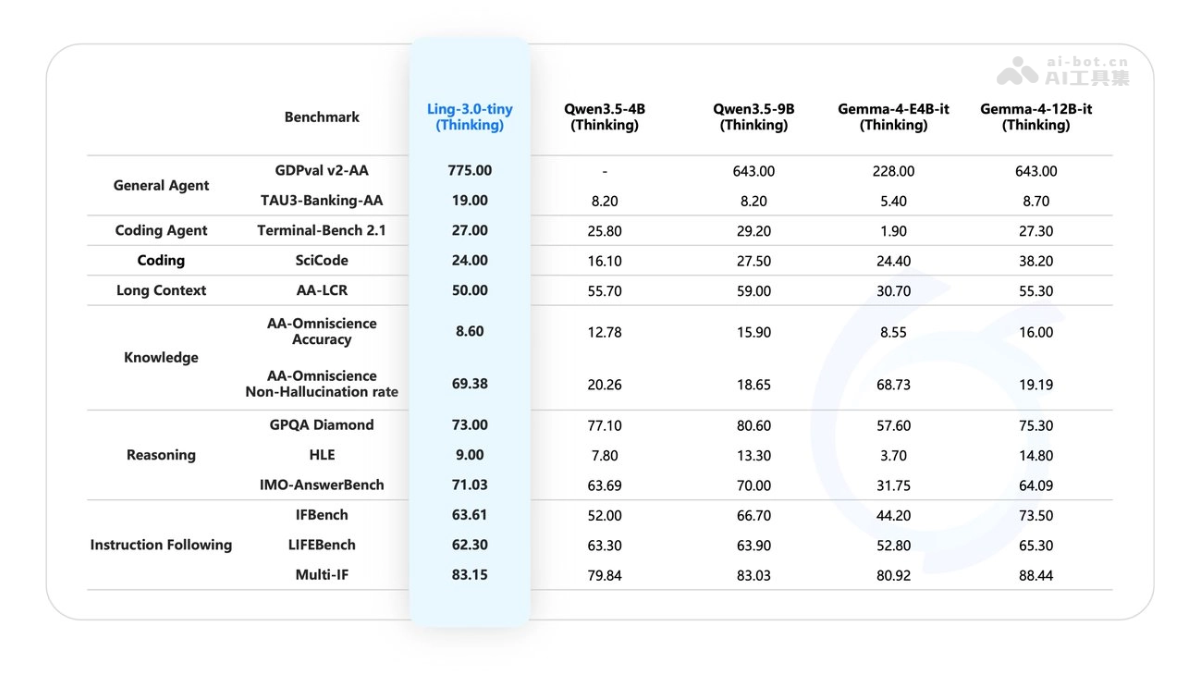
Main Features of Ling-3.0-tiny
-
Hybrid Reasoning Architecture: 7.9B total parameters, with only 1.3B activated per token, achieving efficient computation on mathematical reasoning and instruction following tasks.
-
Native Tool Calling: Built-in tool usage capabilities, able to directly drive browser UI control and mobile device automation operations.
-
Fully Local Inference: Can run without cloud dependencies; after integrating obsidian-cli, it can retrieve, organize, and generate content from a local text library.
-
Lightweight Text Generation: Provides low-latency text generation services for high-frequency scenarios such as local web page translation and daily task processing.
Technical Principles of Ling-3.0-tiny
-
Sparse Mixture-of-Experts Architecture (MoE): The model has 7.9B total parameters, but through a gated routing mechanism, only about 1.3B parameters are activated per token, compressing inference computation to the level of a dense small model while maintaining the expressive capability of a large model.
-
Native Hybrid Reasoning Path: Built-in multiple differentiated reasoning channels that can dynamically select lightweight fast responses or deep chain-of-thought paths based on task complexity, balancing mathematical reasoning accuracy with the response speed of daily instruction following.
-
Gated Routing and Load Balancing: Uses a learnable router to assign the optimal expert subset to each token, supplemented by a load balancing loss function to prevent expert collapse and ensure the 7.9B parameter space is utilized efficiently and evenly.
-
Native Embedding of Tool Calling: Directly encodes tool usage patterns into the model's representation space during pre-training or alignment, enabling the model to generate call instructions conforming to tool interface specifications without external plugins, achieving automated control of browser UI and mobile devices.
-
On-Device Deployment Optimization: Performs quantization compression and KV-Cache memory optimization for local inference scenarios, supports fully offline operation on consumer-grade hardware, eliminating cloud dependencies and reducing the network and compute overhead of high-frequency API calls.
How to Use Ling-3.0-tiny
-
Access the Platform: Visit the OpenRouter official website (https://openrouter.ai)或 Vercel AI Gateway page.
-
Select the Model: Search for and enter the inclusionai/ling-3.0-tiny:free model details page.
-
Obtain Permissions: Register or log in to an account, and directly obtain an API key and call the service during the free trial period.
-
Wait for Open Source: Follow Ant Ling's official channels, and after the weights are open-sourced, download the model files for local deployment.
-
Integrate Tools: Configure obsidian-cli or a browser automation plugin to enable local knowledge retrieval and UI control functions.
Core advantages of Ling-3.0-tiny
-
Extremely lightweight: Runs with only 1.3B activated parameters, with inference cost and GPU memory usage far lower than dense models of the same scale, suitable for on-device and edge deployment.
-
Privacy first: Supports fully local operation, with data never leaving the device, meeting the extremely high data security requirements of scenarios such as finance and healthcare.
-
Native tools: Can call external tools without additional fine-tuning or plugins, lowering the development threshold for automation workflows.
Project address of Ling-3.0-tiny
- HuggingFace model repository:https://huggingface.co/inclusionAI/Ling-3.0-tiny-base
Comparison of Ling-3.0-tiny with similar competing products
| Dimension | Ling-3.0-tiny | Qwen2.5-7B-Instruct |
|---|---|---|
| Architecture | Native hybrid inference (7.9B/1.3B activated) | Dense architecture (7B fully activated) |
| Inference cost | Only 1.3B activated per token, extremely low | 7B fully activated, relatively high |
| Tool calling | Native support | Support |
| Local optimization | Deeply optimized for on-device and high-frequency API scenarios | General-purpose local deployment |
| Open-source status | Weights to be open-sourced soon | Already open-sourced |
Application scenarios of Ling-3.0-tiny
-
Mobile device intelligent assistant: Performs translation, Q&A, and schedule management offline on mobile devices, responding without an internet connection.
-
Browser automation: Automatically performs web form filling, information scraping, and UI interaction tasks through native tool calling.
-
Local knowledge management: Integrates obsidian-cli to build a fully private knowledge base, enabling local document retrieval and intelligent summarization.
-
Enterprise edge deployment: Deployed on industrial computers or intranet environments to provide compliant AI services on resource-constrained devices.
-
High-frequency lightweight services: Serves as a resident background interface to handle high-frequency requests such as web translation and content generation, significantly reducing computing costs.