
What is Ling 3.0 Flash
Ling-3.0-Flash is a lightweight MoE reasoning model launched by Ant Group's Ling large model. It has a total parameter count of 124B, activates 5.1B parameters per token, and supports a 256K ultra-long context along with dual thinking/non-thinking modes. The model is designed for high-frequency Agent workflows, coding Agents, document processing, and long-context multi-turn conversations. It emphasizes completing more effective work within limited token, latency, and cost budgets, achieving production-grade token-efficient reasoning. Its corresponding open-source base, Ling-3.0-flash-base (124B total parameters / 5.1B activated), retains the original pre-training capabilities, providing an open starting point for continued training and expansion toward large codebases, multi-step reasoning, and domain-specific Agent tasks.
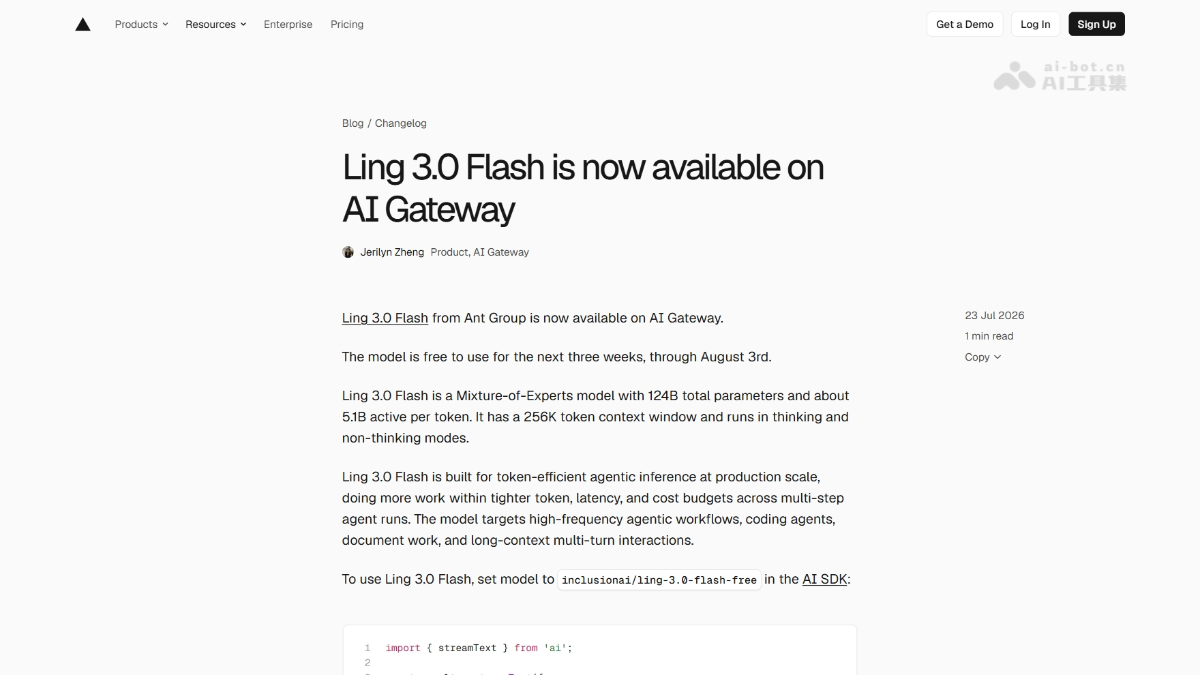
Main features of Ling 3.0 Flash
-
Dual-mode reasoning: Supports two modes, thinking (deep thinking) and non-thinking (fast response), flexibly switching between reasoning depth and response speed.
-
Ultra-long context processing: Supports a 256K token context window, capable of processing long documents, multi-turn conversations, and complex codebases in one pass.
-
Agent workflow support: Natively adapted for multi-step Agent operation, supports tool calling and implicit caching, improving task execution efficiency.
-
Token-efficient reasoning: The MoE architecture activates only 5.1B parameters, significantly reducing inference cost and latency while maintaining performance.
-
Unified API access: One-click invocation via Vercel AI Gateway, supporting streaming output and multi-provider routing.
Technical principles of Ling 3.0 Flash
- Mixture-of-Experts architecture (MoE): Adopts a sparsely activated Mixture-of-Experts architecture, with a total parameter count of 124B, but only about 5.1B parameters activated per token. Through a gating network that dynamically routes inputs to specific expert subnetworks, it greatly reduces computational overhead and inference cost while maintaining the expressive capability of a large model, achieving decoupling of parameter scale and inference efficiency.
- Dual-mode reasoning mechanism: Built in with two reasoning paths, thinking and non-thinking. Non-thinking mode directly outputs results, suitable for high-frequency, low-latency scenarios; Thinking mode activates a deep reasoning chain, improving accuracy on complex tasks through multi-step internal thinking. The two modes share underlying parameters and switch via control signals, without needing to load separate models.
- Ultra-long context modeling: Supports a 256K token context window, using optimized positional encoding and attention mechanisms to process ultra-long sequences. Combined with an implicit caching strategy, it reuses previously computed KV caches in multi-turn Agent interactions, avoiding repeated encoding and significantly reducing overall latency for long conversations and multi-step tasks.
- Token-efficient Agent reasoning: Optimizes reasoning paths for Agent workflows, completing multi-step tool calls and decisions within strictly limited token, latency, and cost budgets. By compressing intermediate representations and streamlining reasoning steps, it ensures responsiveness and cost-effectiveness in high-frequency Agent scenarios, enabling sustainable deployment at production scale.
How to use Ling 3.0 Flash
- Obtain weights via Hugging Face: Visit https://huggingface.co/inclusionAI/Ling-3.0-flash to download the model weight files. The model uses the MIT license and can be freely used commercially.
- Deploy the service with SGLang: Refer to the official SGLang deployment instructions to configure the inference environment, and integrate the HiCache caching architecture to reduce first-token latency for long tasks.
- Deploy the service with vLLM: Set up an OpenAI-compatible API service according to the official vLLM deployment documentation, making it easy to integrate with the existing application ecosystem.
Core Advantages of Ling 3.0 Flash
-
Latency Optimization: Designed for high-frequency scenarios, with excellent P50 first-token latency and throughput performance.
-
Production-Grade Stability: Supports automatic retries, failover, and availability guarantees higher than those of a single provider.
-
Privacy Compliance: Built-in Zero Data Retention support, meeting enterprise security requirements.
-
Ecosystem Compatibility: Seamlessly integrates into the Vercel development ecosystem and works with existing AI SDKs.
Project Address of Ling 3.0 Flash
- HuggingFace Model Repository:
- https://huggingface.co/inclusionAI/Ling-3.0-flash
- https://huggingface.co/inclusionAI/Ling-3.0-flash-base
Comparison of Ling 3.0 Flash with Similar Competitors
| Dimension | Ling-3.0-Flash | GPT-4o-mini |
|---|---|---|
| Architecture | MoE (124B/5.1B activated) | Dense |
| Context | 256K | 128K |
| Positioning | Agent reasoning, code, long documents | General-purpose lightweight conversation |
| Cost Strategy | Free for a limited time, then pay-as-you-go | Pay-as-you-go |
| Access Method | Vercel AI Gateway | OpenAI API |
| Features | Dual-mode reasoning, implicit caching | Multimodal input |
Application Scenarios of Ling 3.0 Flash
-
Intelligent Customer Service Agent: Uses 256K context to remember user history and handle multi-turn complex inquiries and ticket processing.
-
Code-Assisted Development: Quickly understands large codebases, generates, refactors, and reviews code, and supports thinking mode for in-depth debugging.
-
Long Document Analysis: Processes ultra-long texts such as papers, financial reports, and legal contracts in one pass, extracting key information and generating summaries.
-
Automated Office Workflows: Connects calendars, email, and document tools to automatically complete scheduling, email drafting, and data organization.
-
Real-Time Search Enhancement: Combines Web Search capabilities to perform multi-step information retrieval, cross-validation, and structured report generation.