
What is Ling-3.0-flash-VL
Ling-3.0-flash-VL is the first open-source native multimodal large model in Ant InclusionAI's Bailing series, built on Ling-3.0-flash expanded from the MoE architecture, with 124B total parameters and only 5.5B activated per inference, native support for image-text and video input, and a context window of 256K tokens. Ling-3.0-flash-VL enables the model to observe, act, and verify and correct like a human, turning tasks from one-shot generation into reliable continuous delivery.
Main features of Ling-3.0-flash-VL
-
Real-time visual interaction: Open the camera to watch and chat at the same time; it can recognize animals, plants, landmarks, and car models and translate foreign-language signs in real time.
-
Visual feedback programming: Generate front-end code from webpage screenshots and self-correct against the rendered results to reproduce webpages.
-
GUI Agent: Recognize interface structures and operation states, and complete tasks across tools, such as checking webpage data, organizing Excel, and generating charts.
-
Medical report interpretation: Extract cross-page and cross-period indicators such as blood routine, biochemistry, and imaging, and display health risks with red, yellow, and green lights.
-
Real-time learning companion: In course videos, combine the visuals to recognize formula board writing, answer questions instantly, and generate exercises.
-
Long-video highlight editing: Perform "locate → clip → verify → correct" on hour-long match videos and automatically compose highlight reels.
Technical principles of Ling-3.0-flash-VL
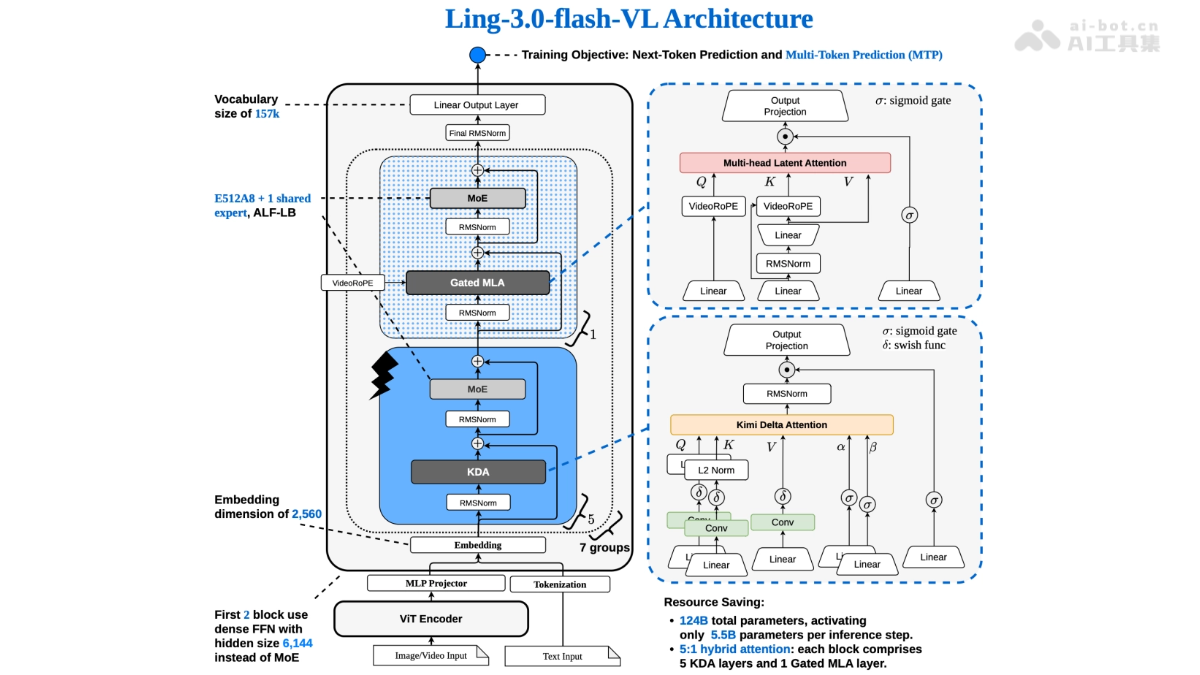
- MoE efficient sparse architecture:The model is expanded from Ling-3.0-flash, with 124B total parameters and only 5.5B parameters activated per inference, greatly compressing compute overhead while ensuring capability, making it suitable as a high-frequency execution node in Agent workflows.
- Native multimodal joint training:Images, text, and video are jointly optimized in the same training, rather than first training text and then attaching a visual module. Practice has shown that introducing visual information not only did not lower text capabilities, but instead brought a 4-point improvement on the Artificial Analysis Intelligence Index.
- Arbitrary-resolution visual encoding and VideoRoPE: Introduces an arbitrary-resolution visual encoder to handle image-text inputs of different sizes, and works with VideoRoPE positional encoding to understand native video without downgrading video into image sequences by frame splitting.
- KDA and Gated MLA hybrid language backbone: The language part continues the 42-layer hybrid architecture, alternating the linear attention mechanism KDA and the gated version of MLA at a 5:1 ratio, balancing long-context efficiency and modeling accuracy, and supporting a 256K token context window.
- Visual feedback closed-loop mechanism: The model introduces a cyclic execution mode of "observe → act → verify → correct", transforming tasks from one-shot generation into multi-round iteration: first understand visual information and act, then observe the execution results and compare them with the goal, and after finding deviations, correct the strategy, ensuring the reliability and verifiability of delivery results.

Follow WeChat and reply "open source" to joinAI Open Source Project Exchange Group
How to use Ling-3.0-flash-VL
- Online experience:
- Open the official website: Visit the Ling Studio official website https://chat.ant-ling.com/chat。
- Free to use: It is currently in a free trial period; after logging in, you can chat directly.
- Upload materials: Enter a text prompt, and you can also upload images or videos for multimodal interaction.
- Try Scenarios: You can test typical capabilities such as webpage screenshot reproduction, video question answering, and photo recognition.
- Local Deployment:
- Download the model: Obtain open-source weights from Hugging Face or ModelScope. BF16 and FP8 versions are already available, and FP4/INT4 versions will be released soon.
- Prepare the environment: Configure an inference environment that supports this parameter scale.
- Load for inference: Use mainstream inference frameworks to load the model, with native support for image-text and video input, and context expandable to 256K tokens.
- Integrate into workflows: Use it via API as an execution node for a visual Agent, embedding it into multi-turn task flows of "observe→act→verify→correct".
Core advantages of Ling-3.0-flash-VL
- Multimodality feeds back into text: Native multimodal joint training not only did not weaken text capabilities, but instead improved the Artificial Analysis Intelligence Index by 4 points compared with the text-only version.
- Visual feedback loop: Through the iterative mechanism of "observe→act→verify→correct", tasks are upgraded from one-shot generation to reliable, verifiable continuous delivery.
- Extreme inference efficiency: With 124B total parameters, only 5.5B are activated per inference, greatly reducing compute and token overhead, making it suitable for high-frequency multi-turn calls.
- Ultra-long context: Native support for 256K tokens makes it easy to handle long document parsing, long video analysis, and the historical memory of multi-step Agents.
- Native omni-modal input: Introduces an arbitrary-resolution vision encoder and VideoRoPE, natively processing images, text, and video without frame splitting or degradation.
- Impressive measured results: In the Image-to-WebDev Arena evaluation, its score with 5.5B activated parameters surpasses GPT-5.4.
Project address for Ling-3.0-flash-VL
- HuggingFace Model Hub:
- https://huggingface.co/inclusionAI/Ling-3.0-flash-VL
- https://huggingface.co/inclusionAI/Ling-3.0-flash-VL-fp8
Comparison of Ling-3.0-flash-VL with similar competitors
| Dimension | Ling-3.0-flash-VL | Qwen2.5-VL-72B |
|---|---|---|
| Model architecture | MoE sparse architecture | Dense architecture |
| Parameter scale | 124B total parameters, only 5.5B activated per inference | 72B, all parameters need to be activated for each inference |
| Inference cost | Small activation volume, significantly lower compute and token overhead | Higher inference compute overhead |
| Context window | 256K Token | Up to about 128K tokens |
| Vision mechanism | Visual feedback loop (observe→act→verify→correct) | Mainly single-turn visual understanding |
| Video capability | Native video understanding (VideoRoPE), supports hour-level long videos | Supports video input understanding |
| Text capability | Multimodal training feeds back into text, Intelligence Index +4 compared with the text-only version | Visual training has a neutral impact on text |
Application scenarios of Ling-3.0-flash-VL
-
Front-end development and webpage reproduction: Generate runnable webpage code based on design mockup screenshots, and continuously self-correct through rendering comparison.
-
GUI Automation Office Work: Execute tasks across software, such as scraping web data, organizing it into Excel, and automatically generating charts.
-
Medical Report Interpretation Assistance: Integrate multiple types of reports such as blood routine, biochemistry, and imaging, extract abnormal indicators, and display health risks with red-yellow-green light grading.
-
Online Education Learning Partner: When watching course videos, explain formulas and blackboard writing in conjunction with the visuals, provide instant Q&A, and generate exercises around knowledge points.
-
Sports Event Highlight Editing: For hour-long match videos, execute "locate → clip → verify → correct" to automatically compose smooth highlight reels.