
What Is Ling-2.6-flash
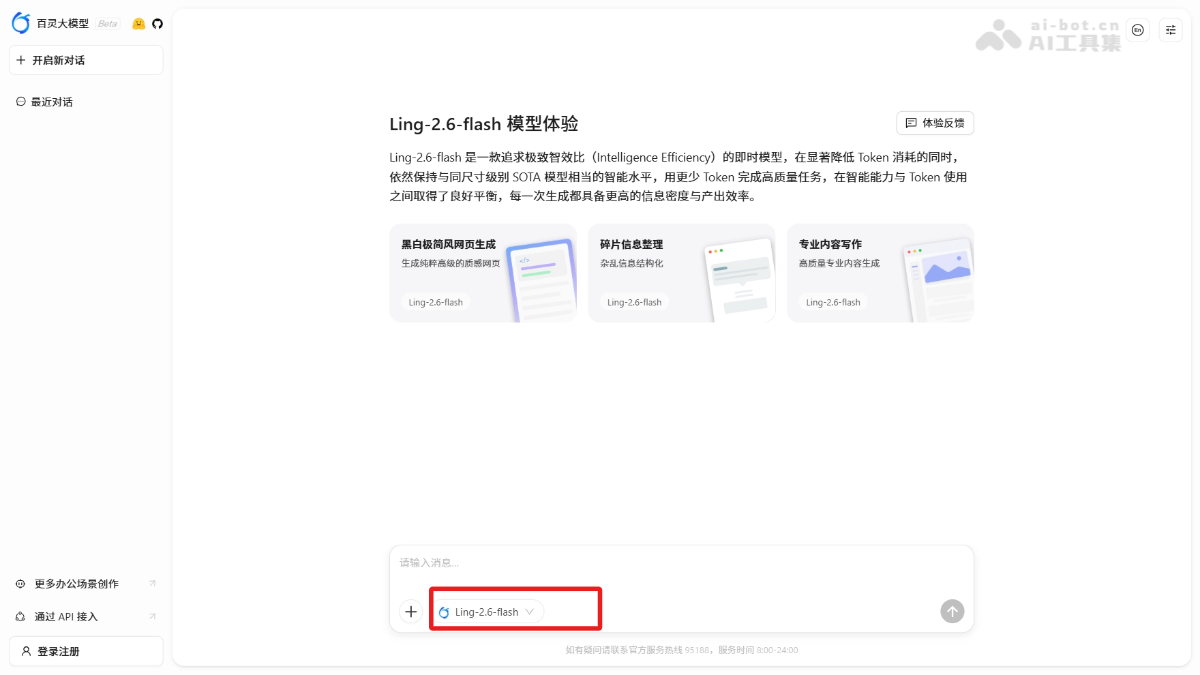
Ling-2.6-flash (anonymous on the OpenRouter platform: Elephant Alpha) is a next-generation efficient Instruct model launched by the Alibaba Bailing large model team, with a total parameter count of 104B and only 7.4B activated parameters. The model adopts a 1:7 hybrid architecture of MLA (Multi-head Latent Attention) and Lightning Linear, combined with a highly sparse MoE design, achieving systematic optimization of inference efficiency and token efficiency while maintaining strong intelligence. The model is on the OpenRouter platform, its call volume continues to grow, ranking first on the Trending list for multiple consecutive days, with daily average token call volume reaching the 100B level.
Main Features of Ling-2.6-flash
-
Hybrid Linear Attention Inference: Through the MLA+Lightning Linear hybrid architecture, it achieves long-context processing with linear time complexity, unleashing underlying computational efficiency.
-
Token Efficiency Optimization: During training, output length is specifically calibrated to complete equally complex tasks with more concise token consumption, reducing inference costs.
-
Agent Task Execution: Strengthens tool calling, multi-step planning, and long-horizon execution capabilities, supporting autonomous task completion in complex interactive environments.
-
Multi-Precision Inference Adaptation: Conducts systematic operator fusion and quantization optimization for BF16 and FP8 scenarios, supporting deployment across all scenarios from single-user to high-concurrency.
-
Long-Context Understanding: Supports 256K tokens of content length, maintaining efficient throughput in long-text understanding and continuous generation scenarios.
Technical Principles of Ling-2.6-flash
-
Hybrid Linear Architecture: Builds on Ling 2.0 by introducing 1:7 MLA+Lightning Linear hybrid attention, replacing traditional GQA, reducing KV cache pressure, and improving long-sequence inference efficiency.
-
Sparse MoE Design: Adopts a highly sparse mixture-of-experts architecture, activating only a small number of parameters for inference, balancing model capacity and computational overhead.
-
Training-Inference Consistency Optimization: Achieves large-scale operator fusion during pre-training, while the inference side maintains consistent fusion granularity and numerical behavior, enhancing training-inference consistency during the RL Rollout stage.
-
Multi-Token Prediction (MTP): The training objective combines Next-Token Prediction with Multi-Token Prediction, improving generation efficiency and training signal density.
-
Targeted RL Training: Relying on self-developed high-fidelity interactive environments, it conducts reinforcement learning for General Agent and Coding Agent, optimizing instruction following and tool calling stability.
How to Use Ling-2.6-flash
- Quick Experience via OpenRouter
-
Register an Account: Visit the OpenRouter official website to complete account registration and login.
-
Select the Model: Search for and select in the model marketplace
inclusionai/ling-2.6-flash:free。 -
Create a Key: Go to the API Keys page to generate a dedicated calling key and keep it safe.
-
Make a Call: Pass in the model name and key through the standard OpenAI-compatible interface to experience it for free.
-
- Access via the Official Platform
-
Visit the Official Website: Visit theBailing Large Modelofficial website to complete account registration.
-
Obtain a Key: Create an application project in the console and copy the generated API Key to your local environment.
-
Integration and Invocation: Configure the request URL, model parameters, and business logic according to the official API documentation.
-
Key Information and Usage Requirements of Ling-2.6-flash
-
Model Scale: Total parameters 104B, activated parameters 7.4B, hidden layer dimension 4096, vocabulary size 157K.
-
Context Length: Supports content understanding and generation of up to 256K tokens.
-
Hardware Requirements: 4 H20 GPUs can achieve an inference speed of 340 tokens/s, suitable for enterprise-level local deployment.
-
Open Source Plan: Inference operators will be gradually open-sourced with the linghe framework, facilitating community integration and secondary development.
-
Precision Support: Full support for BF16 and FP8 inference, adapting to deployment environments with different precision requirements.
Core Advantages of Ling-2.6-flash
-
Extreme Inference Speed: Achieves 340 tokens/s under 4 H20 GPUs, with Prefill and Decode throughput up to 4 times that of models of the same size.
-
Ultra-Low Token Consumption: The full Artificial Analysis evaluation consumes only 15M tokens, about 1/10 that of models such as Nemotron-3-Super.
-
Top-Tier Agent Capabilities: Reaches SOTA or comparable levels on Agent benchmarks such as BFCL-V4, SWE-bench Verified, and PinchBench.
-
High Intelligence-Efficiency Ratio: Achieves equivalent intelligence performance with fewer output tokens, occupying the optimal balance position in the "intelligence-cost" quadrant.
-
Deployment-Friendly: Deeply optimized for real business scenarios, supporting elastic scaling from single-user low latency to high-concurrency batch processing.
Project Address of Ling-2.6-flash
- HuggingFace Model Repository:https://huggingface.co/inclusionAI/Ling-2.6-flash
Comparison of Ling-2.6-flash with Similar Competing Products
| Comparison Dimension | Ling-2.6-flash | Gemini 2.5 Flash-Lite | Grok 4 Fast |
|---|---|---|---|
| Provider | Ant Bailing | xAI | |
| Parameter Scale | 104B | Not disclosed (presumed larger) | Not disclosed |
| Context Window | 256K | 1M+ | 128K |
| Single Output Length | 32K | 64K+ | 32K |
| Token Efficiency | Extremely high, output is extremely concise with no redundancy | Relatively low, output is lengthy and detailed | High, response is fast and direct |
| Code Repair | Precisely locates errors, explains in one line | Functionally complete but with a large output volume | Strong, skilled at real-time programming |
| Meeting Minutes Extraction from Cluttered Text | Precisely removes filler and outputs in a structured way | Information is complete but mixed with redundancy | Moderate, depends on context |
| Data Analysis | Automatically calculates and self-checks for error correction | Can complete it but describes too many steps | Fast but depth is average |
| Product Positioning | Lightweight, efficient "working" model | Long-context, multi-purpose model | Fast-response general-purpose assistant |
Application Scenarios of Ling-2.6-flash
-
Agent Development Platform: Serves as the underlying model to drive Agent frameworks such as Claude Code and Kilo Code, supporting complex long-horizon task execution.
-
Enterprise-grade customer service system: Built on a 256K long context and efficient inference, it enables a low-cost, high-concurrency intelligent customer service and dialogue system.
-
Code-assisted development: It performs excellently in evaluations such as SWE-bench Verified and is suitable for code generation, automated debugging, and software engineering tasks.
-
High-frequency online services: With low latency and high throughput, it supports consumer-facing products that require rapid responses, such as search, recommendation, and content generation.
-
Private deployment: The sparse design with 104B total parameters and 7.4B activated parameters enables enterprises to achieve localized deployment of large models with limited computing power.