
What is LinFusion
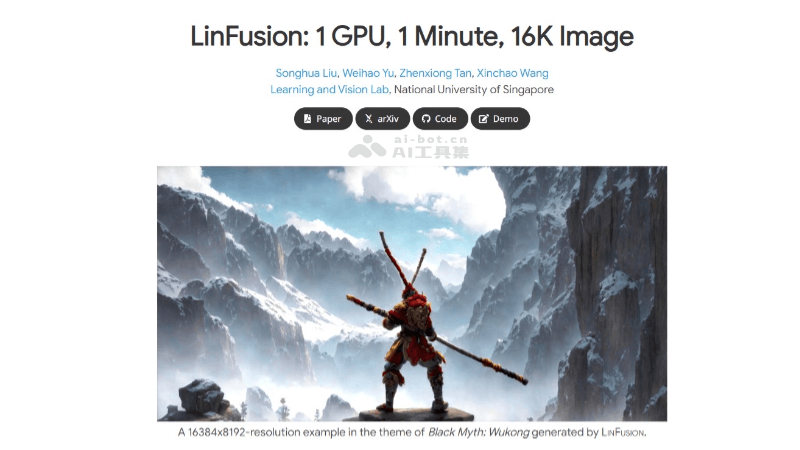
LinFusion is an innovative image generation model developed by a research team at the National University of Singapore. It is based on a linear attention mechanism to handle high-resolution image generation tasks. It keeps the computational complexity of the model linear when processing a large number of pixels, significantly improving generation efficiency. LinFusion is highly compatible with existing pretrained model components such as ControlNet and IP-Adapter, supports zero-shot cross-resolution generation, and can generate images at unseen resolutions. It achieves image generation at up to 16K resolution on a single GPU, providing powerful visual content generation capabilities for fields such as artistic creation, game design, and virtual reality.
Main features of LinFusion
- Text-to-image generation: Generates corresponding high-resolution images based on text descriptions provided by the user.
- High-resolution support: Specifically optimizes the generation of high-resolution images, including resolutions not encountered during training.
- Linear complexity: Adopts a linear attention mechanism, making the model more computationally efficient and less resource-intensive when processing a large number of pixels.
- Cross-resolution generation: Generates images at different resolutions, including resolutions not seen during training.
- Compatibility with pretrained model components: Compatible with pretrained Stable Diffusion components such as ControlNet and IP-Adapter, and can be used without additional training.
Technical principles of LinFusion
- Linear attention mechanism: LinFusion adopts a novel linear attention mechanism, which differs from the quadratic-complexity self-attention in traditional Transformer-based models. The linear attention mechanism makes the computational complexity of the model linear in the number of pixels when processing a large number of pixels, significantly reducing the demand for computational resources.
- Generalized linear attention: LinFusion introduces a generalized linear attention paradigm, an extension of existing linear-complexity token mixers such as Mamba, Mamba2, and Gated Linear Attention. The generalized linear attention mechanism includes normalization awareness and non-causal operations to meet the needs of high-resolution visual generation.
- Normalization awareness: A normalization-aware attention mechanism ensures that the sum of the attention weights of each token equals 1, thereby maintaining consistent performance across images of different scales.
- Non-causality: A non-causal version of the linear attention mechanism allows the model to access all noise space tokens simultaneously during generation, rather than only processing tokens sequentially like a traditional RNN. This helps the model better capture the spatial structure of images.
LinFusion project address
- Project website:lv-linfusion.github.io
- GitHub repository:https://github.com/Huage001/LinFusion
- arXiv technical paper:https://arxiv.org/pdf/2409.02097
Application scenarios of LinFusion
- Artistic creation: Artists and designers use LinFusion to generate high-resolution artworks based on text descriptions, accelerating the creative process.
- Game development: In game design, it quickly generates game scenes, characters, or concept art, improving the efficiency of game art production.
- Virtual reality (VR) and augmented reality (AR): In the creation of VR or AR content, LinFusion helps generate realistic background images or environments, enhancing the user experience.
- Film and video production: Filmmakers use LinFusion to generate concept art or special effects backgrounds for scenes in films, reducing pre-production time.
- Advertising and Marketing: Marketing teams use LinFusion to quickly generate attractive advertising images and social media posts, improving the appeal of marketing content.