
What is LineArt
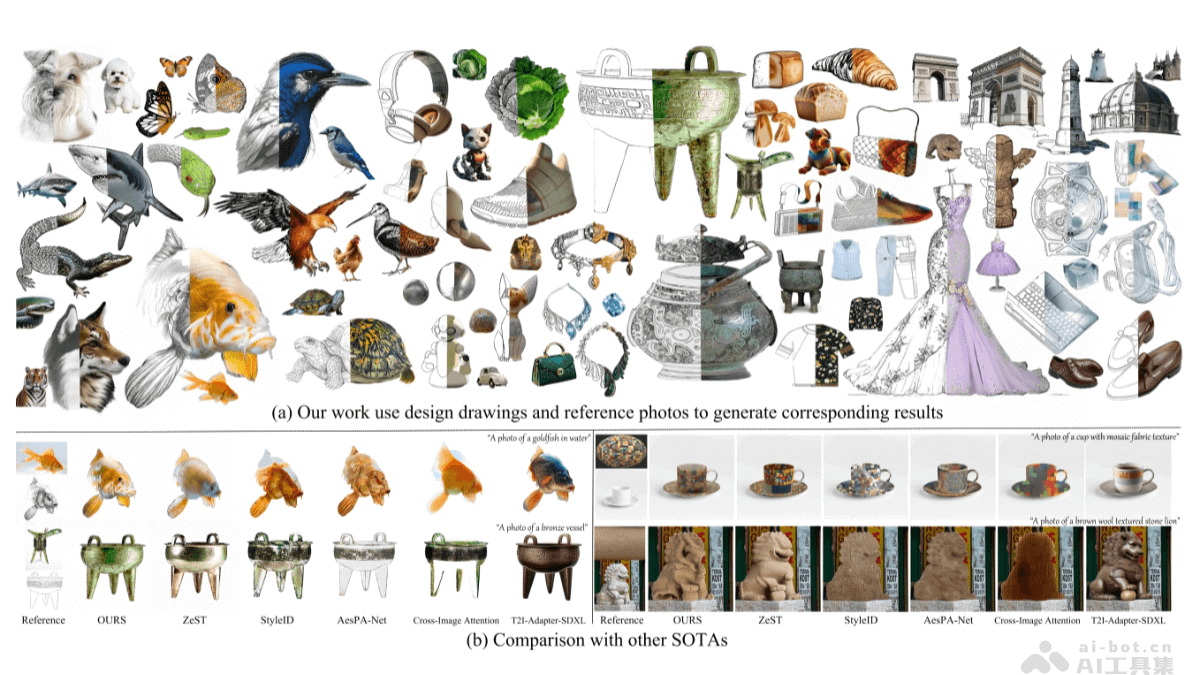
LineArt is a training-free, high-quality design drawing appearance transfer framework launched by Jilin University, KTH Royal Institute of Technology, Tokyo Institute of Technology, and other institutions. It can transfer complex appearance features onto detailed design drawings, assisting design and artistic creation. LineArt is based on simulating the human hierarchical visual cognition process, integrates artistic experience to guide diffusion models, generates high-fidelity images, and at the same time precisely preserves the structural details of the design drawing. LineArt contains two core stages: first, the multi-frequency line fusion module, which supplements the detailed structural information of the input design drawing; second, a two-part painting process divided into base layer shaping and surface coloring, which separately handles illumination and texture features. The LineArt framework does not require precise 3D modeling or network training, making it convenient for executing design tasks, and in experiments it demonstrates performance superior to existing state-of-the-art methods.
Main functions of LineArt
- High-fidelity appearance transfer: Accurately transfer complex appearance features from reference photos (such as material, texture, illumination, etc.) onto design drawings, making the generated image highly consistent visually with the reference photo.
- Preserve structural details: In the process of transferring appearance features, precisely preserve the detailed structure of the design drawing, avoid loss or distortion of details, and ensure that the original intent of the design drawing is fully expressed.
- No need for precise 3D modeling and network training: Eliminates the precise 3D modeling, physical property specification, or large-scale network training process required in traditional methods, reducing the complexity and cost of design tasks and improving design efficiency.
- Support design and artistic creation: Provides designers and artists with a powerful tool to quickly generate previews of design drawings with specific appearance effects, helping them intuitively evaluate design effects, choose the most suitable material combinations, and accelerate the design iteration process.
Technical principles of LineArt
- Multi-frequency line fusion module: Inspired by visual representation theory, the input design drawing is supplemented into an ideal sketch containing three levels of information. The three levels are: continuous single lines for region division, double lines to emphasize local details, and discrete soft edge point sets representing implicit spatial gradients and texture information. The multi-level visual information supplementation provides rich structural details for the subsequent diffusion model, helping to generate more accurate and realistic images.
- A two-part painting process of base layer shaping and surface coloring:
- Base layer shaping: Decompose the brightness control factor from the reference image, simulating the base coating process in oil painting. Based on the brightness control factor, it provides the initial light-dark contrast and structural shape, laying the foundation for subsequent illumination effects and texture generation. Based on the mean and variance that affect the initial noise distribution, it controls the overall brightness of the generated result, establishes a soft link between the generated image and the reference image, and makes the illumination attributes of the generated image match those of the reference image.
- Surface coloring: Globally encode the texture map decomposed from the reference image, and then selectively inject it into specific attention layers of the U-net architecture, simulating the transparent layer coloring process in oil painting. This process integrates text features, content features, and appearance features based on a decoupled cross-attention mechanism, allowing the synthesized texture image to guide appearance generation, using soft edges as high-frequency guidance, ensuring that the generated result aligns with the texture pattern, promoting natural layout changes, and achieving precise material embedding and appearance feature transfer.
- Knowledge-Guided Structure Preservation and Appearance Transfer: LineArt integrates human drawing knowledge and visual cognitive processes into image generation. It analyzes three levels of the input sketch, processing salient features as double lines, object block divisions and geometric edges as single-line visual representations, and discrete low-level visual features (soft edges) for guiding spatial gradient representation and subsequent texture generation, accurately reproducing spatial relationships and adapting to high-frequency textures of objects. In terms of appearance transfer, drawing on the "Imprimatura" technique of classical oil painting, the painting process is divided into two stages: underpainting and glazing, which respectively handle implicit image information (such as lighting, illumination, and shadow reflections) and features related to texture and color, achieving high-fidelity appearance transfer effects.
LineArt's project address
- Project official website:https://meaoxixi.github.io/LineArt/
- arXiv technical paper:https://arxiv.org/pdf/2412.11519v1
LineArt's application scenarios
- Industrial design: Used for product appearance design previews and accelerating design iterations, combining with different material textures to quickly generate realistic effects and optimize product design.
- Interior design: Enables furniture material matching and spatial effect simulation, helping designers choose suitable materials and enhancing the overall style and texture of interior design.
- Fashion design: Displays clothing fabric effects and style-material combinations, providing references for fabric selection and pattern design, enhancing the innovation and competitiveness of fashion design.
- Architectural design: Simulates building exterior materials and detail design, evaluates the harmony between buildings and the environment, optimizes architectural design schemes, and improves building quality.
- Animation and game design: Applied to character design and scene design, generating realistic character images and scene effect previews, enhancing visual experience and immersion.