
What is LightLab
LightLab is a diffusion model-based image light source control model launched by Google and other institutions, capable of fine-grained parametric control of light sources in a single image. The model supports users in adjusting the intensity and color of light sources, inserting virtual light sources, and changing the intensity of ambient light. Trained on a combination of a small number of real photo pairs and a large number of synthetic rendered images, LightLab can generate physically plausible lighting effects, such as shadows and reflections. The tool provides an interactive demo interface, where users can intuitively adjust lighting parameters based on sliders to achieve complex lighting editing. LightLab performs excellently in a variety of scenarios, providing powerful functionality for photography and image editing.
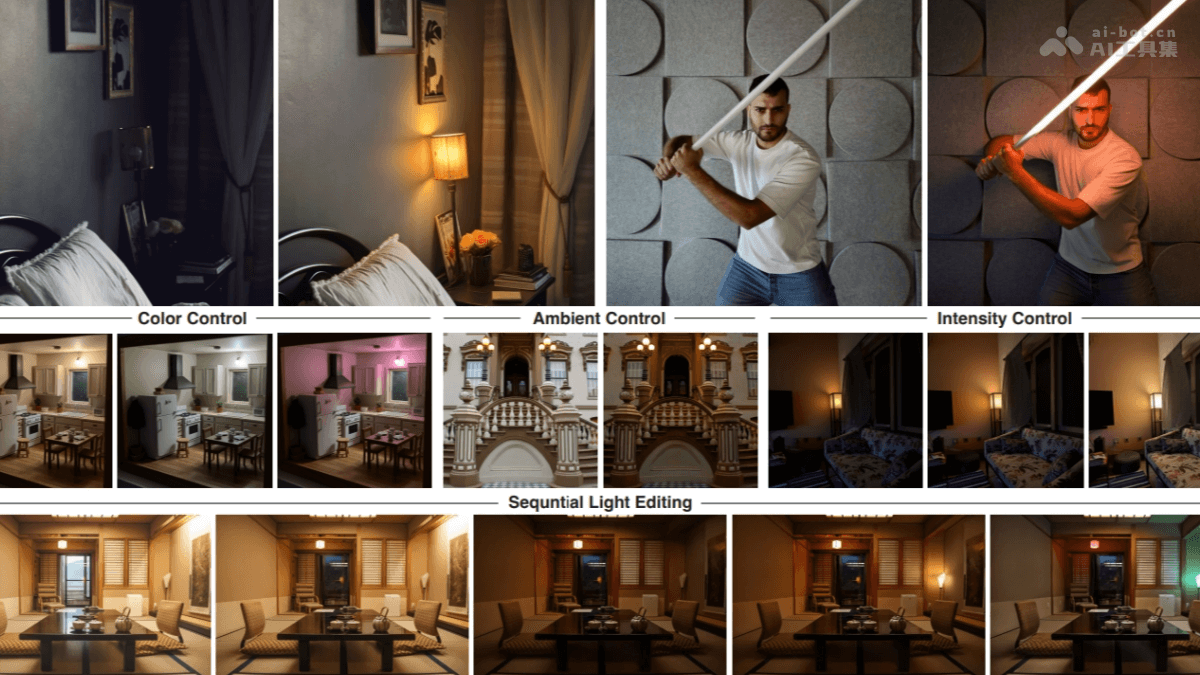
Main features of LightLab
- Light source intensity control: Users can adjust the intensity of a specific light source in an image, achieving adjustment from completely off to any intensity.
- Light source color control: Supports users in changing the color of light sources, supporting multiple color temperatures and custom RGB colors.
- Ambient light control: Users can adjust the ambient light intensity of the scene, simulating different ambient lighting conditions.
- Virtual light source insertion: Supports inserting virtual light sources and generating plausible lighting effects.
- Continuous editing: Supports multiple continuous lighting edits on the same image, with each edit based on the result of the previous one.
Technical principles of LightLab
- Diffusion model: Based on the powerful generative capability of diffusion models, after training it can understand and generate realistic lighting effects.
- Data generation: Generates training data by combining a small number of real photo pairs and a large number of synthetic rendered images. Real photo pairs provide complex geometry and lighting details, while synthetic data increases the diversity of lighting conditions.
- Linear light model: Based on the linear characteristics of light, uses simple addition and subtraction operations to synthesize image sequences with different lighting intensities and colors.
- Conditional diffusion model: Conditions the diffusion model, so that the model generates corresponding images according to user-specified lighting parameters, such as light source intensity, color, and ambient light intensity.
- Tone mapping: Uses an appropriate tone mapping strategy to ensure that the generated images have visually reasonable exposure and contrast.
- Parametric control: Controls the properties of light sources in a parametric way, allowing users to intuitively adjust them based on interface elements such as sliders.
Project address of LightLab
- Project official website:https://nadmag.github.io/LightLab/
- HuggingFace model library:https://huggingface.co/papers/2505.09608
- arXiv technical paper:https://arxiv.org/pdf/2505.09608
Application scenarios of LightLab
- Photography post-processing: Adjust photo light sources, enhance or change lighting effects.
- Film and television special effects: Quickly generate images under different lighting conditions.
- Interior design: Simulate the effects of different lighting layouts.
- Game development: Optimize the lighting effects of game scenes.
- Advertising production: Highlight product features and create attractive visual effects.