
What is LifeSim
LifeSim is the first long-horizon user life simulation framework launched by Fudan University and Shanghai Innovation Institute, used to evaluate personalized AI assistants. The framework is based on the BDI cognitive model, simultaneously modeling the user's internal cognition (beliefs, desires, intentions) and the external environment (time, location, weather), generating coherent life trajectories and multi-turn interactions. Through the LifeSim-Eval benchmark with 1,200 scenarios across 8 life domains, LifeSim evaluates a model's ability to handle explicit and implicit intentions and long-term preference modeling, addressing the disconnect between existing evaluations and real-world scenarios.
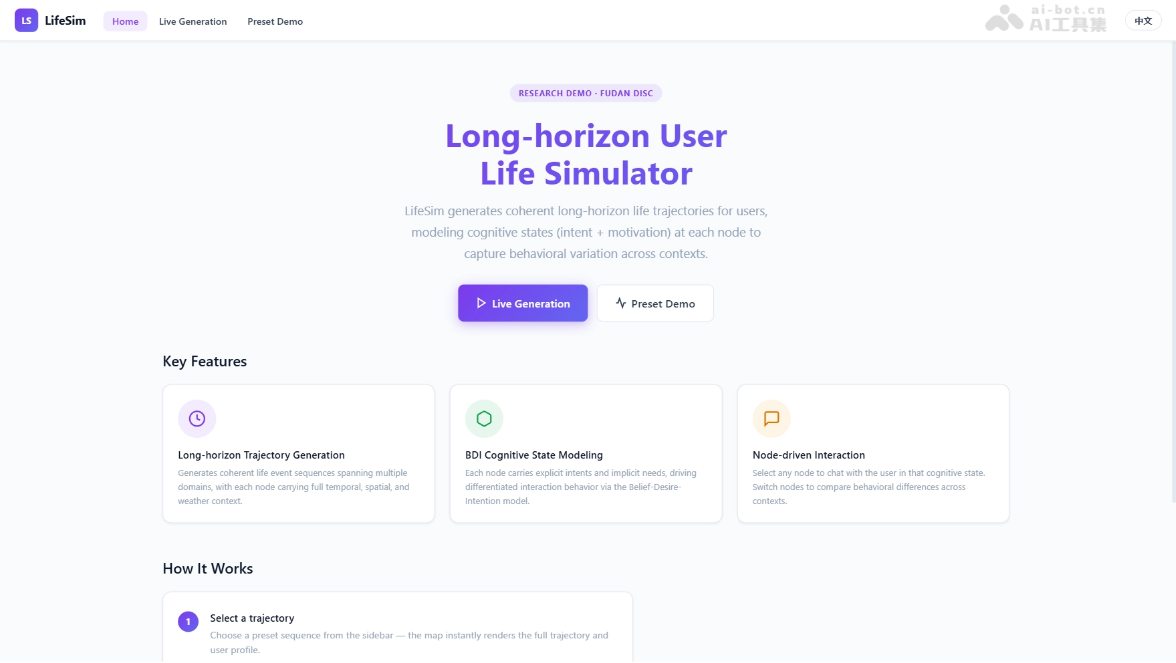
LifeSim's Main Features
-
Long-Horizon Life Trajectory Simulation: Generates coherent sequences of user life events based on real travel data, covering external environmental constraints such as time, location, and weather.
-
Multi-Turn Interaction Behavior Simulation: Simulates natural conversations between users and AI assistants, supporting memory conflict detection, emotional reasoning, and dynamic behavior selection.
-
Personalization Capability Evaluation: Uses the LifeSim-Eval benchmark to test a model's ability to recognize explicit/implicit intentions and to reconstruct and align with long-term preferences.
-
Privacy-Safe Data Synthesis: Supports generating millions of diverse user profiles, providing high-quality synthetic data for personalized assistant training.
LifeSim's Technical Principles
-
Belief Engine: Integrates long-term user profiles with short-term situational cognition (physical/psychological/environmental states).
-
Desire Engine: Retrieves candidate intentions from a needs library, then reranks them by combining user beliefs and the external environment.
-
Event Engine: Controls event trigger probabilities based on logical functions, ensuring life events conform to real spatiotemporal constraints.
-
Behavior Engine: Generates user responses through three stages: memory awareness (detecting historical conflicts), emotional reasoning (GoEmotions classification), and action selection.
How to Use LifeSim
- Online Demo Experience:
- Visit the Official Website: Directly visithttp://fudan-disc.com/lifesim/可使用可视化界面。
-
Preset Demo: Select a built-in user, click any life node on the map timeline, view the scenario at that time, and converse with the simulated user.
-
Real-Time Generation: Customize profiles such as age, occupation, and personality traits, and watch the BDI engine generate life events in real time and interact.
- Local Deployment Evaluation:
- Environment Preparation: Install Python dependencies and prepare user profile and life event data.
- Model Configuration: Connect the user simulation model (e.g., Qwen3-32B) and the assistant model under test (supporting local vLLM or APIs such as OpenAI/DeepSeek).
- Run Simulation: Choose single-scenario (independent conversation) or long-horizon mode (multi-turn interaction with historical memory), and the system will automatically generate conversation logs.
- Automatic Scoring: Use LLM-as-Judge to automatically score 7 dimensions including intention recognition, implicit need satisfaction, and profile alignment.
LifeSim's Key Information and Usage Requirements
- Positioning: The first long-horizon user life simulator, used to evaluate the capabilities of personalized AI assistants in real dynamic scenarios.
- Technical Core: Based on the BDI cognitive model (Belief-Desire-Intention), it integrates the external environment (time/location/weather) with internal cognitive states (personality/preferences/memory) to generate user behavior.
- Data scale: A million-level user profile pool, 3,374 real trajectories, and 1,200 evaluation scenarios (covering 8 major life domains).
- Evaluation focus: Distinguish explicit intent (direct needs) from implicit intent (requiring inference from profiles and scenarios), supporting long-range dialogue (up to 16K tokens of historical context):
- Affiliated institutions: Jointly developed by Fudan University Data Science and Shanghai Innovation Institute.
LifeSim's core advantages
- Bridging the real-world scenario gap: Breaking through the limitations of existing static, short-context evaluations, it is the first to achieve multi-day/week-level long-range life trajectory simulation, bringing AI assistant evaluation truly close to "Jarvis"-style continuous service scenarios.
- In-depth modeling with the BDI cognitive architecture: Unlike simple role-playing, it is based on the belief-desire-intention psychological model, systematically simulating "how users think" (cognitive states) and generating reasonable behavior chains with consistent personality.
- Dual challenge of explicit and implicit intent: Through implicit intent (requiring inference from weather, location, and historical preferences), it exposes a 20+ point performance gap in current LLMs in long-term user understanding.
- Fusion of physical-cognitive dual environments: Uniquely combining real geographic trajectories (3,374), temporal and weather physical constraints, and cognitive mechanisms such as dynamic psychological emotions and memory forgetting, the generated events possess real-world plausibility.
LifeSim's project address
- GitHub repository:https://github.com/dfy37/lifesim
- arXiv technical paper:https://arxiv.org/pdf/2603.12152
- Online experience Demo:http://fudan-disc.com/lifesim/
LifeSim comparison with similar competitors
| Comparison dimension | LifeSim | Generative Agents (Smallville) |
AgentBench |
|---|---|---|---|
| Core positioning | Long-range capability evaluation benchmark for personalized AI assistants | Virtual social sandbox behavior observation platform | LLM Agent tool-calling capability evaluation |
| Time dimension | Long-range continuous (multi-day/week-level, up to 16K tokens of context) | Continuous time (no clear upper limit) | Short-range tasks (single-turn or few turns) |
| Environment modeling | Real physical environment (time + weather + geographic trajectories) + cognitive states | Virtual 2D sandbox environment (game-style interaction) | Virtual tool environment (OS/web/database) |
| User modeling | BDI cognitive model(belief-desire-intention + Big Five personality + dynamic emotions) | Memory stream + reflection(observe emergent behavior) | None(only tests the Agent's own capabilities) |
| Evaluation focus | Explicit and implicit intent recognition, long-term preference alignment, profile restoration | Emergence of social phenomena, group interaction patterns | Tool usage accuracy, task completion efficiency |
| Interaction mode | User-AI assistant adversarial dialogue (can evaluate third-party models) | Free interaction among AI agents (observational) | AI interacting with virtual environment (task-based) |
| Data scale | Million-level user profiles, 1,200 standard evaluation scenarios | 25 agents, limited pre-built scenarios | 8 environments, thousands of test cases |
| Reproducibility | Standardized seed scenarios + automated scoring(supports horizontal model benchmarking) | Open-ended observation(results highly random, hard to reproduce) | Fixed test set(reproducible) |
| Main advantages | Real-life scenarios, psychological theory support, ability to quantify implicit intent | Emergent swarm intelligence, visual social simulation | Rich tool ecosystem, clear task boundaries |
| Main limitations | Limited to single-user-assistant dyadic interaction (multi-agent society not yet supported) | Lack of standardized evaluation metrics, difficult to compare model strengths and weaknesses | Lack of user cognitive modeling, does not involve personalized long-term service |
LifeSim application scenarios
- AI assistant capability evaluation and benchmarking: Provides a standardized "long-horizon personalization" examination for models such as GPT-4o, Claude, and DeepSeek, precisely identifying model capability boundaries in implicit intent understanding, long-term memory retention, user profile alignment, and other aspects.
- Synthetic data generation:: Generates large-scale, diverse long-term interaction dialogue data based on millions of simulated users, addressing the scarcity and privacy sensitivity of real user data, for fine-tuning personalized assistants or reinforcement learning training.
- Intelligent customer service and companion AI pre-training: Simulates extreme or rare scenarios in a virtual environment (such as a user seeking help during consecutive days of anxiety), testing the customer service system's emotional support capabilities and long-term context consistency, avoiding real user testing risks after launch.
- Human-Computer Interaction (HCI) academic research: Provides a controllable experimental platform for cognitive science and social psychology, studying how different personality traits (such as the Big Five personality) affect users' acceptance of AI assistants and the process of trust building.
- Personalized recommendation algorithm validation: In 8 major life domains including diet, fitness, and parenting, validates whether recommendation systems can make dynamic adjustments by combining users' long-term preferences with real-time context (such as rainy weather + fitness habits).