
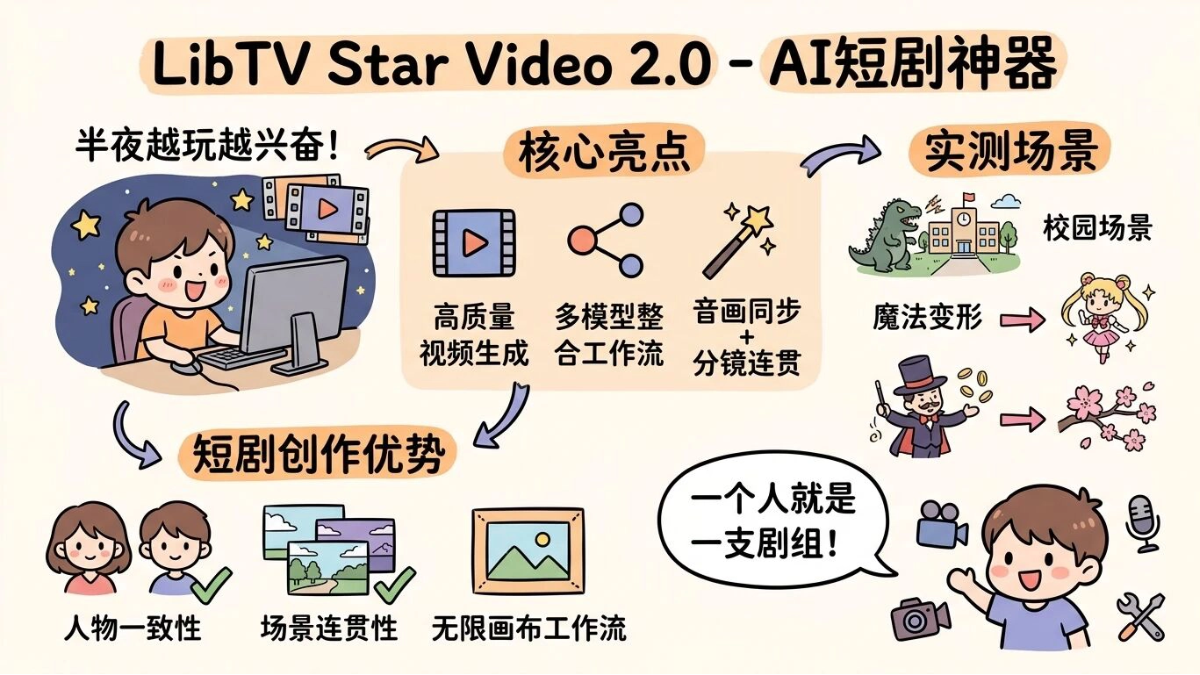
Yesterday I discovered that LibTV had quietly launched a new video model, Star Video 2.0. I originally planned to casually test its performance and then go to sleep, but I ended up getting more and more excited in the middle of the night and it completely woke me up!
It is no exaggeration to say that Star Video 2.0's high-quality video generation capability, combined with LibTV's original multi-model integrated workflow, is simply a heaven-sent short drama神器.
Don't believe it? Let me perform a little magic trick for everyone:
Look at this audio-visual synchronization effect. The storyboard design is very coherent, and there is no need to painstakingly draw storyboard images yourself or dub in post-production.
Even more impressive is that I tried making several coherent short drama clips, and the quality was also quite good. Scene continuity and character consistency were maintained very well.
Without further ado, let me take everyone directly through my hands-on testing process.
01. Hands-On Test of Star Video 2.0
We open LibTV the official website and click to start creating.
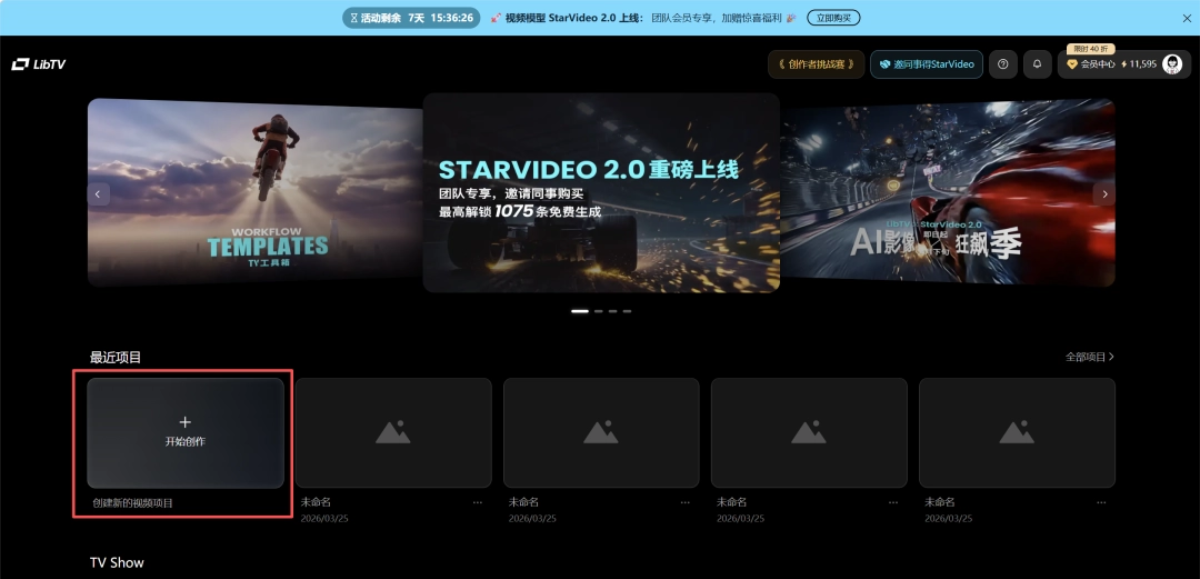
Official website:https://www.liblib.tv
LibTV will directly create an infinite canvas. All materials in the same project, whether text, images, videos, audio, or scripts, can be scheduled and generated on the same canvas, which is very convenient.
Double-click an empty area on the canvas to add a video node, and switch to the Star Video 2.0 model in the lower-left corner (currently only open to applications from enterprise teams).
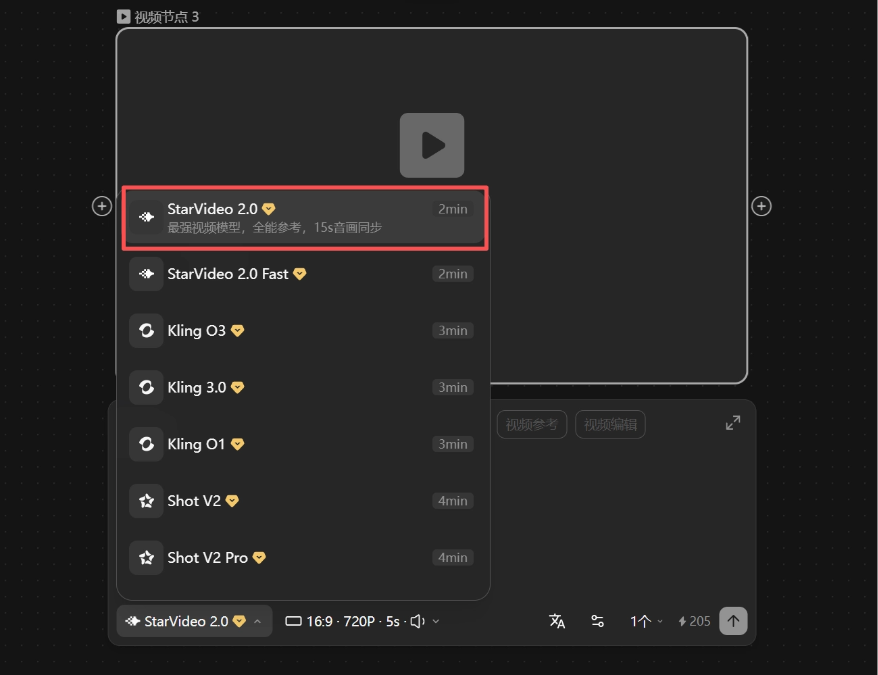
Let's casually make a short film to try it out:
Casual snapshot style, modern campus playground, daytime, natural light, many students gathered on the playground playing, chatting, and running, with a realistic campus life feel in the image. The camera first shoots the lively playground and teaching building from a wider perspective, with a relaxed, everyday atmosphere. Suddenly, commotion comes from one side of the teaching building. A giant Godzilla suddenly appears from beside the building, bringing a strong sense of pressure. The surrounding students flee in panic, and the scene instantly falls into chaos.
The camera quickly cuts to a bench at the edge of the playground, where a young woman was originally sitting quietly reading a book. Her expression is calm. She slowly puts down the book in her hands and stands up to walk toward the monster. As she advances step by step, her body begins to glow, and her clothing and body structure gradually undergo mechanical upgrades, completing a cool transformation and turning into a mecha war-god form, with metal armor wrapping her whole body and a powerful aura. She continues forward, raises her hand to gather power, and suddenly throws a punch. The force of the punch forms a strong air shockwave, and the visible surge hits Godzilla head-on, instantly blasting it away and heavily knocking it to the ground. The image is stunning, with a strong impact, cinematic-level visual effects, and a tight rhythm.
In less than ten minutes, a complete short film was generated.
The art style is extremely realistic! The image quality is quite good. What surprised me most is Star Video 2.0's understanding of complex actions. Every action requirement in the prompt was accurately presented by Star Video 2.0, and it even designed cinematic-level storyboards on its own. The camera transitions were done very well。
If we want the visuals to be more controllable, we can refine the prompt structure further. For example, clearly write out the style, characters, visual elements, environment, and even the timeline down to each second.
-Style
Stylized 3D animation, exaggerated shapes, rounded forms, with a graphic flatness, strong action expressiveness, cinematic camera language, overall tight and smooth rhythm, with a mysterious and gorgeous Gothic stage atmosphere
-Characters
A female magician stands in front, wearing a Gothic black gown, a cinched-waist long dress with layered skirt hem and lace details, a white high-necked shirt underneath, a black velvet bow tie, and a black Gothic top hat, with an overall look that is exquisite, mysterious, cool and elegant
A small group of spectators stands around and in front of her, forming a loose semicircle
The female magician is calm and composed, confident and unhurried, with precise hand control and elegant, restrained movements
-Props
A silver coin, medium-sized, with a clear metallic texture and natural specular highlights on its surface
At the beginning, there is only this one silver coin
There are no other extra props in her hands
After the silver coin splits in the air, all the silver coins maintain the same material, size, and appearance as the original silver coin
The silver coin's appearance remains consistent throughout the entire performance
-Environment
A riverside walkway at night, stone-paved ground, soft streetlights, with an open night sky overhead
The surrounding spectators are clearly visible in the background and at the edges of the frame
Warm ambient light falls on the female magician, and the silver coin's surface has a delicate reflection
The overall atmosphere is mysterious, romantic, and dark-toned, and the fireworks can clearly spread across the night sky
-Timeline
0:00–0:03
The shot opens with a close-up of the female magician's hands.
She places a silver coin in the palm of her left hand, slowly closes her left hand, and turns it over so the back of her hand faces up.
Her right hand gently rubs the back of her left hand.
0:03–0:04
She turns her left hand over so the back of her hand faces down, slowly opens her left hand, and the silver coin has disappeared.
0:04–0:06
She makes her right hand cross her left hand at a ninety-degree angle.
Her right hand hovers above the palm of her left hand and gently sways, then slowly moves away.
The silver coin reappears in the center of her left palm.
0:07–0:10
She picks up the coin and tosses it into the air.
The camera tilts upward following the silver coin.
As the silver coin rises, it splits into multiple identical silver coins that scatter loosely in all directions.
0:10–0:12
The camera continues tracking upward.
At the highest point, these silver coins instantly transform into cherry blossom petals in their respective positions.
The petals first disperse from a few small areas, then rapidly increase, spreading layer upon layer in the air as if lifted by the night breeze.
A large expanse of cherry blossoms slowly falls from high above, forming a dense and dreamy cherry blossom rain.
The number of petals keeps increasing, with falling cherry blossoms in the foreground, midground, and background, covering the entire night sky.
The overall image is romantic and beautiful, with soft colors and a light, graceful sense of dynamic beauty.
0:12–0:14
When a few remaining silver coins begin to fall, the camera tilts downward.
The female magician takes a slight step forward, smoothly raises her hand, and cleanly catches a falling silver coin between her index and middle fingers.
Close-up: she offers the silver coin toward the camera, and the silver coin keeps spinning on her index fingertip without falling.
0:14–0:15
The camera slowly pulls back, revealing the female magician and the surrounding spectators.
The spectators applaud, and she displays the spinning silver coin at her chest while lightly lifting her hat in greeting, as cherry blossom petals gradually fade away in the background.
Such detailed requirements, Star Video 2.0 understood and presented them all. The generated footage is very coherent and smooth in one continuous shot, the beautiful special effect of silver coins turning into a rain of cherry blossom petals, the character's calm and elegant posture... the generated quality is already maxed out.。
Although in the end I asked for the coin to spin on the tip of the index finger, it imagined it onto the middle finger for me, but the flaw does not outweigh the merits; the overall image is still stunning.
With such strong video generation quality, not using it to make coherent short dramas would be a sheer waste of something excellent.
As everyone knows, the core pain point of creating short dramas is the continuity of scenes and characters. In LibTV, we can make full use of its infinite canvas workflow to carry out batch creation of continuous storylines.
To keep the story highly consistent, we first lock in the protagonist's appearance. Generate 2 images of the protagonist in the canvas, and connect the images to the video node.
We can directly drag images into the prompt, or @image material as an precise reference.
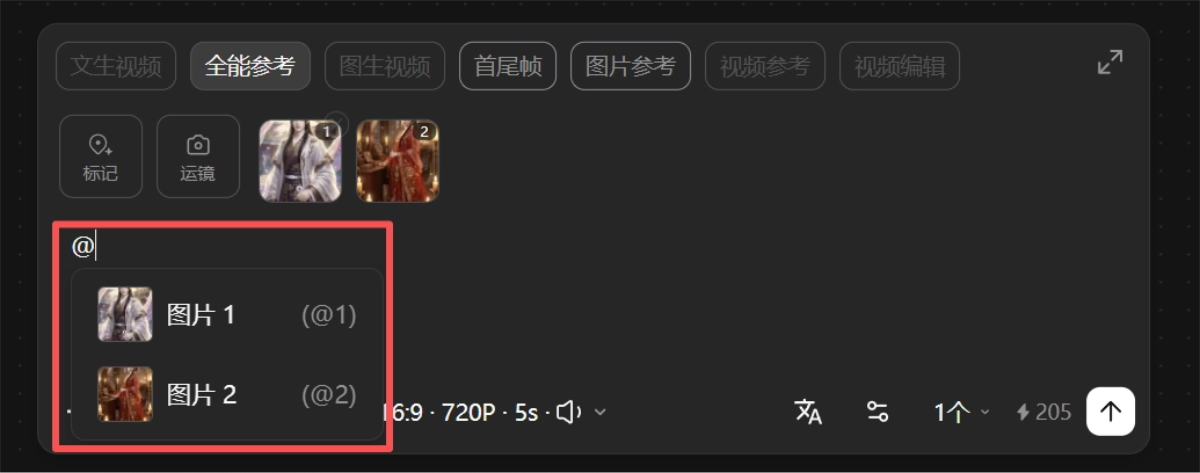
Shot 1 (0–4 seconds)
Visual: Inside the Mazu Temple, incense smoke curls around, and the candlelight on the altar flickers gently. The girl [Image 1] kneels before the Mazu statue, hands clasped together, with a devout yet nervous expression. Warm-toned lighting and shadow; the camera closes in on the girl's face as she closes her eyes and makes a wish.
Dialogue: The girl softly makes a wish: "What my heart desires, may heaven grant me a good match."
Shot 2 (4–8 seconds)
Visual: The girl [Image 1] picks up the moon blocks [Image 2] and throws them to the ground. The moon blocks roll and then stop, and they turn out to be a laughing block result. The camera cuts to a close-up of the moon blocks on the ground, then cuts to the girl's stunned and then disappointed expression. The atmosphere in the temple is quiet and solemn.
Dialogue: The girl says dejectedly in a low voice: "Mazu, are you still not agreeing..."
Shot 3 (8–12 seconds)
Visual: The girl [Image 1] is unwilling to give up, picks up the moon blocks [Image 2] again, and throws them once more. After the moon blocks land, it is still a laughing block result. The camera quickly cuts between the moon blocks landing and the girl's increasingly anxious expression, with a slight touch of comedy.
Dialogue: The girl mutters softly: "Why is it a laughing block again..."
Shot 4 (12–15 seconds)
Visual: The girl [Image 1] kneels properly again, hands clasped together, raises her head to look at the Mazu statue, her eyes slightly red, her expression aggrieved yet serious. Under the candlelight, the Mazu statue is compassionate and quiet.
Dialogue: The girl says pitifully: "Mazu, please help me..."
The biggest fear in making AI short dramas is that the character is a stunningly beautiful but expressionless face. Let's look at the video footage generated by Star Video 2.0. From the girl's devout wish, to her disappointment after throwing the laughing block, to her final plea, the micro-expression changes are very natural.
The key is that my prompt only briefly described the direction of the plot,Star Video 2.0 used its high-quality generation capability to perfectly restore the warm-light cinematic texture, and, like an experienced director, it maxed out the emotional atmosphere of the visuals。
Star Video 2.0 really understands short dramas!
Let's continue with the second episode. To achieve storyline continuity, we need to maintain not only character consistency but also scene consistency. Thanks to LibTV's powerful and rich features, all of this becomes incredibly simple on the canvas.
We click the "camera" button in the lower right corner of the first episode's video to generate a screenshot of the frame with one click.
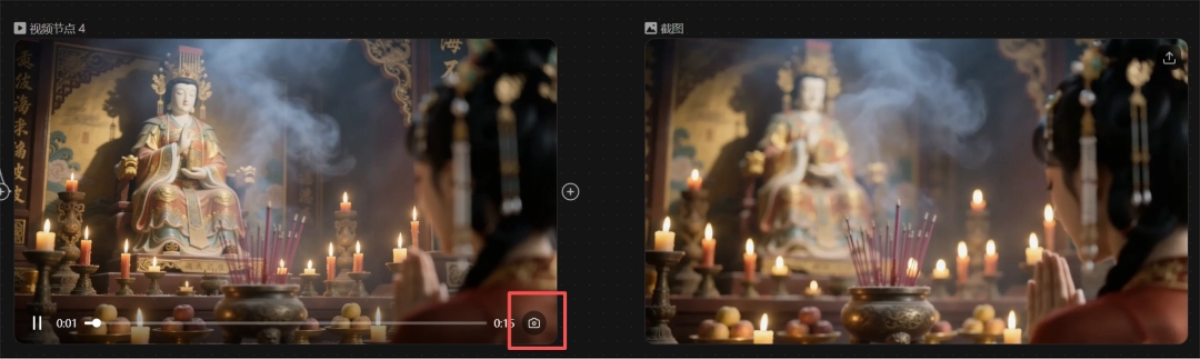
Use the statue of Mazu directly as a reference image, and drag a connection line to the video node of the second episode.
Shot 1 (0–4 seconds)
Visual: The girl [Image 1] closes her eyes, looking especially serious, and bows her head silently to make a wish to the Mazu statue [Image 3].
Dialogue: The girl's inner OS: "I beg you, Mazu..."
Shot 2 (4–9 seconds)
Visual: The girl [Image 1] throws the moon blocks [Image 2]. The moon blocks land and roll, finally stopping as a laughing block result. The camera closes in on the moon blocks on the ground.
Shot 3 (9–12 seconds)
Visual: The Mazu statue [Image 3] quietly bends down and gently nudges one of the blocks. The camera closes in on the laughing block on the ground slowly turning into a sacred block.
Shot 4 (12–15 seconds)
Scene: The girl [Image 1] opens her eyes and discovers it is actually the holy grail. She is stunned at first, her pupils dilate, and then a delighted smile appears. She covers her mouth with both hands, her eyes shining, so happy she almost jumps up. Dialogue: The girl says in surprise, in a low voice: "It worked! It really worked!"
The girl's facial features, clothing, and the Mazu statue were all replicated at pixel level in the second episode, and the story continues perfectly.
Even the somewhat fantastical shot of the statue quietly bending down to move the holy grail, which extremely tests AI comprehension, was accurately rendered by Star Video 2.0!
We don't need to repeatedly write long passages describing what the previous shot looked like, making the creative efficiency much higher.
We continue to make the third episode. This time we raise the difficulty by adding large-span scene switching and introducing the male lead:
Shot 1 (0–3 seconds)
Inside an ancient boudoir, a redwood dressing table, the girl [Image 1] wears a red wedding dress, a golden phoenix crown on her head, and her long hair is braided into a thick braid hanging over her chest. The girl is beautiful and cute, with furrowed brows, pouting and throwing a tantrum, hands on her hips. Close-up of her facial expression, warm candlelight.
The girl says coquettishly: "I don't want to marry someone I've never even met!"
Shot 2 (3–6 seconds)
Interior of a red festive bridal sedan chair, the girl [Image 1] holds a red round fan to cover her face, sitting in the sedan. Red gauze curtains flutter, the girl looks dissatisfied and mutters. Wedding music comes from outside.
The girl's inner OS: "It's definitely some ugly freak anyway..."
Shot 3 (6–12 seconds)
The hall of an ancient mansion, the girl [Image 1] holds a round fan and slowly steps down from the sedan chair, looking up. The male lead [Image 2] in a purple-gold cloud-patterned brocade robe walks over from backlight, with a white gauze garment draped outside, hair bound with a filigree gold crown, and a ruby shining on the gold crown. A dark purple wide belt at the waist, with a white jade jinbu and an emerald jade pendant. The purple-gold long robe shimmers in the sunlight, overwhelmingly noble. Black hair flutters, peach blossom eyes smile, incomparably handsome. Sunlight falls, as if gilded with a layer of golden light. Cinematic lighting, slow motion, robes fluttering, both ethereal and noble.
Shot 4 (12–15 seconds)
Close-up of the girl [Image 1], the round fan drops, pupils dilate, her gaze freezes. Her cheeks instantly flush bright red, lips slightly parted. She shyly bites her lip, fingers twisting the sleeve. The image fades out, romantic and beautiful filter.
The girl's inner OS: "Mazu Niangniang... really answered my prayer"
With multi-scene switching and multi-character introduction, Star Video 2.0 still performs amazingly. Especially in the last few seconds, the heroine's continuous actions of the fan dropping, pupil earthquake, and cheeks flushing red are done in one go, plus the coyness and surprise of the inner OS. This texture... who would believe this was made for me by AI in just a few minutes?!
02. Some sharing
Overall, after experiencing it, I am completely won over by Star Video 2.0. The success rate of drawing cards is really too high. My package only had a few credits in total, and basically there were no wasted clips.
I believe that for all content creators who have suffered from the blind box-style draw of AI, this is absolutely an epic-level experience upgrade.
As a productivity tool,LibTV's seamlessly integrated infinite canvas workflow, is the real killer feature.
In the past, to make an AI video, we had to conceive the storyboard, write prompts to make storyboard images, switch software to generate video, then switch software for voiceover, and finally package and edit all the materials. The creative process was extremely fragmented.
Now, LibTV integrates top models and functions in one stop. All content creation not only ensures quality, but is also all completed by connecting within one canvas. The overall creative efficiency has achieved an exponential leap.。
One person being an entire film crew is about to become a reality within reach.
In the past, to produce a short drama with exquisite costumes, makeup, and props, excellent lighting and shadow, and special effects, we needed massive funding, expensive equipment, and a professional team. But today, all it takes is a brain with an internet sensibility and storytelling skills, combined with LibTV and Star Video 2.0, to get straight into the game.
LibTV gives all grassroots creators and one-person teams the confidence to unleash their imagination and create the next breakout hit.
Experience address:https://www.liblib.tv
Original link:Hands-on test of LibTV's new model Star Video 2.0: short drama creators' private Hollywood is here!