
At the investor exchange meeting, Liang Wenfeng systematically explained the underlying logic of DeepSeek: the company takes AGI as its sole goal and is driven by vision rather than KPIs in its management; it adheres to open source and restrained pricing of "recouping costs in ten months," believing that the more restrained one is, the easier it is to succeed; it depicted a technology roadmap from Agent to continual learning, then to the singularity of self-iteration and embodied intelligence; it candidly admitted that the gap between China and the United States lies only in computing power resources rather than talent, and is going all out to expand cards and is optimistic about domestic chip substitution; it emphasized that team stability is the only core interest, and that C-end and B-end are merely byproducts on the road to AGI.


Get for free the 《Liang Wenfeng Investor Exchange Meeting · Transcript of Audio Recording》report PDF original file, scan the code to follow and reply with the code word: 20260723
Basic Information of the Exchange Meeting
- Time: Recorded on May 20, 2026, about 3 hours and 44 minutes, organized into a transcript by AI.
- Speaker: Liang Wenfeng (founder of DeepSeek)
- Audience: Investors
- Nature: Internal exchange meeting, containing sensitive information (card counts, finances, etc.), required not to be shared externally.
Company Vision and Core Values
The original intention behind the founding of DeepSeek was "with great goodwill toward this world," believing that AI is something useful to humanity and beyond money. The company's management does not rely on rules and regulations and KPIs, but is driven by vision. This vision has never even been written down, yet it runs through everyone's way of doing things and attitude toward the world. Everyone's understanding of the vision may differ, but the general direction is the same.
The manager Liang Wenfeng admires most is former General Electric CEO Jack Welch, believing he got one thing right: managing a large company relies not on rules and regulations, but on vision. Vision is not a slogan hung on the wall, but how you act, not what you say.
Open Source Strategy
Open source is DeepSeek's core strategy, for two reasons:
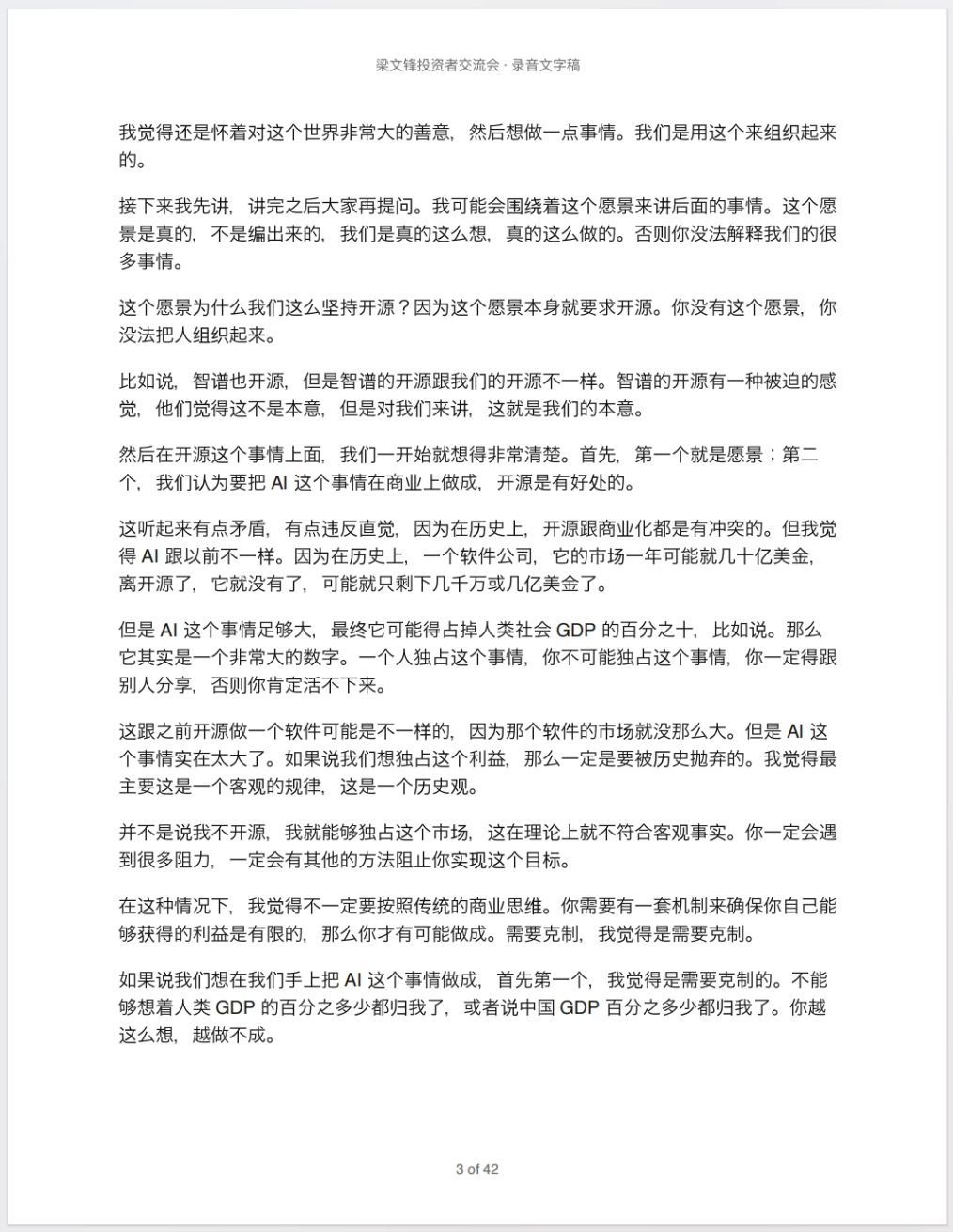
- First, it is required by the vision. Without this vision, it would be impossible to organize people. Zhipu also open-sources, but there is a feeling of being forced into it; for DeepSeek, open source is the original intent.
- Second, it is a business judgment. AI will ultimately account for 10% of human society's GDP, and the market size is too large to be monopolized by one company. The more one thinks about monopolizing it, the greater the resistance, and the easier it is to be abandoned by history.
Open source and business do not conflict, provided that only reasonable profits are made—pricing based on recouping equipment costs in ten months (about 6 times profit). At this profit level, third parties cannot achieve the same deployment cost, and open source will not affect revenue. He even said that the strongest models will also be open-sourced, and "I don't see any benefit in closed source."
Philosophy of Restraint
- Pricing restraint: Recouping costs in ten months is enough; do not pursue profit maximization. Once, when a model had just launched with relatively high pricing, the team was unhappy, and later it was reduced to a quarter, and many people in the group cheered. Because so much effort was spent making the model good, the purpose was to make it affordable for everyone.
- User restraint: Last year during the Spring Festival, C-end users surged, and it did not take the opportunity to monetize, grab traffic, or make it into a super app. There was no idea of "making the next ByteDance, the next Tencent." The AGI opportunity is too great; what is in front is merely sesame seeds.
- Business restraint: 3D, video generation, world models, etc. are not on the main intelligence line, so we don't do them. Not because they have no value, but because they are not the key bottleneck currently limiting AGI. We will do multimodality, but only as a component, not as intelligence itself.
- Restraint in competition: We do not make enemies of any major or small internet company, and are even willing to help competitors. Because it is open-sourced, there is no boundary to begin with, and we hope to assist everyone in reproducing it.
AGI technology roadmap
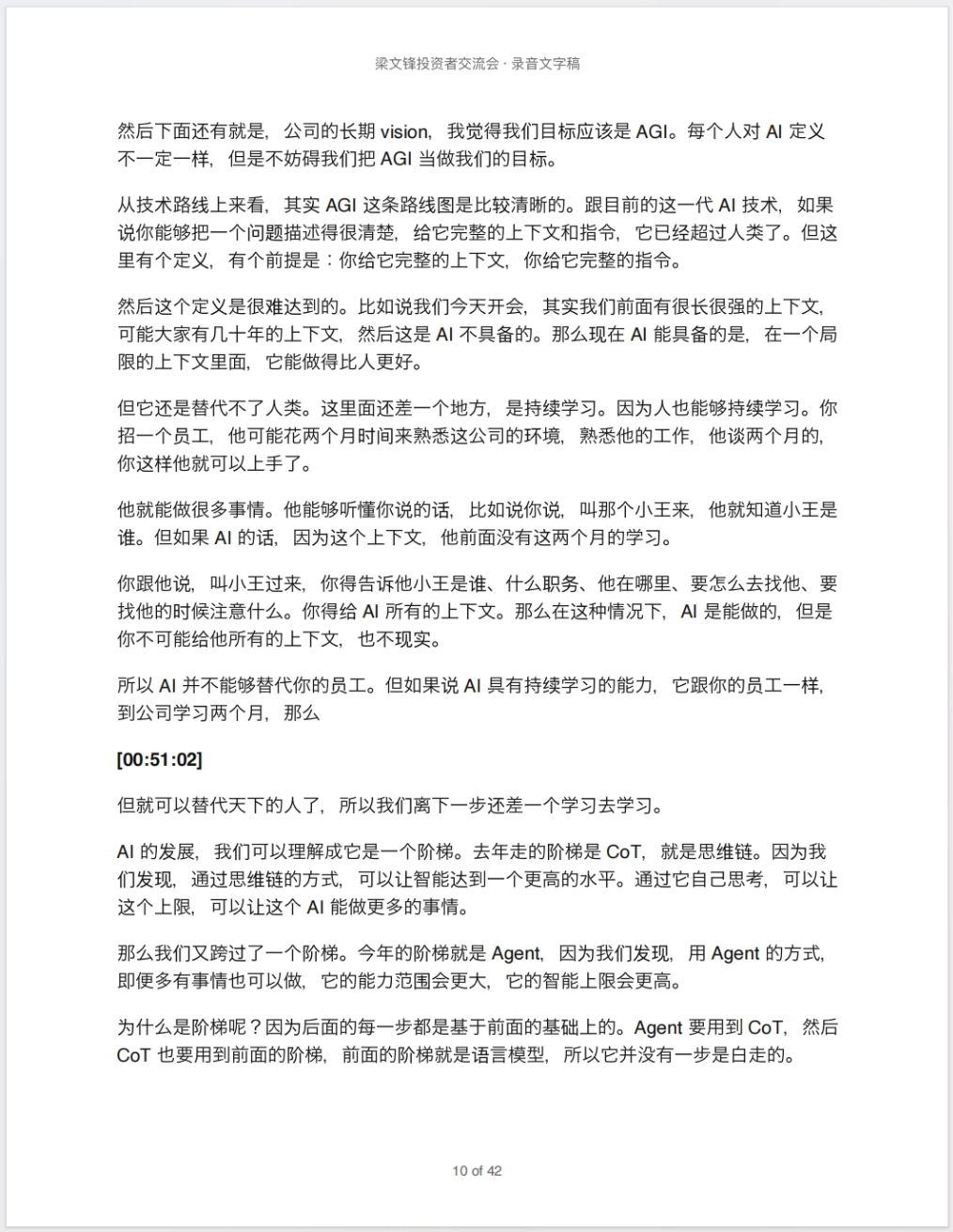
AI development is a stepped evolution; each step is based on the previous one, and no step is taken in vain.
- Language models are the foundational capability. CoT chain-of-thought is the step crossed last year, raising the upper limit of intelligence through self-thinking. Agent is the step being taken this year, with a larger scope of capability. Agent will reach its capability limit, but "still cannot replace your employees," because it cannot continuously learn.
- The next bottleneck: continuous learning. Make AI spend two months like a new employee getting familiar with the environment and understanding context. The world has not yet found a very effective solution.
- After solving continuous learning, we arrive at the self-iteration singularity. The model can develop the next version itself and research more advanced AI itself. This is a gradual process, not a sudden mutation.
- Embodied intelligence. The model enters the real world, does housework, and cares for the elderly. At this step it does not need people to do it; the model itself can come out.
Organizational management characteristics
- Two lines in parallel. Top-down is formal projects, requiring division of labor and coordination, for example releasing the V4 model, taking no more than half the time. Bottom-up is free exploration, with no KPIs and no one managing it, taking at least half the time, exploring directions one considers important.
- No overtime. First, research needs a relaxed environment; if pushed too hard, research cannot be done. Second, the company is very focused and restrained, so there is not that much to do. Many products are imperfect, and we do not patch them either.
- There is only one core interest: team stability. This is the only thing that cannot be conceded; everything else can be restrained. As long as the core people do not leave, AGI will definitely be achieved; everything else is a matter of time, at most half a year or a year later. Money and resources are not a problem.
China-US gap and compute
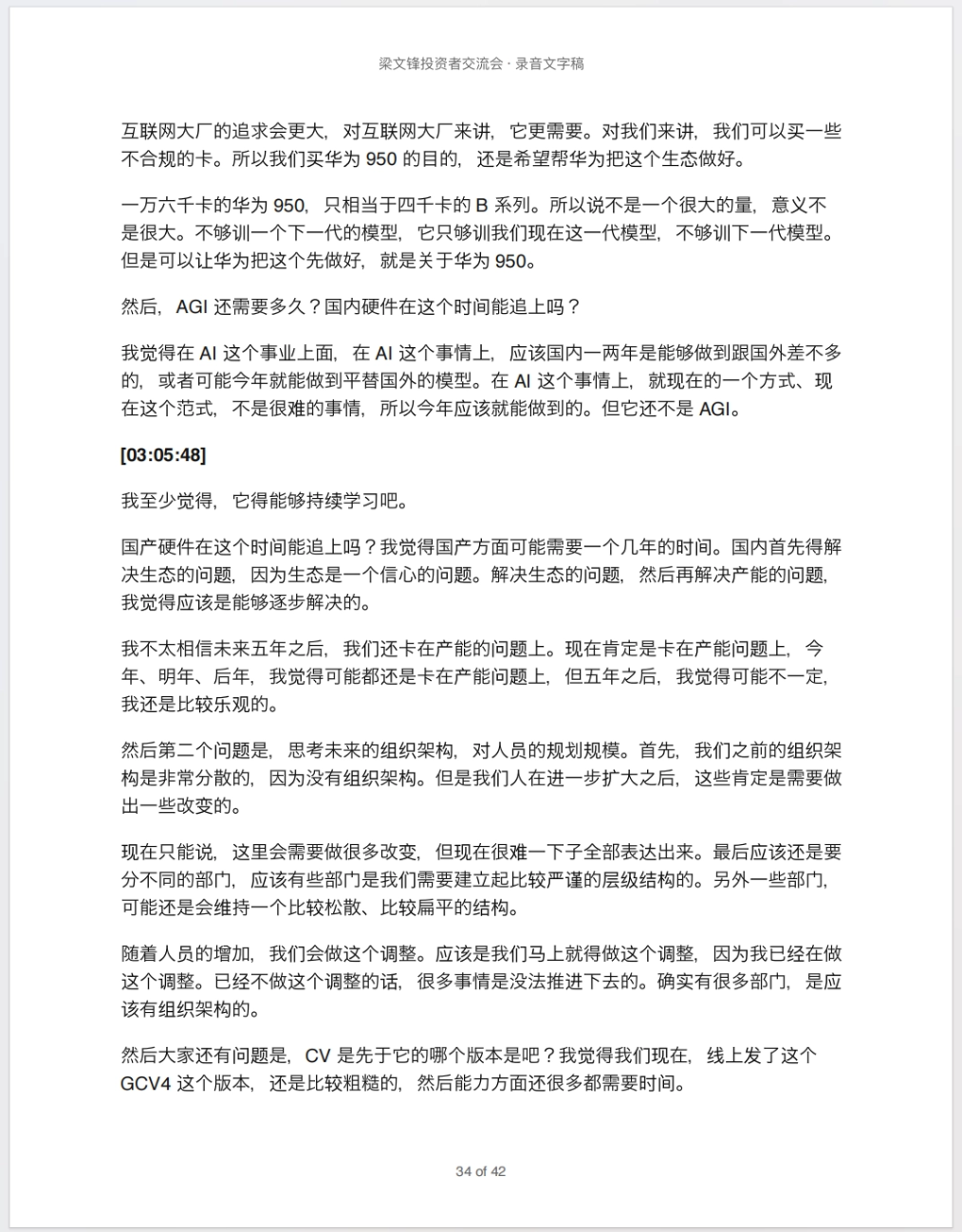
The gap is mainly in compute resources, not talent. There is almost no talent gap; it is basically the same group of people, and China has a large base and adds many every year. Currently about 20,000 H-equivalent compute, far lower than the United States. China's largest model has tens of B activated, while the United States has reached 800B, a difference of an order of magnitude. Training an equally large model requires 50,000 GB300s or 200,000 Huawei cards.
We are about 12 to 18 months behind in time. The strategy is "buy as many cards as you can," and it would be ideal to spend all the financing within half a year. Buying cards is more cost-effective than putting money in the bank; the social cost can be recovered in ten months.
Domestic chips: four Huawei 950s are equivalent to one NVIDIA GB300, two years behind. In terms of ecosystem there will not be a gap in the future, because the TileLang high-level compiler + AI writing code can quickly rebuild the ecosystem. V3 training is already almost independent of the NVIDIA ecosystem. The only bottleneck is insufficient production capacity; Huawei can only supply about 16,000 cards.
Commercialization and finance
Both C-end and B-end are byproducts of doing AGI, not the goal.
- C-endUsers "cannot even be driven away," maintained at low cost, and we do not know what use they will have later; if it can be picked up easily, then pick it up along the way.
- B-endOptimistic about growth, possibly reaching several hundred million USD in ARR. If AI can reach one billion USD, the company's cash flow will turn positive, covering R&D expenses.
Judgment of the competitive landscape
The gap in the endgame lies in three aspects: cost ranks first, time second, and user experience third. Beyond that, there is no essential gap. There are "too many" companies in China building foundation models, while there may be only three in the US. Resources are dispersed, and some are wasted. Ultimately, it will converge to three or four companies, and competition will be quite sufficient. There will be no windfall profits, only reasonable profits. Because if the profit margin is very high, "it definitely does not conform to objective laws." China is very likely to be one of the global AI "three-body" powers; low systemic costs are a structural advantage, and "AI produced in China may be cheaper."
Get for free the 《Liang Wenfeng Investor Exchange Meeting · Audio Transcript》report PDF original file, scan the QR code to follow and reply with the code word: 20260723