
What is LEOPARD
LEOPARD is a vision-language model launched by Tencent AI Lab Seattle Lab, specifically designed to understand and process multi-image tasks containing large amounts of text. LEOPARD is based on two main technological innovations: first, the curation of approximately one million high-quality multimodal instruction tuning data samples specifically for text-rich, multi-image scenarios; second, the development of an adaptive high-resolution multi-image encoding module that dynamically optimizes the allocation of visual sequence length. LEOPARD demonstrates outstanding performance on multiple benchmarks and excels in complex tasks that require understanding the content of a single image and reasoning across multiple visual inputs.
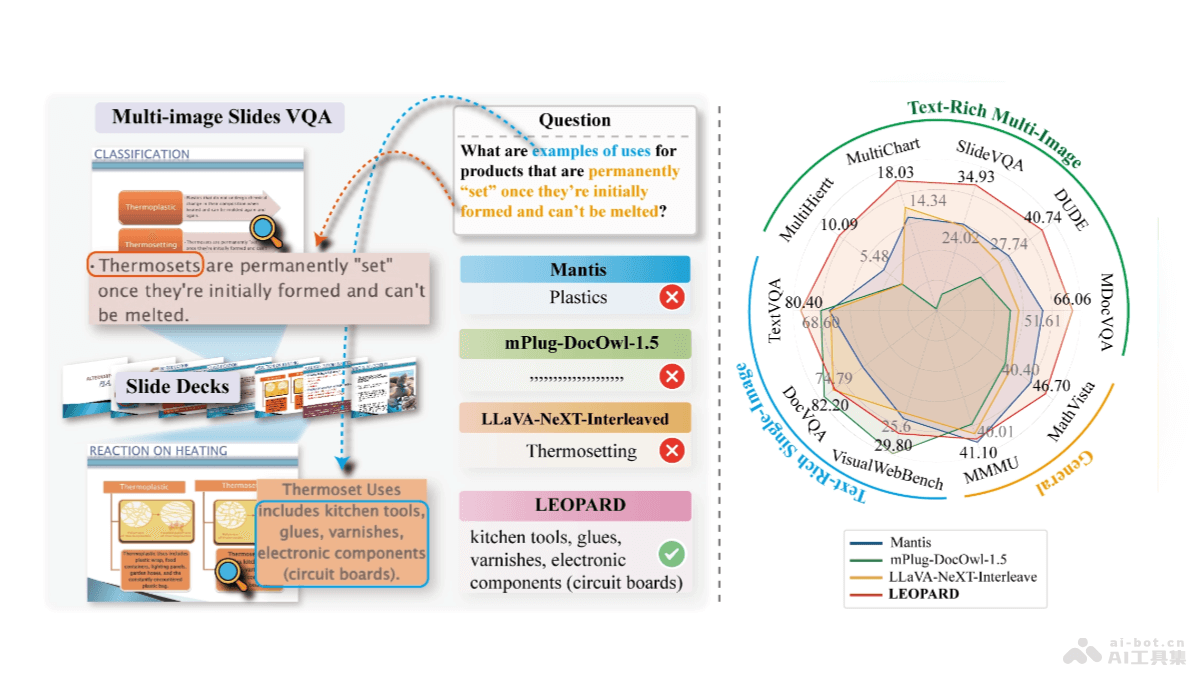
Main Features of LEOPARD
- Processing Text-Rich Multi-Image Tasks: Used to understand and process multi-image scenarios containing large amounts of textual information, such as slides, scanned documents, and webpage screenshots.
- Cross-Image Reasoning: The model can understand the content of a single image and perform logical reasoning and establish relationships across multiple images.
- High-Resolution Image Processing: Based on the adaptive high-resolution multi-image encoding module, it can effectively process high-resolution images and maintain the clarity of text and details.
- Dynamic Visual Sequence Length Optimization: Dynamically optimizes the visual sequence length according to the original aspect ratio and resolution of the input image, balancing image details and model processing capability.
- Multimodal Instruction Tuning: Uses a large-scale multimodal instruction tuning dataset and can be optimized for complex vision-language tasks.
Technical Principles of LEOPARD
- Multimodal Large Language Model (MLLM): Based on the MLLM architecture, it integrates a visual encoder, a vision-language connector, and a language model to process visual and textual information.
- Dataset Construction: Constructs the LEOPARD-INSTRUCT dataset, containing approximately one million instructions for text-rich, multi-image scenarios, used for model training and optimization.
- Adaptive High-Resolution Encoding: Based on an adaptive strategy, it dynamically adjusts the visual feature sequence according to the characteristics of the input image to adapt to the model's sequence length limit.
- Pixel Shuffle Technology: Applies pixel shuffle operations to compress long visual feature sequences losslessly into shorter sequences, making it easier for the model to process more high-resolution images.
- Image Splitting: Splits high-resolution images into multiple sub-images so they can be processed independently while preserving details, and then inputs the visual features together with textual information into the language model.
LEOPARD Project Address
- GitHub Repository:https://github.com/tencent-ailab/Leopard
- HuggingFace Model Library:https://huggingface.co/datasets/wyu1/Leopard-Instruct
- arXiv Technical Paper:https://arxiv.org/pdf/2410.01744
Application Scenarios of LEOPARD
- Automated Document Understanding: Processes multi-page documents such as contracts, reports, and academic papers, automatically extracting key information and data.
- Education and Academic Research: Assists educational tools such as e-courseware and academic presentations, providing interactive learning experiences.
- Business Intelligence and Data Analysis: Analyzes business charts and tables, providing market trend predictions and decision support.
- Web Content Analysis: Understands and extracts webpage content for search engine optimization (SEO) and content recommendation systems.
- Customer Service and Support: Based on analyzing user-uploaded images and text, provide more accurate customer service and technical support.