
What is LegoGPT
LegoGPT is a Lego brick design model launched by Carnegie Mellon University that supports generating physically stable and buildable Lego brick models based on text prompts. LegoGPT is trained on autoregressive language models and a large-scale Lego design dataset, gradually generating Lego structures according to user-input text descriptions, ensuring the stability and assemblability of the design. LegoGPT supports adding textures and colors to Lego models, and the generated models can be manually assembled or automatically assembled by robots. LegoGPT provides an efficient and creative generation method for Lego design, promoting the application of AI in the physical world.
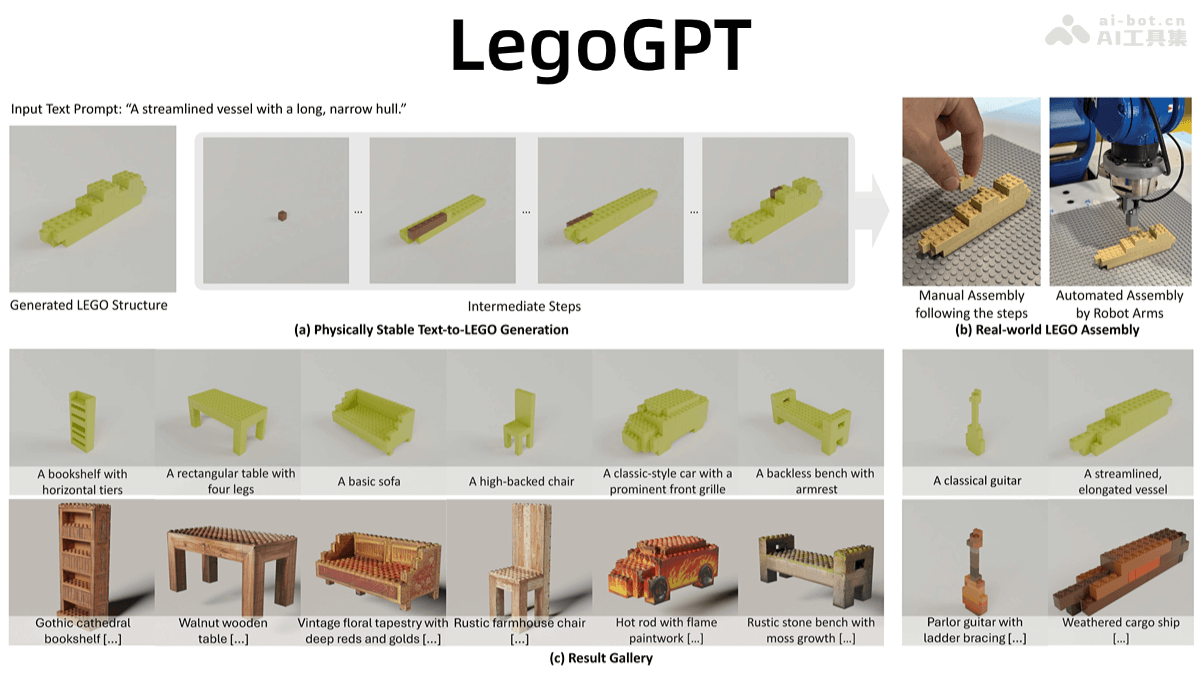
Main Features of LegoGPT
- Text-to-Lego Design: Generates physically stable and buildable Lego brick models based on user-input text descriptions (such as "a chair with four straight legs").
- Physical Stability Verification: Checks in real time whether the generated Lego structure is stable; if unstable, it automatically rolls back and regenerates.
- Texture and Coloring Function: Adds textures and colors to the generated Lego models.
- Automatic Assembly Support: The generated Lego designs are suitable for manual assembly and robotic automatic assembly.
Technical Principles of LegoGPT
- Autoregressive Language Model: Uses an autoregressive language model as the base architecture. It transforms the Lego design task into a sequence generation problem, gradually constructing the Lego structure by predicting the placement position and size of the next brick.
- Physics-Aware Rollback Mechanism: During the generation process, it checks in real time whether the generated Lego structure meets physical stability requirements. If an unstable part is found, the model rolls back to the most recent stable state and regenerates the subsequent bricks, ensuring the stability of the final design.
- Text-to-Lego Mapping: Uses natural language processing technology to understand geometric and structural information in the text and convert it into placement instructions for Lego bricks.
- Large-Scale Dataset Training: LegoGPT's training dataset contains a large number of Lego structures and corresponding text descriptions. By training on these data, the model can learn how to generate stable and diverse Lego designs from text.
LegoGPT Project Addresses
- Project Official Website:https://avalovelace1.github.io/LegoGPT/
- GitHub Repository:https://github.com/AvaLovelace1/LegoGPT/
- arXiv Technical Paper:https://arxiv.org/pdf/2505.05469
- Online Experience Demo:https://huggingface.co/spaces/cmu-gil/LegoGPT-Demo
Application Scenarios of LegoGPT
- Creative Design: Helps designers quickly generate Lego prototypes and validate ideas.
- Educational Tool: Inspires students' creativity and helps them learn physics and spatial knowledge.
- Toy Development: Generates personalized models for Lego enthusiasts.
- Automated Assembly: Supports robotic automatic assembly of Lego, improving efficiency.
- Virtual Reality: Generates realistic Lego models for VR and games.