
What is Leffa
Leffa (Learning Flow Fields in Attention) is a framework for controllable character image generation launched by Meta AI. It is based on introducing flow field learning into the attention mechanism to precisely control character appearance and pose. Leffa is based on a regularization loss function to guide the model during training to focus target queries on the correct regions in the reference image, reducing detail distortion and improving image quality. Leffa does not add extra parameters or inference cost, and is applicable to a variety of diffusion models, demonstrating good model-agnosticism and generalization ability.
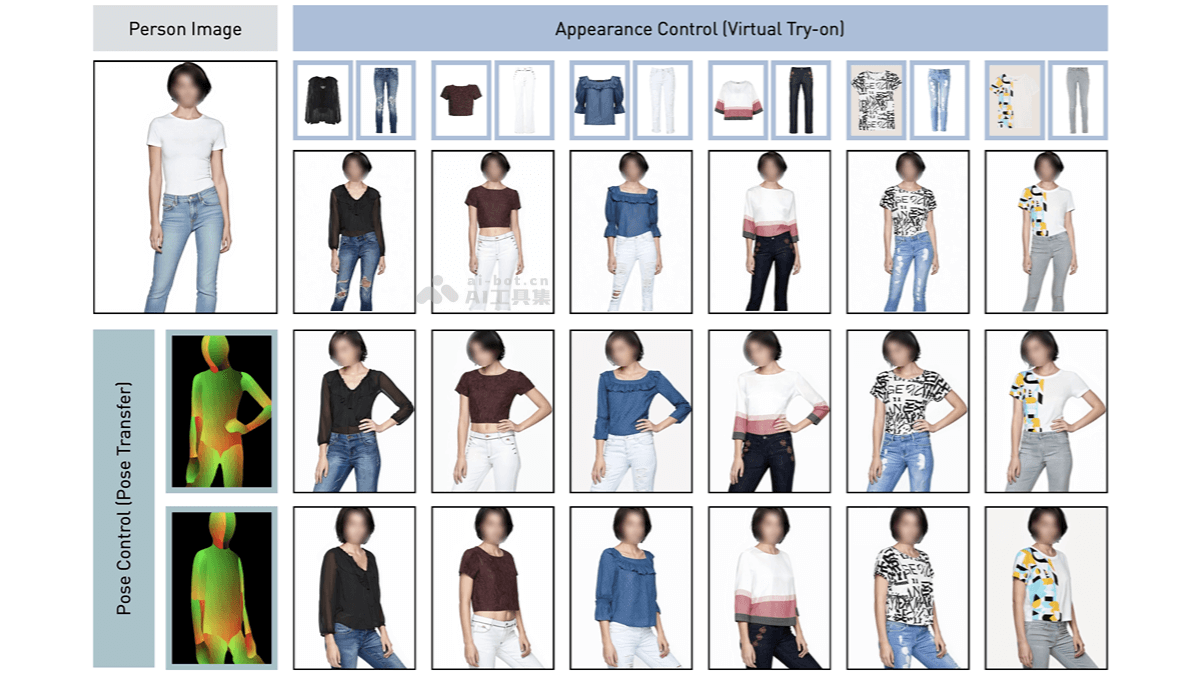
Main Features of Leffa
- Appearance Control (Virtual Try-On): Generate a character image wearing the clothing based on a reference image (such as a clothing image), while keeping the character's original features unchanged.
- Pose Control (Pose Transfer): L transfers a character's pose from one image to another, preserving the character's appearance details.
- Detail Preservation: Reduce detail distortion in generated images, such as textures, text, and logos.
- Quality Maintenance: Maintain the overall high quality of generated images while controlling details.
Technical Principles of Leffa
- Attention Mechanism: Based on the attention mechanism, use attention layers to associate the target image (the character image to be generated) with the reference image (the image providing appearance or pose).
- Flow Field Learning: Based on learning flow fields in the attention layers, explicitly guide the target query to focus on the correct regions of the reference key.
- Regularization Loss: Apply regularization loss on the attention map, deform the reference image to align more closely with the target image, and encourage the model to correctly focus on reference regions during training.
- Spatial Consistency: Based on converting the attention map to a flow field, use grid sampling operations to deform the reference image, ensuring spatial consistency between the target query and the reference image.
- Model-Agnosticism: As a regularization loss function, it can be integrated into different diffusion models without additional parameters or complex training techniques.
- Progressive Training: Apply in the final stage of training to avoid early performance degradation, based on fine-tuning by combining traditional diffusion loss and Leffa loss to optimize model performance.
Leffa Project Address
- GitHub Repository:https://github.com/franciszzj/Leffa
- HuggingFace Model Library:https://huggingface.co/franciszzj/Leffa
- arXiv Technical Paper:https://arxiv.org/pdf/2412.08486
- Online Experience Demo:https://huggingface.co/spaces/franciszzj/Leffa
Application Scenarios of Leffa
- Virtual Try-On: In e-commerce and the fashion industry, create virtual fitting rooms, allowing consumers to see themselves wearing different clothes online without actually trying them on.
- Augmented Reality (AR): In AR applications, change or add the user's appearance and clothing in real time, providing a more immersive experience.
- Games and Entertainment: In game development, used for character customization, allowing players to adjust the character's appearance and posture according to their preferences.
- Film and Video Production: In film post-production, generate or modify character images, such as changing an actor's clothing or posture, without reshooting.
- Personalized Advertising: In the advertising industry, generate personalized advertising images and customize the model's image based on the characteristics of the target audience.