
What is LayerSkip
LayerSkip is a technology used to accelerate the inference process of large language models (LLMs). Based on applying layer dropout and early exit loss during the training phase, it enables the model to exit more accurately from early layers during inference, without needing to traverse all layers. It improves the model's inference speed and reduces the consumption of computational resources. LayerSkip introduces a self-speculative decoding method. The method is based on early layer exit to generate tokens, uses the remaining layers for verification and correction, improves decoding efficiency, uses less memory, and benefits from shared computation and activations. LayerSkip shows significant speed improvements on a variety of tasks, such as document summarization, programming tasks, and semantic parsing, while maintaining high accuracy.
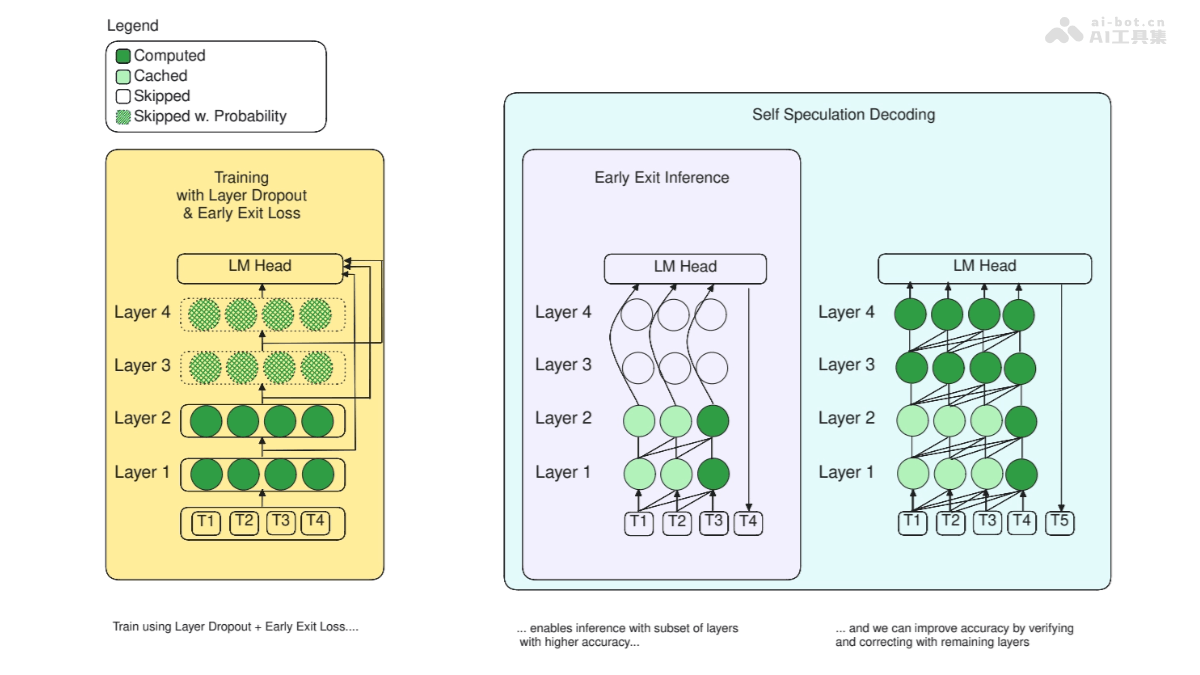
LayerSkip's main features
- Accelerating the inference of large language models: By reducing the number of layers the model needs to traverse when generating output, LayerSkip can improve the model's inference speed.
- Early exit inference: Applying layer dropout and early exit loss during training enables the model to accurately exit from early layers during inference, without having to use all layers.
- Self-speculative decoding: LayerSkip proposes a self-speculative decoding method, which supports the model in generating predictions at early layers and using the remaining layers for verification and correction, improving decoding efficiency.
LayerSkip's technical principles
- Layer dropout: During training, LayerSkip uses different dropout rates for different model layers, with lower dropout rates for early layers and higher dropout rates for later layers. The differentiated dropout strategy encourages the model to learn more general features in early layers and reduces dependence on deep layers.
- Early exit loss: To improve the prediction accuracy of early layers, LayerSkip introduces early exit loss during training, enabling the model's output layer (LM head) to better process embeddings from early layers.
- Self-speculative decoding: During inference, LayerSkip uses early layers to quickly generate predictions (drafts), and uses the model's remaining layers to verify and correct the predictions. The method is based on the fact that verifying a set of tokens is faster than generating each token autoregressively, reducing overall inference time.
- Cache reuse: To further optimize self-speculative decoding, LayerSkip reuses activations and key-value (KV) caches during the draft and verification stages, reducing memory usage and computation.
LayerSkip's project addresses
- GitHub repository:https://github.com/facebookresearch/LayerSkip
- HuggingFace model library:https://huggingface.co/collections/facebook/layerskip-666b25c50c8ae90e1965727a
- arXiv technical paper:https://arxiv.org/pdf/2404.16710
LayerSkip's application scenarios
- Real-time applications: In scenarios requiring immediate feedback, such as online customer service, chatbots, and speech recognition systems, LayerSkip can speed up response times and improve user experience.
- Mobile and edge computing: LayerSkip reduces the model's computational requirements, enabling large language models to be deployed on resource-constrained mobile devices or edge devices, suitable for offline or low-latency application needs.
- Online translation: In multilingual environments, LayerSkip can accelerate the inference process of language models and provide faster translation services.
- Content generation: For applications that need to generate textual content such as articles, reports, or code, LayerSkip can improve the speed of content generation and shorten creation time.
- Natural language processing (NLP) tasks: Layer Skip is used in various NLP tasks, such as text summarization, sentiment analysis, question answering systems, etc., to improve task processing speed.