
What is LayerDiffusion
LayerDiffusion (now renamed LayerDiffuse) is a technology proposed by Stanford University researchers Lvmin Zhang (the author of ControlNet, Zhang Lvmin) and Maneesh Agrawala that uses large-scale pretrained latent diffusion models (such as Stable Diffusion) to generate transparent images, helping users generate a single transparent image or multiple transparent layers. The core of this method lies in introducing the concept of "latent transparency," encoding the transparency information of the image's alpha channel into the latent space, thereby enabling models originally used to generate non-transparent images to generate images with transparency.
With LayerDiffusion, users do not need to first generate an image and then use AI technologies such as Remove.bg for cutout; they can directly and quickly generate ready-to-use images with transparent backgrounds.
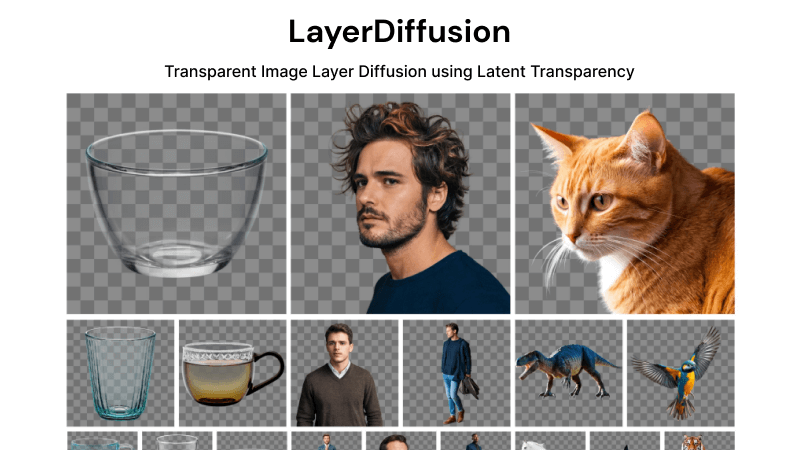
LayerDiffusion official website entry
- GitHub code repository:https://github.com/layerdiffusion/LayerDiffusion(Models and source code will be released soon)
- LayerDiffusion SD WebUI version:https://github.com/layerdiffusion/sd-forge-layerdiffusion
- arXiv research paper:https://arxiv.org/abs/2402.17113
LayerDiffusion features
- Generate transparent images: LayerDiffusio can generate images with transparency, meaning it can create images with an alpha channel, where the alpha channel defines the transparency of each pixel in the image.
- Generate multiple transparent layers: In addition to a single transparent image, LayerDiffusion can also generate multiple transparent layers. These layers can be generated independently or based on specific conditions (such as foreground or background), and can be blended together to create complex scenes.
- Condition-controlled generation: LayerDiffusion supports condition-controlled generation, generating foreground or background based on a transparent image, providing flexibility for creating images for specific scenes.
- Layer content structure control: Users can also combine LayerDiffusion with the ControlNet control framework to apply structural control to layer content, guiding layers, layouts, elements, object shapes, and more.
- Repeated iterative layer composition: LayerDiffusion can iteratively combine multiple layers by repeatedly applying the background-conditioned foreground model, incrementally building composite images with any number of transparent layers.
- High-quality image output: By adding transparency as a latent offset to the latent space of the pretrained model, LayerDiffusion can maintain the high-quality output of the pretrained model without significantly changing the original latent distribution.
How LayerDiffusion works
- Preparation of the latent space:
- First, LayerDiffusion uses the latent space of a pretrained latent diffusion model (such as Stable Diffusion), which is obtained by encoding RGB images through a variational autoencoder (VAE).
- To support transparency, LayerDiffusion introduces an additional dimension in the latent space (latent transparency) to represent the image's alpha channel (transparency information).
- Encoding and decoding of latent transparency:
- LayerDiffusion trains two independent neural networks: a latent transparency encoder and a latent transparency decoder.
- The encoder receives the RGB and alpha channels of the original image and encodes the transparency information as a latent offset, which is added to the representation of the latent space.
- The decoder then extracts the transparency information from the adjusted latent representation and decodes it back to the original alpha channel.
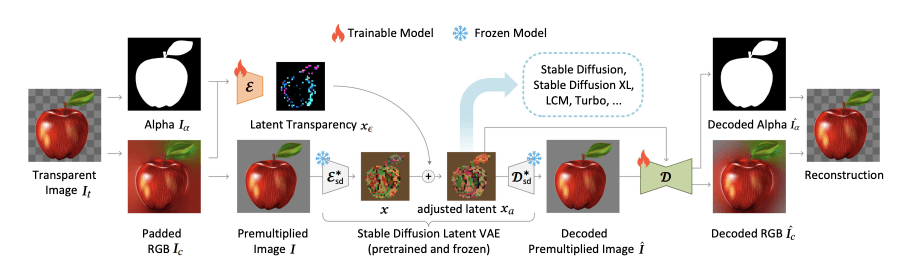
- Adjustment of the latent space:
- To ensure that the added transparency information does not disrupt the distribution of the original latent space, LayerDiffusion adjusts the latent representation through latent offsets.
- This process involves a "harmlessness" metric, which evaluates whether the latent offsets have damaged the model's reconstruction ability by comparing the decoding results of the original pretrained model's decoder on the adjusted latent representation.
- Fine-tuning of the diffusion model:
- After introducing transparency information into the latent space, LayerDiffusion fine-tunes the original diffusion model so that it can generate transparent images in the new latent space.
- This process involves training the diffusion model so that it can learn how to preserve transparency information during the process of adding noise.
- Multi-layer generation:
- LayerDiffusion also extends its capabilities to support the generation of multiple transparent layers. This is achieved through shared attention mechanisms and low-rank adaptations (LoRAs), ensuring consistency and harmonious blending between different layers.
- Dataset preparation and training:
- To train the model, the researchers collected a large number of transparent images (consisting of 1 million transparent images, covering a variety of content themes and styles), and these data were obtained through a human-involved collection scheme. Based on this dataset, the model was trained to generate high-quality transparent images and layers.