
What is LatentLM
LatentLM is a multimodal generative model jointly launched by Microsoft Research and Tsinghua University. It can uniformly process discrete data (such as text) and continuous data (such as images and audio). The model uses a variational autoencoder (VAE) to encode continuous data into latent vectors, and introduces next-token diffusion technology to autoregressively generate vectors. LatentLM is implemented based on a causal Transformer architecture to enable information sharing between different modalities, improving the model's performance and scalability in multimodal tasks. LatentLM introduces σ-VAE to solve the variance collapse problem and enhance the robustness of autoregressive modeling, demonstrating outstanding performance in multiple fields such as image generation, multimodal large language models, and text-to-speech synthesis.
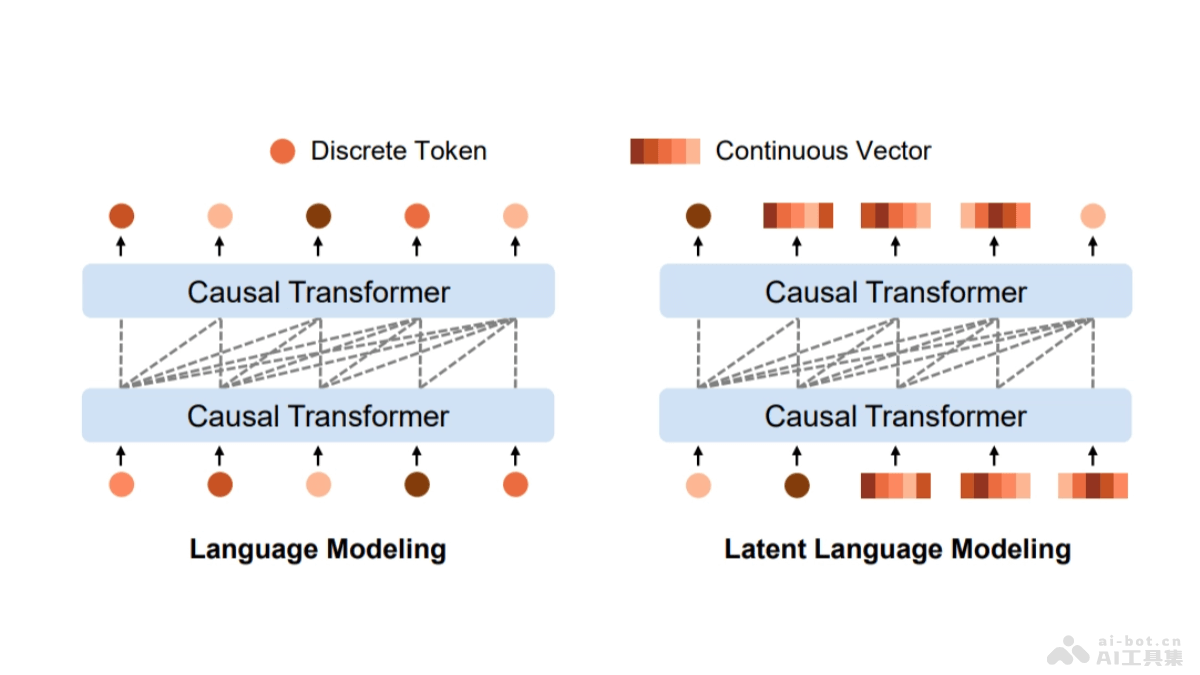
Main features of LatentLM
- Multimodal data processing: Simultaneously processes discrete data (such as text and code) and continuous data (such as images, audio, and video).
- Unified generation and understanding interface: Provides an interface that unifies the generation and understanding of multimodal data; for example, it can generate any combination of text, images, audio, and video.
- Autoregressive generation: Based on next-token diffusion technology, the model autoregressively generates latent vectors for continuous data.
- High-performance image generation: In image generation tasks, it is comparable to models based on diffusion or discrete tokens.
- Multimodal large language model integration: Integrates into multimodal large language models to improve the performance of language models in multimodal tasks.
- Text-to-speech synthesis: In the field of text-to-speech synthesis, it achieves performance superior to existing state-of-the-art models with fewer decoding steps.
Technical principles of LatentLM
- Variational autoencoder (VAE): Uses a VAE to encode continuous data into latent vectors, which are then reconstructed into the original data by a decoder.
- Next-Token Diffusion: A method for autoregressively generating latent vectors, in which a diffusion head produces latent vectors based on each Transformer hidden state.
- Causal Transformer: Uses a causal Transformer to process discrete and continuous data, enabling the model to autoregressively predict the next element in a sequence.
- σ-VAE: To solve the variance collapse problem, LatentLM proposes σ-VAE, which improves the model's robustness in autoregressive modeling by maintaining a fixed variance in the latent space.
- Mixed-modal training: Handles different types of data during training, including pure text data, image-text pair data, and interleaved image-text data.
- Efficient inference process: During inference, it achieves an efficient decoding process based on a single pass through the Transformer backbone and multiple denoising steps of a lightweight diffusion head.
LatentLM project address
- GitHub repository:https://github.com/microsoft/unilm/tree/master/LatentLM
- arXiv technical paper:https://arxiv.org/pdf/2412.08635
Application scenarios of LatentLM
- Image generation: Automatically creates corresponding images based on text descriptions provided by users, suitable for rapid prototyping in advertising design and game development.
- Intelligent customer service: In customer service, understands users' natural language queries and provides multimodal responses containing images, text, and links.
- Voice assistant: Converts users' voice commands into text and provides voice responses, suitable for smart home control and personal assistant devices.
- Automatic subtitle generation: Generates subtitles matching video content in real time within video content, improving content accessibility.
- Virtual anchor: Based on speech and images generated by LatentLM, creates virtual news anchors or virtual instructors for instructional videos.