
What is LangExtract
LangExtract is a Python library open-sourced by Google for extracting structured information from unstructured text. LangExtract uses large language models (LLMs) to automatically process materials such as clinical notes and reports, identify and organize key details, and ensure that the extracted data precisely corresponds to the source text. LangExtract supports a variety of LLMs, including cloud-hosted models (such as Google Gemini) and local open-source models (through the Ollama interface). LangExtract requires no model fine-tuning and is applicable to any domain. Defining extraction tasks with a few examples greatly lowers the barrier to use.
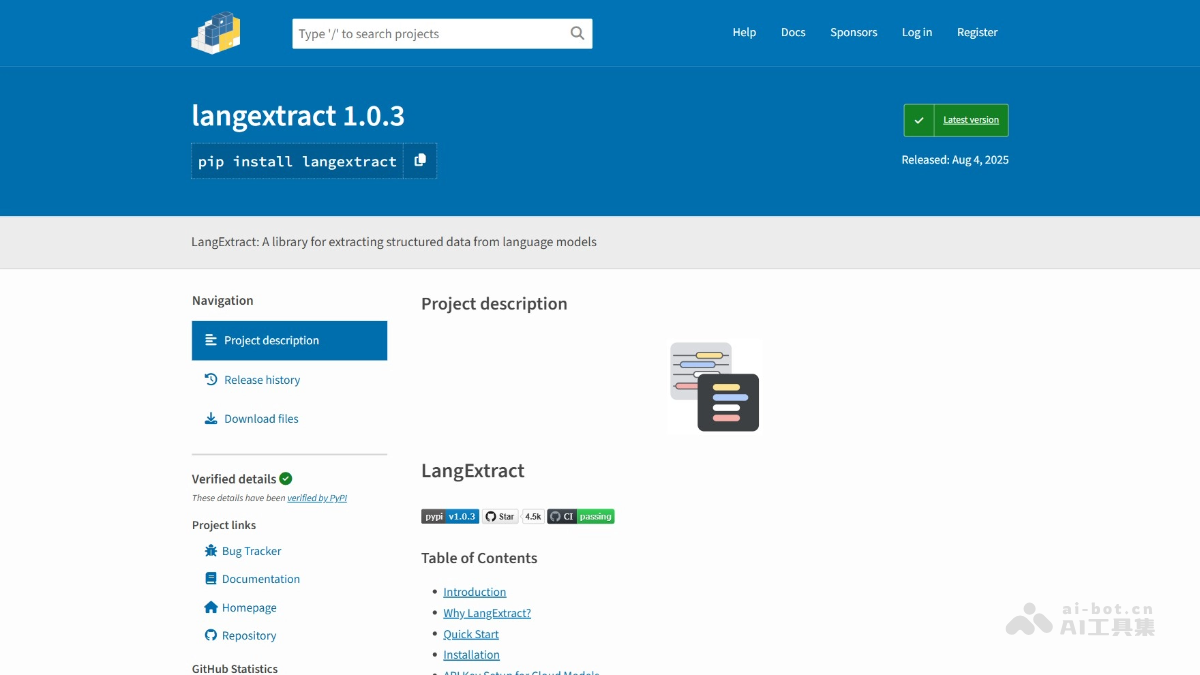
Main features of LangExtract
- Precise source grounding: Maps each extraction to the exact location in the source text, supports visual highlighting, and facilitates verification and traceability.
- Reliable structured output: Based on user-provided examples, enforces a consistent output schema to ensure the accuracy and consistency of extraction results.
- Long document processing: Based on optimized text chunking, parallel processing, and multi-pass extraction, efficiently processes large documents and improves recall.
- Interactive visualization: Generates interactive HTML visualization files, making it convenient for users to review thousands of extractions in their original context.
- Flexible model support: Supports a variety of large language models (LLMs), including cloud-hosted models (such as Google Gemini) and local open-source models (through the Ollama interface).
- Domain adaptability: Define extraction tasks with a few examples, with no model fine-tuning required, applicable to any domain.
- Leveraging the world knowledge of LLMs: Based on precise prompts and examples, guides LLMs to use their knowledge base for smarter extraction.
Technical principles of LangExtract
- Large language models (LLMs): LangExtract uses pretrained large language models (such as Google Gemini or OpenAI's GPT series) to understand text content and generate extraction results. Through user-provided prompts and examples, it guides LLMs to generate structured information that meets requirements.
- Text chunking and parallel processing: For long documents, LangExtract splits text into multiple chunks to facilitate efficient model processing. Using parallel processing technology, it processes multiple text chunks simultaneously, significantly improving processing speed.
- Multi-pass extraction: To improve extraction recall, LangExtract performs multi-pass extraction. Each extraction pass focuses on different text chunks to ensure that important information is not missed.
- Precise source grounding: The result of each extraction is mapped back to the exact location in the source text, ensuring the accuracy and traceability of the extraction. It provides visual highlighting functionality, making it convenient for users to verify extraction results in the original text.
LangExtract project address
- Project official website:https://pypi.org/project/langextract/
- GitHub repository:https://github.com/google/langextract
Application scenarios of LangExtract
- Healthcare industry: Extract key information such as patients' medical history, symptoms, and diagnosis results from electronic medical records to assist medical data analysis and research.
- Legal field: Extract key information from contract clauses and legal documents, helping legal professionals quickly locate important content.
- Financial field: Extract key financial indicators and transaction information from financial reports and transaction records for risk assessment and compliance checks.
- Scientific literature: Extract experimental parameters, data tables, and key conclusions from scientific papers, facilitating literature reviews and data mining for researchers.
- Business documents: Automatically extract key information from invoices, orders, and market research reports to improve the efficiency of business document processing.