
What is LanDiff
LanDiff is an innovative hybrid framework for high-qualitytext-to-video(T2V) generation, combining the advantages of autoregressive language models (LLM) and diffusion models (Diffusion Model), and through a coarse-to-fine generation approach, effectively overcoming the limitations of a single method in semantic understanding and visual quality. It achieved a high score of 85.43 on the VBench T2V benchmark, surpassing multiple open-source and commercial models including the 13B Hunyuan Video.
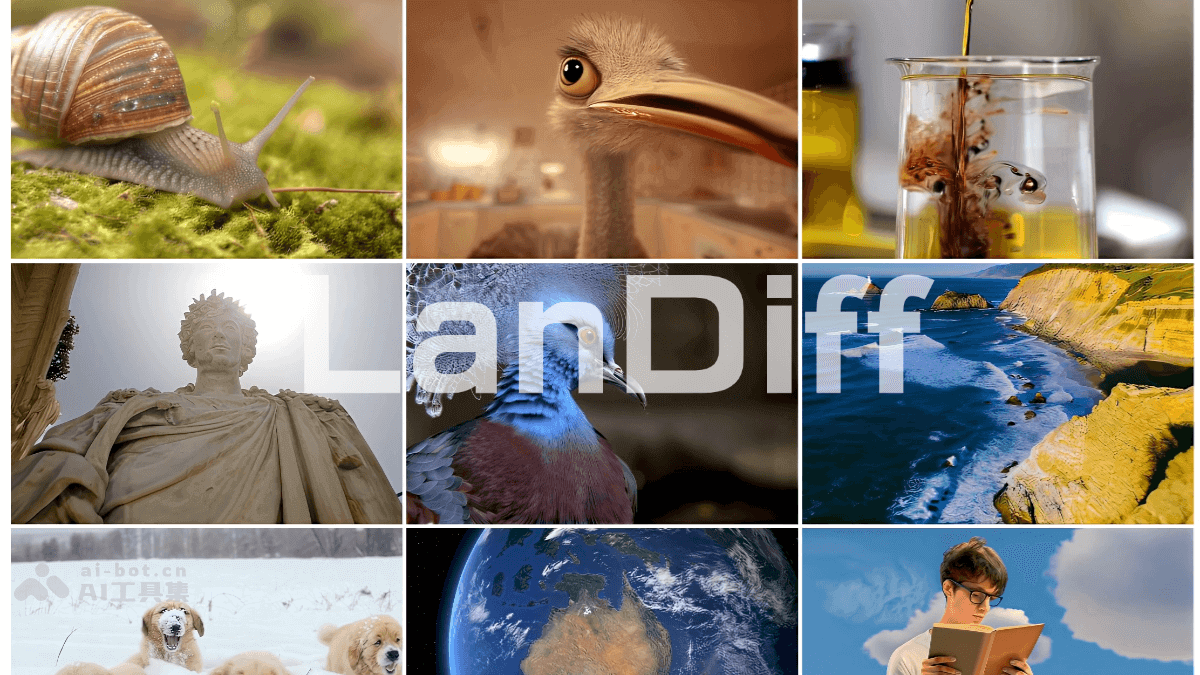
LanDiff's main features
- Efficient semantic compression: Through a semantic tokenizer, 3D visual features are compressed into 1D discrete representations, with a compression ratio of up to 14,000x, preserving rich semantic information.
- High-quality video generation: Based on a streaming diffusion model, semantic tokens are refined into high-fidelity videos, supporting long video generation and reducing computational cost.
- Semantic consistency and causal modeling: Relying on the autoregressive generation of the language model, it ensures that videos are highly consistent with text and temporally coherent, avoiding the temporal incoherence problem of traditional diffusion models.
- Flexible control and customization: Supports control conditions such as frame count and motion score, can generate videos with specific lengths and dynamic characteristics, and balances high-quality visual effects with semantic accuracy.
- Efficient computation and optimization: Uses video frame grouping technology to reduce temporal redundancy, and uses an efficient Transformer structure and attention mechanism to reduce computational resource consumption.
LanDiff's technical principles
- Coarse-to-fine generation paradigm: LanDiff adopts a two-stage generation process:
- First stage (coarse-grained generation): Based on a language model (LLM), semantic tokens are generated. These tokens represent the high-level semantic structure of the video and provide a blueprint for subsequent video generation.
- Second stage (fine-grained generation): Through the diffusion model, these semantic tokens are refined into high-fidelity videos, gradually adding details, and ultimately generating high-quality videos.
- Semantic tokenizer: Compresses 3D visual features into compact 1D discrete representations, with a compression ratio of up to 14,000x. Inspired by the MP4 video encoding algorithm, video frames are divided into keyframes (IFrame) and non-keyframes (PFrame). Keyframes are fully encoded, while non-keyframes only capture temporal changes, significantly reducing temporal redundancy.
- Language model: Uses the pretrained T5-XXL model to extract text features and convert videos into 1D discrete token sequences. Additional control conditions (such as frame count and motion score) are introduced to enhance the controllability of the generation results. Semantic tokens are generated autoregressively to ensure the semantic consistency and temporal coherence of the generated content.
- Streaming diffusion model: Adopts an architecture similar to MMDiT, decodes semantic tokens into semantic features through a video tokenizer decoder, and then uses them as conditions to guide the diffusion model in generating videos.
LanDiff's project address
- Project official website:https://landiff.github.io/
- arXiv technical paper:https://arxiv.org/pdf/2503.04606
LanDiff's application scenarios
- Video production: LanDiff can quickly generate high-quality video content, helping video creators, advertising agencies, and media organizations efficiently produce video ads, short films, animations, etc.
- Virtual reality (VR) and augmented reality (AR): Generate virtual scenes and character animations to enrich the content ecosystem of VR and AR applications.
- Educational videos: Based on teaching syllabi or knowledge point descriptions, generate educational videos to help students understand complex concepts more intuitively.
- Social media content: Generate personalized and engaging video content for social media platforms to enhance brand influence and user engagement.