
What is LanceDB
LanceDB is a serverless vector database designed specifically for artificial intelligence applications, supporting vector search, full-text search, and SQL queries, with optimization for multimodal data processing. It uses vector indexing technology to achieve efficient similarity search, and its scalability depends on disk, improving stability and scalability. LanceDB is easy to integrate, providing a friendly API and visualization tools, and is suitable for AI scenarios such as image recognition and natural language processing.
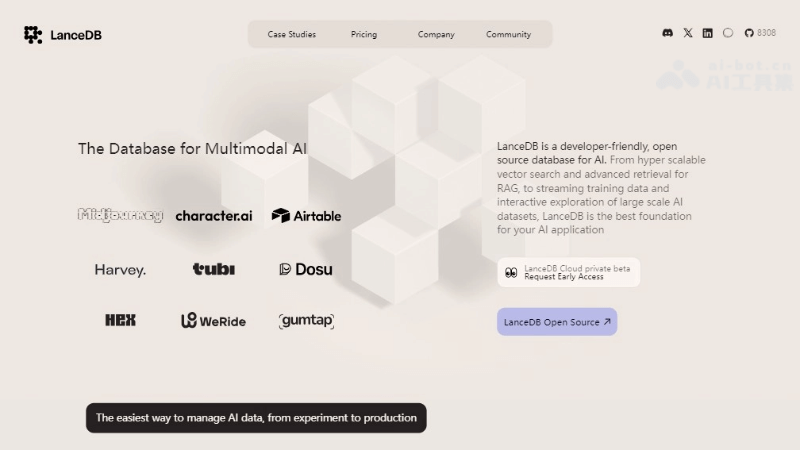
Main features of LanceDB
- Vector search: Supports efficient similarity search of high-dimensional vector data, suitable for scenarios such as image recognition and recommendation systems.
- Full-text search: Provides full-text text search capabilities, enabling fast retrieval of text data.
- SQL support: Allows the use of SQL language for data queries, increasing query flexibility.
- Serverless architecture: No need to manage servers, reducing operational costs and improving development efficiency.
- Multimodal data optimization: Optimized for multiple data types such as images, text, and audio, improving the ability to process complex data.
- Ease of use: Provides developer-friendly API interfaces and visualization tools, simplifying database integration and use.
Technical principles of LanceDB
- Vector indexing technology: LanceDB uses vector indexing technology to process and query high-dimensional vector data. This technology can map high-dimensional data to a low-dimensional space, thereby achieving fast similarity search.
- Columnar storage: Unlike traditional row-based databases, LanceDB uses columnar storage, which can process and query large-scale datasets more effectively, especially when performing data analysis and machine learning tasks.
- Disk-dependent scalability: LanceDB's scalability depends on disk storage rather than memory, making it more stable and scalable when handling large-scale data.
- Serverless architecture: LanceDB is designed as a serverless database, which means developers do not need to manage server infrastructure and can focus more on application development.
- Multimodal data support: LanceDB optimizes the processing of multimodal data (such as text, images, audio, etc.), allowing developers to process different types of data on a unified platform.
Project address of LanceDB
- Project official website:lancedb.com
- Github repository:https://github.com/lancedb/lancedb
Application scenarios of LanceDB
- Image recognition: In the fields of image processing and recognition, LanceDB can store and retrieve image feature vectors for tasks such as image search and similar image lookup.
- Natural language processing (NLP): LanceDB supports the vectorization of text data and can be used for NLP applications such as semantic search, text similarity comparison, and sentiment analysis.
- Recommendation systems: In recommendation systems, LanceDB can store vector representations of users and items, and quickly find items that users may be interested in through vector search.
- Multimodal learning: LanceDB optimizes the processing of multimodal data (combining images, text, audio, etc.), and is suitable for scenarios that require comprehensive analysis of multiple types of data.