
What is Laminar
Laminar is an open-source observability and analytics platform designed specifically for large language model (LLM) applications. Laminar provides a complete set of tools to trace, evaluate, annotate, and analyze LLM data, enabling developers to deeply understand and optimize their applications. Laminar's core features include automatic tracing of LLM calls and database interactions, event-driven analytics, and intuitive dashboard displays. Laminar supports data labeling and reuse, and supports users in building datasets to improve models. Laminar is built on a modern technology stack, including Rust, RabbitMQ, Postgres, and Clickhouse, ensuring high performance and scalability. Laminar simplifies the development and maintenance of LLM applications, improving transparency and efficiency.
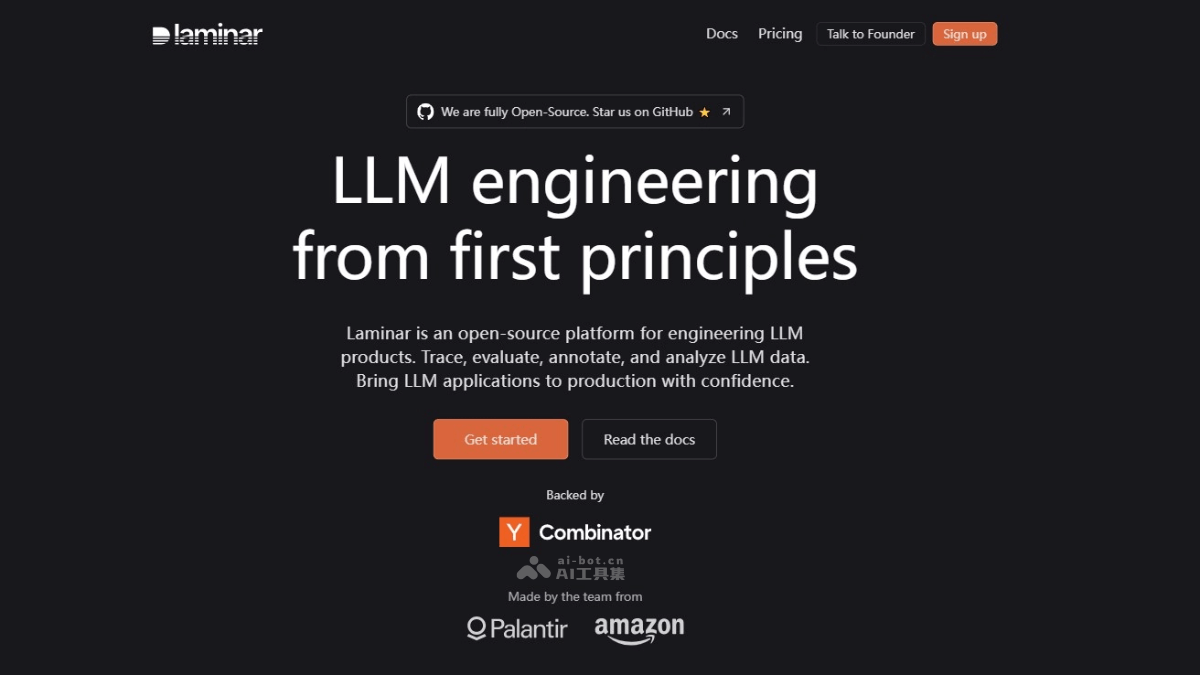
Laminar's main features
- Tracing: Automatically traces LLM calls and vector database interactions, providing execution trajectories of applications.
- Event analytics: Analysis based on semantic events, converting LLM outputs into traceable metrics to help understand the behavior of users or agents.
- Dashboard: Provides an intuitive dashboard that displays trace, span, and event data, making the data clear at a glance.
- Data labeling: Allows users to label and annotate LLM traces, building datasets to improve models.
- Evaluation: Supports offline evaluation, helping analyze model effectiveness.
- Prompt chain management: Builds and hosts chains of prompts and LLMs, simplifying complex workflows.
- Modern technology stack: Built on Rust, RabbitMQ, Postgres, and Clickhouse, ensuring high performance and scalability.
Laminar's technical principles
- OpenTelemetry: Automatic tracing based on OpenTelemetry, compatible with multiple languages and frameworks.
- Semantic events: Extracts semantic events based on natural language processing technology, converting them into traceable metrics.
- Message queue: RabbitMQ serves as the message queue, ensuring reliable transmission of trace data.
- Database technology: Postgres stores application data, and Clickhouse performs efficient event and trace analysis.
- Vector database: Qdrant serves as the vector database, supporting efficient vector search and retrieval.
- Frontend technology: Builds the user interface based on modern frontend technologies such as Next.js.
- Containerization and orchestration: Docker and Kubernetes are used for containerized deployment and orchestration, simplifying deployment and scaling.
Laminar's project address
- Project website:lmnr.ai
- GitHub repository:https://github.com/lmnr-ai/lmnr
Laminar's application scenarios
- Development and debugging: During the development phase, Laminar helps developers trace and analyze LLM calls, enabling a better understanding of model behavior and performance.
- Performance monitoring: In production environments, Laminar monitors the performance of LLM applications, detecting and responding to performance bottlenecks or anomalies in real time.
- User experience optimization: Based on analyzing semantic events generated by user interactions with LLMs, Laminar helps optimize user experience.
- Business decision support: Based on data traced and analyzed by Laminar, enterprises can make more accurate business decisions.
- Model fine-tuning and training: The data annotation feature provided by Laminar helps developers create and organize datasets for fine-tuning and retraining models.
- Automation and Workflow Management: Laminar's prompt chain management feature automates complex LLM workflows and improves efficiency.