
What Is Kosmos
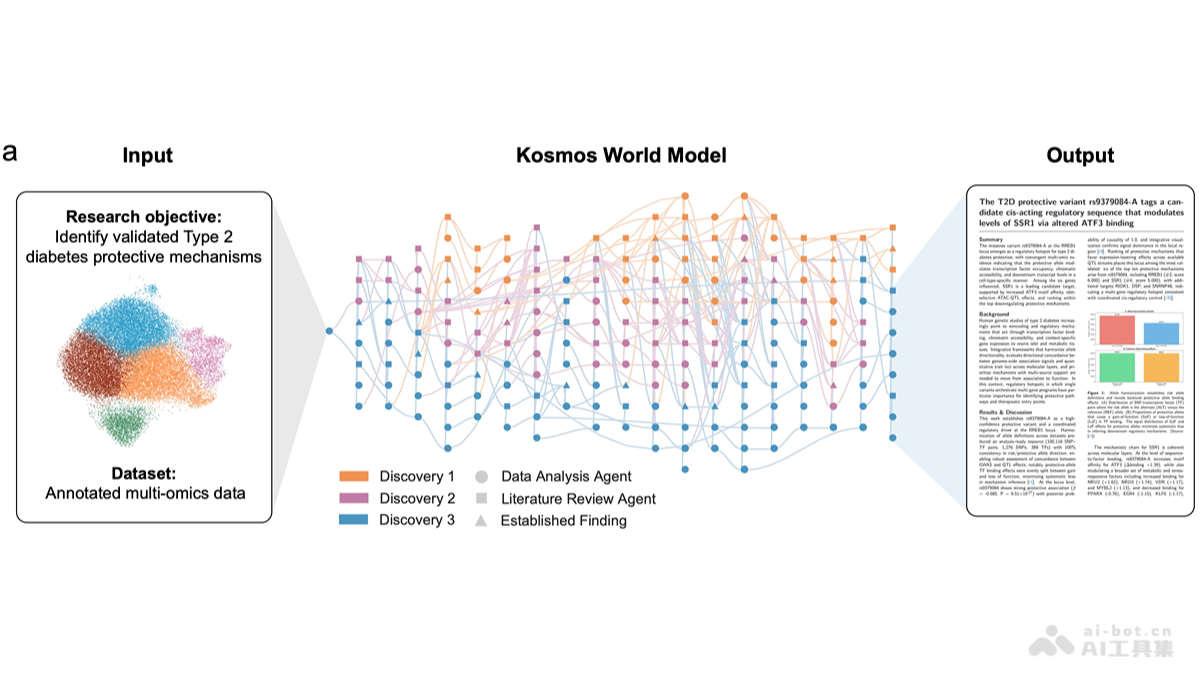
Kosmos is a new-generation AI scientist, upgraded from Robin, the automated scientific research system launched by FutureHouse. Kosmos uses a structured world model to efficiently integrate massive amounts of information. A single run can parse 1,500 papers and execute 42,000 lines of code, handling a scale far beyond similar systems. Kosmos can quickly complete complex research tasks in fields such as neuroscience, materials science, and statistical genetics. One day of work is equivalent to six months of investment by human scientists, and 79.4% of its conclusions are accurate and reliable. Kosmos is fully auditable, ensuring transparent and traceable research.
Kosmos's Main Features
-
Automated scientific discovery: It can independently complete the entire scientific discovery process from literature search and data analysis to hypothesis generation, without manual intervention.
-
Efficient information integration: Through a structured world model, it efficiently integrates massive amounts of information, processing content on the scale of tens of millions of tokens, ensuring the coherence of scientific research goals.
-
Large-scale data analysis: A single run can parse 1,500 papers and execute 42,000 lines of analysis code, handling a scale far beyond existing agent systems.
-
Cross-domain applications: It is applicable to multiple disciplines such as neuroscience, materials science, statistical genetics, and cardiovascular medicine, and can reproduce and propose new scientific discoveries.
-
Full auditability: Every conclusion can be traced back to the code or literature fragment that inspired it, ensuring the research process is transparent and verifiable.
-
Accelerating the research process: The workload completed in one day is equivalent to six months of research investment by human scientists, significantly improving research efficiency.
-
Proposing innovative methods: It can independently develop new analysis methods, such as proposing a new time series analysis method in Alzheimer's disease research.
-
Supporting scientific research: It provides scientists with auxiliary tools to help quickly verify hypotheses, explore new directions, and generate traceable scientific reports.
Kosmos's Technical Principles
- Structured World Model: A structured world model is used to manage information sharing and task coordination among multiple agents, ensuring coherence and consistency in complex tasks. By continuously updating the world model, Kosmos can efficiently integrate information from different agents, supporting large-scale parallel processing and multi-step reasoning.
- Multi-Agent System: It is composed of multiple agents, each responsible for specific tasks such as data analysis, literature search, or hypothesis generation. The agents collaborate through the structured world model to achieve parallel processing and efficient task allocation, significantly improving work efficiency.
- Deep Language Models: Based on deep language models, it can understand and generate natural language text, and is used for literature search and analysis. Through context management, Kosmos maintains coherence in multi-step reasoning and handles complex scientific problems.
- Efficient information integration and reasoning: Kosmos can efficiently integrate information from different sources, including experimental data and literature knowledge, and gradually approach scientific discoveries through multi-step reasoning. This capability enables it to discover hidden patterns and relationships in large-scale data.
- Full Traceability: Every conclusion of Kosmos can be traced back to specific code or literature fragments, ensuring the transparency and verifiability of the research process. Each statement in the generated scientific report is accompanied by supporting citations, making it convenient for scientists to verify and reproduce.
- Dynamic Update and Iteration: Kosmos's world model is dynamically updated based on the results of each run, gradually optimizing the analysis methods and hypotheses. Through multiple iterations, Kosmos improves the accuracy and reliability of discoveries.
- Scientist-in-the-loop: As an auxiliary tool for scientists, it provides high-quality data and research objectives, and offers preliminary findings through automated analysis and reasoning. Scientists evaluate and verify the findings, forming an efficient feedback loop.
Kosmos Project Address
- Project Official Website:https://edisonscientific.com/articles/announcing-kosmos
- arXiv Technical Paper:https://arxiv.org/pdf/2511.02824
Kosmos Application Scenarios
-
Neuroscience: Reproduce the key role of nucleotide metabolism in the brains of mice treated with low temperature, revealing the molecular mechanism of neuronal vulnerability in Alzheimer's disease.
-
Materials Science: Determine the decisive effect of absolute humidity during thermal annealing on the efficiency of perovskite solar cells, helping to optimize material performance.
-
Statistical Genetics: Propose a new mechanism by which single nucleotide polymorphisms (SNPs) reduce the risk of type II diabetes, providing a new perspective for genetics research.
-
Cardiovascular Medicine: Discover that high levels of SOD2 may alleviate myocardial fibrosis, providing a potential therapeutic target for cardiovascular disease research.
-
Alzheimer's Disease Research: Develop a new method to analyze the sequence of molecular events in tau protein accumulation, advancing research on the pathological mechanisms of Alzheimer's disease.